
Zorevunersen showed durable seizure reductions and sustained cognition and behavior improvements through four years in patients with Dravet syndrome.
Written By: Saniya Katakdhond, PharmD
Reviewed By: Pharmacally Editorial Team
Stoke Therapeutics and Biogen will present four-year Phase 1/2a open-label extension data (NCT04442295) for zorevunersen in Dravet syndrome at the 16th European Epilepsy Congress (EEC), with findings showing sustained improvements in cognition and behavior alongside durable seizure reductions and a generally well-tolerated safety profile. The companies also will report exploratory analyses covering severe seizure types and quality of life.
Targeting the Genetic Cause of Dravet Syndrome
Dravet syndrome is a severe developmental and epileptic encephalopathy most often caused by mutations in one copy of the SCN1A gene. The resulting reduction in functional NaV1.1 protein disrupts neuronal signaling, producing recurrent seizures as well as cognitive, behavioral and developmental impairment.
Despite available anti-seizure medicines, up to 57% of patients do not achieve at least a 50% reduction in seizure frequency. The disease also carries a substantial risk of SUDEP and other serious complications. Importantly, no disease-modifying therapy is currently approved for Dravet syndrome.
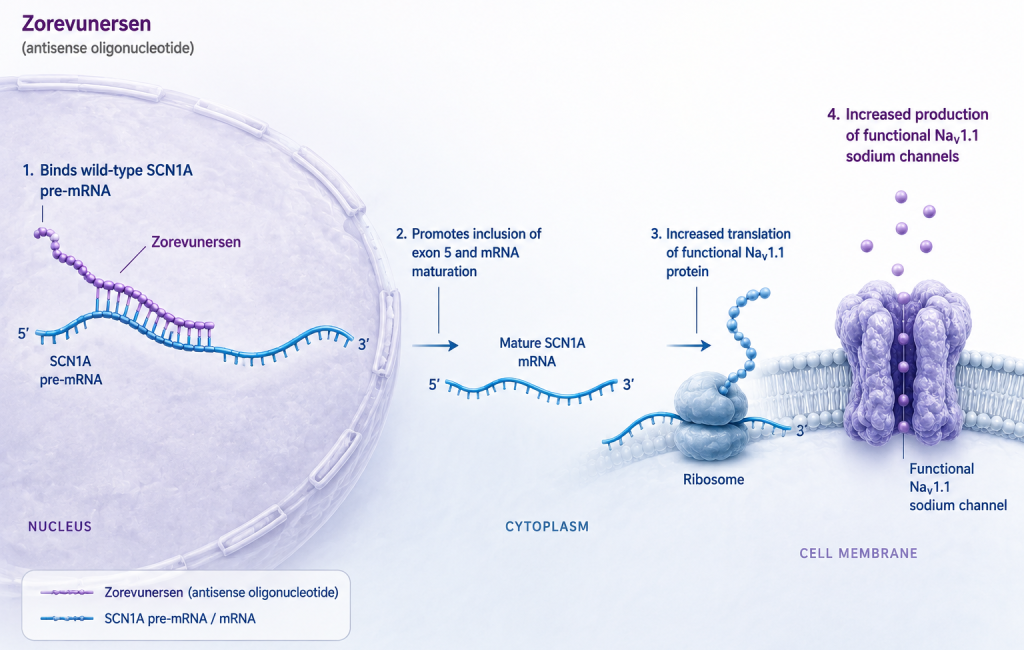
Zorevunersen is an investigational antisense oligonucleotide that increases production of functional NaV1.1 protein from the unaffected, wild-type SCN1A copy in brain cells. By addressing the underlying protein deficiency rather than only suppressing seizures, the approach is being evaluated for potential effects on both seizure burden and neurodevelopment.
Four-Year Extension Data
The Phase 1/2a program enrolled 81 children and adolescents aged 2 to 18 years with highly refractory Dravet syndrome. The studies assessed safety, pharmacokinetics and cerebrospinal fluid exposure, with secondary measures including major motor seizure frequency, overall clinical status and quality of life. The ADMIRAL study (NCT04740476) also evaluated neurodevelopment using the Vineland Adaptive Behavior Scales, Third Edition.
After completing Phase 1/2a treatment, eligible patients entered one of two ongoing open-label extension studies, receiving zorevunersen every four months. At the four-year data cutoff, 58 of the 75 patients who continued into the extensions remained on study. Overall, 93% of Phase 1/2a participants continued treatment in an extension study.
The four-year findings showed that improvements in cognition and behavior were sustained, while seizure reductions remained durable. New exploratory analyses also examined the therapy’s effects on the most severe seizure types, which are associated with SUDEP (Sudden Unexpected Death in Epilepsy) risk, as well as patient quality of life.
Long-Term Safety Remains Under Evaluation
Zorevunersen has been administered for more than five years in some participants across the Phase 1/2a and extension studies, with more than 930 doses given as of July 31, 2026. The treatment remained generally well tolerated. Elevated cerebrospinal fluid (CSF) protein levels occurred in approximately 94% of patients; however, 59% were classified as treatment-emergent adverse events (TEAEs). Crucially, no serious or severe clinical manifestations were linked to these elevations, and no cases of hydrocephalus were reported.
Phase 3 Results Expected in 2027
The global pivotal Phase 3 EMPEROR study (NCT06872125) is now underway to evaluate zorevunersen’s safety and efficacy, with results anticipated in the third quarter of 2027. The therapy has received orphan drug designations from the FDA and EMA, while the FDA has also granted rare pediatric disease and Breakthrough Therapy designations. China’s Center for Drug Evaluation has granted Breakthrough Therapy Designation as well.
The Phase 1/2a and extension findings strengthen the rationale for testing whether sustained restoration of NaV1.1 protein can produce effects beyond seizure control. The Phase 3 EMPEROR results will be critical in determining whether those long-term signals translate into a clinically meaningful disease-modifying treatment for Dravet syndrome.
Reference

About the Writer
Saniya Sanjay Katakdhond (Linkedin) is a Doctor of Pharmacy professional with hands-on experience in patient case review, clinical documentation, medical record analysis, and patient care.
Her hospital experience has strengthened her understanding of clinical conditions, treatment approaches, and multidisciplinary healthcare practices.
With ICH-GCP certification and a research-oriented approach, she brings clinical insight and attention to detail to healthcare content development.
As a healthcare writer, Saniya focuses on translating clinical knowledge and patient-care experience into clear, accurate, and evidence-informed medical content.