
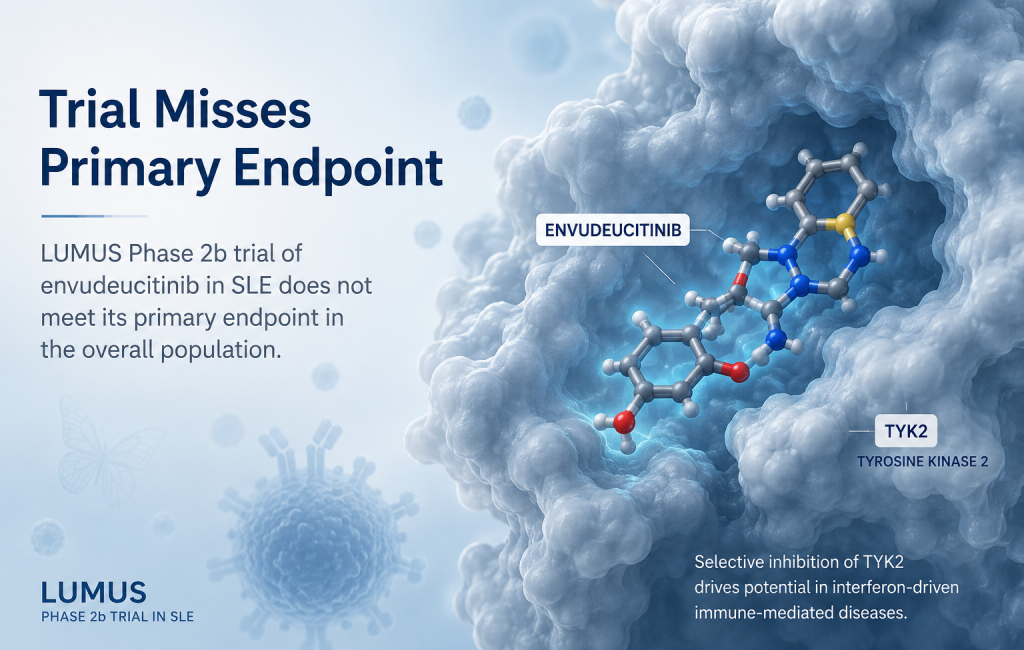
Alumis’ envudeucitinib missed LUMUS Phase 2b endpoints in SLE overall, but IFNGS-high patients showed robust responses supporting Phase 3 plans.
Written By: Mansi Nakum, PharmD
Reviewed By: Pharmacally Editorial Team
Alumis reported that its Phase 2b LUMUS trial (NCT05966480) of envudeucitinib in moderate-to-severe systemic lupus erythematosus (SLE) did not meet its primary or secondary efficacy endpoints across the overall study population. However, a prespecified analysis identified stronger treatment responses among patients with a high interferon gene signature (IFNGS-high), supporting plans to discuss Phase 3 development with regulators.
The company said IFNGS-high patients showed robust responses on the primary BICLA endpoint and key secondary measures, including CLASI-50, SRI-4, and LLDAS.
IFNGS-high patients were under-represented in LUMUS despite representing a majority of patients with moderate-to-severe SLE, according to Alumis. The imbalance reduced the contribution of this biologically responsive population to the overall trial results.
Targeting TYK2-Driven Interferon Signaling
Envudeucitinib is an oral, selective allosteric inhibitor of tyrosine kinase 2 (TYK2). The drug provides sustained TYK2 inhibition across pathways involving IL-23, IL-17, and type I interferon signaling, which are implicated in several immune-mediated diseases.
Type I interferon signaling has a particularly important role in SLE, where excessive pathway activation can contribute to persistent immune dysfunction and disease activity. Identifying patients with elevated interferon pathway activity could therefore define a population more likely to benefit from targeted TYK2 inhibition.
Pharmacodynamic findings from LUMUS strengthened this biological rationale. Envudeucitinib produced dose-dependent suppression of interferon pathway activity, with the greatest target engagement observed at the highest tested dose of 40 mg twice daily.
408 Patients Evaluated Over 48 Weeks
The global, randomized, double-blind, placebo-controlled LUMUS Phase 2b trial enrolled 408 adults with moderately-to-severely active, autoantibody-positive SLE. Patients received one of three envudeucitinib doses or placebo during the 48-week Part A period.
The primary endpoint was BICLA response at Week 48, which measures improvement across multiple domains of lupus disease activity without deterioration in other affected organ systems.
Secondary assessments included safety and tolerability, corticosteroid use, CLASI, and SRI-4. Eligible participants could enter a four-week safety follow-up or continue into Part B, a long-term open-label extension.
Although the overall population failed to achieve the trial’s efficacy objectives, the IFNGS-high subgroup showed consistent activity across several clinically relevant endpoints.
Safety Profile Remained Favorable
Envudeucitinib was generally well tolerated in LUMUS, with no new safety signals identified. The safety findings provide continued support for development of the compound while the company evaluates its efficacy in biologically defined patient populations.
Alumis Chief Medical Officer Jörn Drappa said the magnitude of the response in IFNGS-high patients supports regulatory discussions around Phase 3 development, particularly given the limited availability of targeted oral therapies for SLE.
Phase 3 SLE Discussions Ahead
The company plans to engage regulators on a potential Phase 3 program focused on envudeucitinib in SLE. Alumis also highlighted additional opportunities in type I interferon-driven diseases, including cutaneous lupus erythematosus and Sjögren’s disease.
Separately, the company remains on track to submit a New Drug Application for envudeucitinib in moderate-to-severe plaque psoriasis in the fourth quarter of 2026, following positive Phase 3 ONWARD (NCT06586112) results.
The LUMUS outcome therefore leaves envudeucitinib’s SLE program at a pivotal point: the overall Phase 2b study was negative, but the prespecified IFNGS-high findings and pharmacodynamic evidence provide a potential path for a biomarker-defined Phase 3 strategy.
Reference

About the Writer
Mansi Nakum (Linkedin) is a Pharm.D professional with a strong foundation in clinical pharmacy, evidence-based healthcare writing, and clinical data interpretation.
She has published work on Brugada syndrome and has a keen interest in guideline integration, multimodal therapy, pharmacogenomics, and antibiogram utilization.
As a healthcare writer, she focuses on translating clinical evidence into clear, accurate, and clinically relevant content, while continuously developing her expertise in evolving pharmacy practice.