
TRex Bio reports Phase 1a results for TRB-061, showing Treg activation, dose-proportional pharmacokinetics and favorable safety in healthy adults.
Written By: Mansi Nakum, PharmD
Reviewed By: Pharmacally Editorial Team
TRex Bio reported topline Phase 1a results for TRB-061, an investigational TNFR2 agonist being developed for immune-mediated diseases. Across single-ascending-dose (SAD) and multiple-ascending-dose (MAD) cohorts, the therapy showed consistent pharmacokinetics and reproducible pharmacodynamic activity, including activation and expansion of regulatory T cells (Tregs).
The findings provide early clinical evidence that TRB-061 can engage its intended immunoregulatory pathway in humans and support continued development in moderate-to-severe atopic dermatitis (AD).
Selective Treg Activity Supports TNFR2 Approach
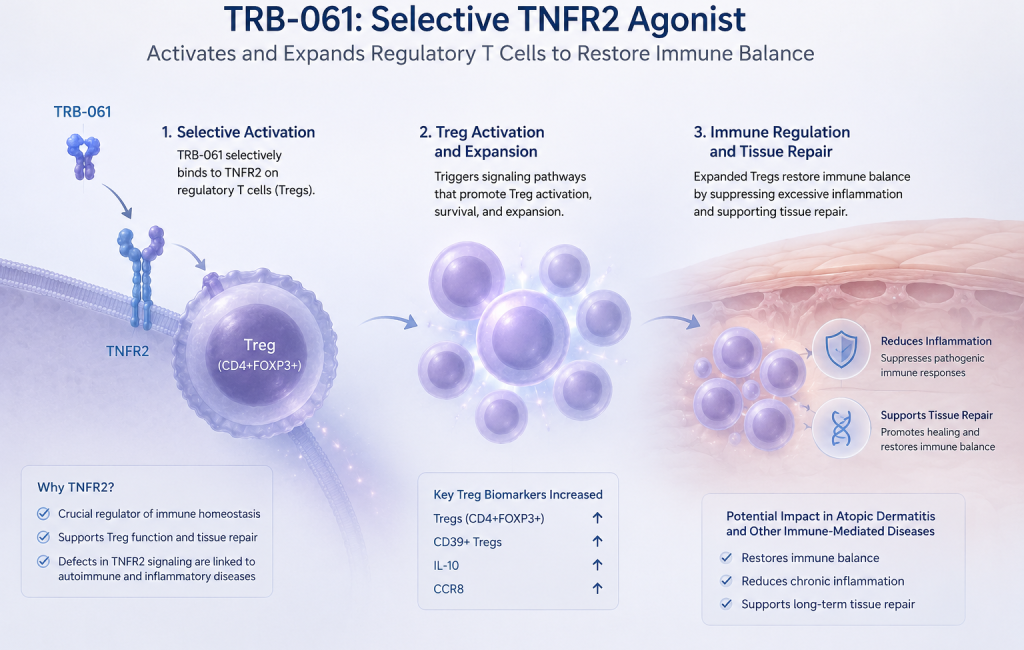
TNFR2 plays an important role in immune homeostasis by supporting Treg function, tissue repair, and control of inflammation. TRB-061 selectively activates this pathway to expand immunoregulatory Tregs in inflamed tissues while avoiding broader stimulation of unwanted immune cells.
In the Phase 1a study, single and multiple doses increased Tregs, including CD39-positive Tregs, a population associated with immunoregulatory activity. Treatment also induced IL-10 and CCR8, additional biomarkers linked to Treg biology.
The pharmacodynamic profile, together with approximately dose-proportional pharmacokinetics, supported dosing at four-week intervals or longer.
Favorable Phase 1a Safety Profile
The randomized, double-blind, placebo-controlled Phase 1a portion enrolled 65 healthy adults. Participants in both SAD and MAD cohorts were randomized 6:2 to receive TRB-061 or placebo.
The MAD cohorts received three doses administered every four weeks.
TRB-061 was generally well tolerated across all tested dose levels. No treatment-related serious adverse events, dose-limiting toxicities, or treatment-related discontinuations occurred. All treatment-emergent adverse events were mild or moderate.
The combined safety, pharmacokinetic, and pharmacodynamic findings supported selection of the 24 mg and 50 mg dose levels for the Phase 1b study.
Phase 1b Moves into Atopic Dermatitis
The ongoing Phase 1b trial (NCT06934252) is evaluating TRB-061 in adults with moderate-to-severe AD. The study will assess safety, pharmacokinetics, and pharmacodynamic biomarkers in both blood and skin, alongside exploratory measures of clinical activity.
The inclusion of skin-based biomarker assessments will help determine whether systemic administration produces the intended immunoregulatory effects within inflamed tissue, an important test of the therapy’s proposed mechanism.
Johnston Erwin, CEO of TRex Bio, said the Phase 1a findings increase confidence that TRB-061 could restore immune balance and support tissue repair in AD and other immune-mediated diseases.
Mid-2027 Data Readout
The company expects topline Phase 1b results in mid-2027. Those data should provide the first clinical assessment of whether the Treg activation observed in healthy participants translates into measurable biological and clinical effects in patients with moderate-to-severe AD.
For now, the Phase 1a results establish a favorable early safety profile and provide proof-of-mechanism evidence for selective Treg activation, while the ongoing patient study will determine whether that biology can deliver therapeutic benefit.
Reference

About the Writer
Mansi Nakum (Linkedin) is a Pharm.D professional with a strong foundation in clinical pharmacy, evidence-based healthcare writing, and clinical data interpretation.
She has published work on Brugada syndrome and has a keen interest in guideline integration, multimodal therapy, pharmacogenomics, and antibiogram utilization.
As a healthcare writer, she focuses on translating clinical evidence into clear, accurate, and clinically relevant content, while continuously developing her expertise in evolving pharmacy practice.