
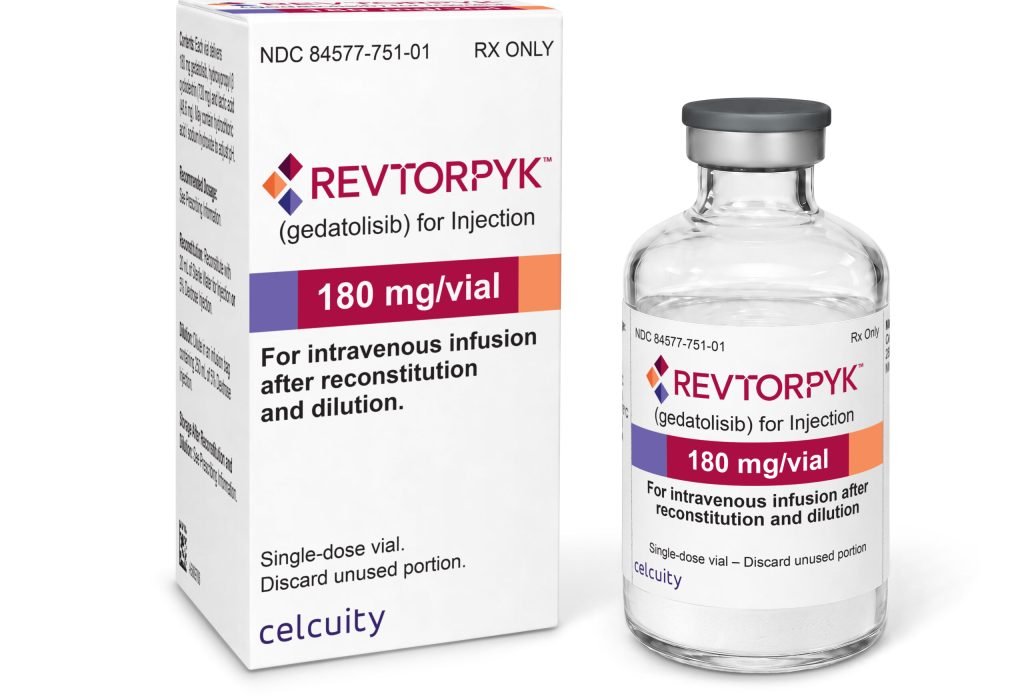
Celcuity submits an FDA sNDA to expand REVTORPYK (gedatolisib) to PIK3CA-mutant HR+/HER2− advanced breast cancer based on VIKTORIA-1 results.
Written By: Saniya Katakdhond, PharmD
Reviewed By: Pharmacally Editorial Team
Celcuity has submitted a supplemental New Drug Application to the U.S. Food and Drug Administration seeking to expand REVTORPYK™ (gedatolisib) to adults with hormone receptor-positive (HR+), human epidermal growth factor receptor 2-negative (HER2−), locally advanced or metastatic breast cancer with a PIK3CA mutation following progression on or after at least one line of endocrine therapy.
The application is supported by positive results from the PIK3CA-mutant cohort of the Phase 3 VIKTORIA-1 trial. In the trial, gedatolisib-based regimens demonstrated improved progression-free survival (PFS) compared with alpelisib plus fulvestrant.
The submission follows the FDA’s July 14, 2026, approval of REVTORPYK for adults with HR+/HER2− locally advanced or metastatic breast cancer without a detected PIK3CA mutation following progression on or after at least one line of endocrine therapy in the metastatic setting. The new application seeks to expand the treatment population to include patients with PIK3CA-mutant disease.
Phase 3 VIKTORIA-1 Demonstrates a PFS Benefit
VIKTORIA-1 (NCT05501886) is a Phase 3, open-label, randomized clinical trial evaluating the efficacy and safety of gedatolisib in combination with fulvestrant, with or without palbociclib, in adults with HR+/HER2− advanced breast cancer whose disease progressed on or after prior CDK4/6 therapy in combination with an aromatase inhibitor.
The trial enrolled 701 subjects regardless of PIK3CA mutation status, enabling separate evaluation according to PIK3CA status. In the PIK3CA-mutant cohort, 350 eligible subjects with confirmed PIK3CA mutations were randomly assigned in a 3:3:1 ratio to receive the gedatolisib triplet, alpelisib plus fulvestrant, or the gedatolisib doublet.
The REVTORPYK triplet, consisting of gedatolisib plus fulvestrant and palbociclib, reduced the risk of disease progression or death by 50% compared with alpelisib plus fulvestrant (HR, 0.50; 95% CI, 0.37–0.68; p<0.0001).
Median PFS was 11.1 months with the triplet compared with 5.6 months with alpelisib plus fulvestrant.
The REVTORPYK doublet, consisting of gedatolisib plus fulvestrant, also reduced the risk of disease progression or death by 49% compared with alpelisib plus fulvestrant (HR, 0.51; 95% CI, 0.33–0.79; descriptive p=0.0013).
Median PFS was 11.3 months with the doublet compared with 5.6 months with alpelisib plus fulvestrant.
Objective Response and Duration of Response
The efficacy findings extended beyond PFS.
The REVTORPYK triplet produced an objective response rate (ORR) of 49%, with a median duration of response (DOR) of 15.7 months.
The REVTORPYK doublet produced an ORR of 36%, with a median DOR of 24.2 months.
Together, these findings form the clinical basis for Celcuity’s sNDA seeking to expand REVTORPYK into the PIK3CA-mutant population.
PI3K/mTOR Pathway Targeting with Gedatolisib
REVTORPYK is a kinase inhibitor that targets all four class I PI3K isoforms, PI3Kα, PI3Kβ, PI3Kδ, and PI3Kγ, as well as the mTOR complexes mTORC1 and mTORC2.
The treatment results in downstream inhibition of multiple effectors, including AKT.
Celcuity said that, if approved, REVTORPYK would be the first and only therapy for advanced breast cancer with a PIK3CA mutation to inhibit all four class I PI3K isoforms as well as mTORC1 and mTORC2.
Clinical Context of PIK3CA-Mutant HR+/HER2− Disease
HR+/HER2− breast cancer is the most common breast cancer subtype, accounting for approximately 70% of all breast cancers, according to Celcuity. Approximately 40% of patients with this subtype have PIK3CA mutations.
REVTORPYK received FDA approval on July 14, 2026, in combination with fulvestrant, with or without palbociclib, for adults with HR+/HER2− locally advanced or metastatic breast cancer without a detected PIK3CA mutation following progression on or after at least one line of endocrine therapy in the metastatic setting.
The new sNDA seeks to add patients with PIK3CA-mutant disease to the treatment population.
Safety Findings in the REVTORPYK Program
Safety findings from the PIK3CA-mutant cohort were generally consistent with previously reported data from the PIK3CA wild-type cohort of the Phase 3 VIKTORIA-1 trial.
The August 26, 2026, Celcuity source does not provide separate detailed adverse-event rates for the PIK3CA-mutant cohort. Accordingly, detailed safety percentages are not included here.
FDA Review of the PIK3CA-Mutant Indication
The sNDA represents a regulatory step toward expanding REVTORPYK beyond its current FDA-approved population.
The FDA has not approved REVTORPYK for PIK3CA-mutant breast cancer at the time of this submission. The application is now subject to FDA review.
If approved, the expanded indication would provide an additional treatment option for adults with PIK3CA-mutant HR+/HER2− locally advanced or metastatic breast cancer following progression on or after at least one line of endocrine therapy.
Reference

About the Writer
Saniya Sanjay Katakdhond (Linkedin) is a Doctor of Pharmacy professional with hands-on experience in patient case review, clinical documentation, medical record analysis, and patient care.
Her hospital experience has strengthened her understanding of clinical conditions, treatment approaches, and multidisciplinary healthcare practices.
With ICH-GCP certification and a research-oriented approach, she brings clinical insight and attention to detail to healthcare content development.
As a healthcare writer, Saniya focuses on translating clinical knowledge and patient-care experience into clear, accurate, and evidence-informed medical content.