
Spyre’s SPY072 showed statistically significant efficacy signals in Phase 2 rheumatoid arthritis, but the benefit was insufficient to prioritize monotherapy development.
Written By: Kirti Kumbhar, M. Pharm (QA)
Reviewed By: Pharmacally Editorial Team
Spyre Therapeutics reported topline Phase 2 data for SPY072 in rheumatoid arthritis (RA), showing statistically significant benefits versus placebo on selected disease activity and clinical response measures. Although the findings provide proof-of-mechanism for TL1A inhibition in RA, the magnitude of benefit was insufficient for the company to prioritize SPY072 as an RA monotherapy.
TL1A inhibition shows activity in RA
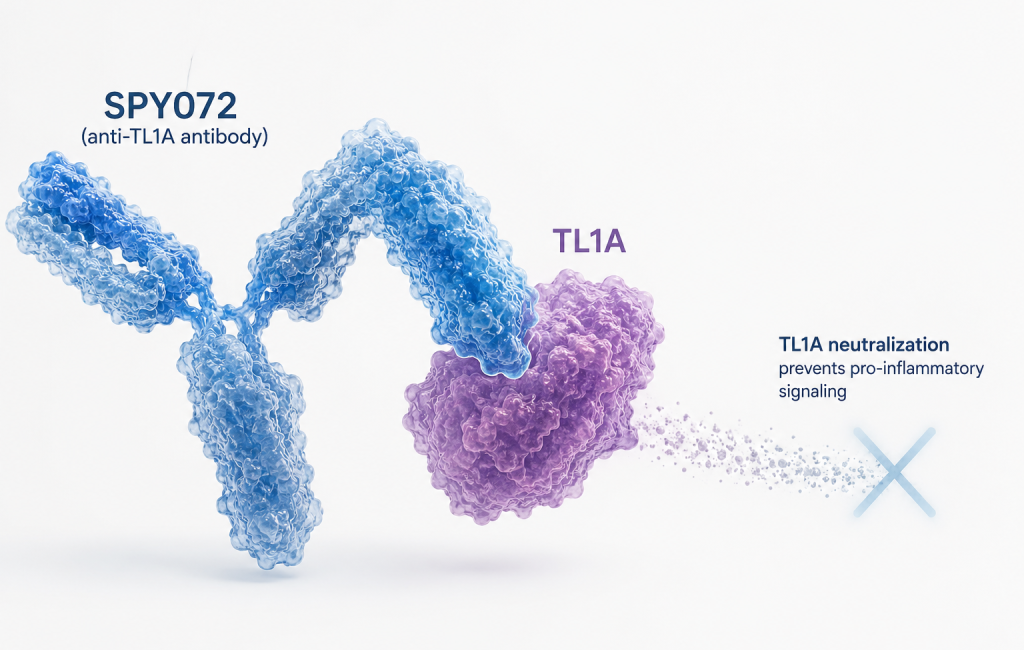
SPY072 is a long-acting antibody targeting tumor necrosis factor-like ligand 1A (TL1A), an inflammatory pathway implicated in autoimmune disease. Spyre is evaluating TL1A antibodies across multiple immune-mediated inflammatory (I&I) conditions, including inflammatory bowel disease, hidradenitis suppurativa (HS), and rheumatic diseases.
The RA findings add clinical evidence that TL1A can modulate inflammatory disease activity beyond the indications where the mechanism has already shown therapeutic potential.
Phase 2 SKYWAY-RA results
The randomized, placebo-controlled SKYWAY-RA sub-study (NCT07148414) enrolled patients with moderate to severely active RA who had inadequate responses to conventional or advanced therapies. The study evaluated high- and low-dose SPY072, with change from baseline in Disease Activity Score in 28 joints using C-reactive protein (DAS28-CRP) at Week 12 as the primary endpoint. ACR20 response served as the secondary endpoint.
At Week 12, low-dose SPY072 produced a statistically significant improvement in DAS28-CRP versus placebo, with a mean change of -1.9 compared with -1.3 for placebo. High-dose SPY072 showed a mean change of -1.5.
For ACR20, responses were 63% with high-dose SPY072, 58% with low-dose SPY072, and 43% with placebo. The high-dose result was nominally significant versus placebo. ACR50 responses were 31%, 38%, and 19%, respectively, with the low dose result nominally significant.
ACR70 responses were 13% with high-dose SPY072, 4% with low-dose treatment, and 2% with placebo. Results were generally comparable between patients who were advanced-therapy-naïve and those previously exposed to advanced therapies.
Both doses achieved target drug concentrations and completely suppressed free TL1A through Week 12, indicating sustained target engagement.
Favorable short-term safety profile
SPY072 was generally well tolerated. Treatment-emergent adverse events occurred in 27% of SPY072-treated patients versus 36% with placebo, and events were generally mild or moderate.
One serious treatment-emergent adverse event occurred in each group, with neither considered drug-related. One death occurred in the placebo group. Infections and infestations were the most common adverse-event category, reported in 14% of SPY072-treated patients and 15% of placebo-treated patients.
Development shifts toward broader autoimmune applications
Spyre CEO Cameron Turtle said the RA results do not justify prioritizing SPY072 monotherapy in RA but argued that the combination of efficacy signals and a favorable safety profile strengthen the rationale for TL1A antibodies across autoimmune diseases and as components of combination regimens.
The company expects topline SKYWAY results in psoriatic arthritis and axial spondyloarthritis in the fourth quarter of 2026. It has also initiated the SKYLIGHT trial evaluating SPY072 with an IL-17A/F inhibitor in HS, with topline data expected in late 2027 or early 2028.
Other upcoming milestones include SKYLINE Part A data for SPY003 in ulcerative colitis (NCT07012395) in September 2026 and additional SKYLINE Part B combination-program data in 2027.
For SPY072, the RA study establishes biological activity but leaves the program’s value dependent on whether stronger differentiation emerges in other rheumatic diseases or in combination strategies.
Reference

About the Writer
Kirti Kumbhar (LinkedIn) is an M.Pharm graduate with experience in Quality Assurance at Lupin Limited and a strong interest in clinical research, regulatory affairs, and Trial Master File (TMF) management. She has developed knowledge of regulatory documentation, quality systems, compliance, and healthcare research through her professional experience. Passionate about clinical development and continuous learning, Kirti is committed to supporting high-quality healthcare documentation, regulatory excellence, and research-driven healthcare advancements.