
Bausch + Lomb advances its dual-action dry eye drop to Phase 3 after Phase 2 data and reports positive Phase 1b results for BL1332.
Written By: Anshu Gupta, PharmD
Reviewed By: Pharmacally Editorial Team
Bausch + Lomb is advancing a first-in-class dual-action eye drop for dry eye disease into Phase 3 after Phase 2 data identified a significant treatment effect at Day 15. The company also reported positive Phase 1b results for BL1332, a topical TRPV1 antagonist for ocular surface pain, supporting continued Phase 2 development.
Dual-Action Approach Targets Two Drivers of Dry Eye
Dry eye disease involves multiple biological processes, including ocular surface inflammation and excessive tear evaporation. Current prescription therapies generally address individual components of the disease rather than both mechanisms in a single treatment.
The investigational combination pairs 5% lifitegrast, the active ingredient in XIIDRA, with perfluorohexyloctane (PFHO), the active ingredient in MIEBO. Administered twice daily, the formulation combines anti-inflammatory activity with reduction of tear evaporation.
A four-week, randomized, double-masked, active-controlled Phase 2 study (NCT07111013) enrolled 443 adults with dry eye disease across six treatment arms, including the combination, lifitegrast alone, PFHO alone, and three vehicle controls.
The study did not meet its primary endpoint at Day 29, which assessed change from baseline in total corneal fluorescein staining (tCFS) versus lifitegrast. Although the numerical results favored the combination, the difference was not statistically significant (p=0.196).
A pre-specified Day 15 analysis, however, produced a statistically significant result. Mean change from baseline in tCFS favored the dual-action treatment over lifitegrast alone (p=0.0007). In addition, 41.6% of patients receiving the combination achieved at least a three-unit improvement in tCFS, compared with 18.8% for lifitegrast and 31.6% for PFHO.
The safety profile across the three active treatment groups remained consistent with the established profiles of XIIDRA and MIEBO, with no new safety signals.
BL1332 Provides Clinical Support for TRPV1 Blockade
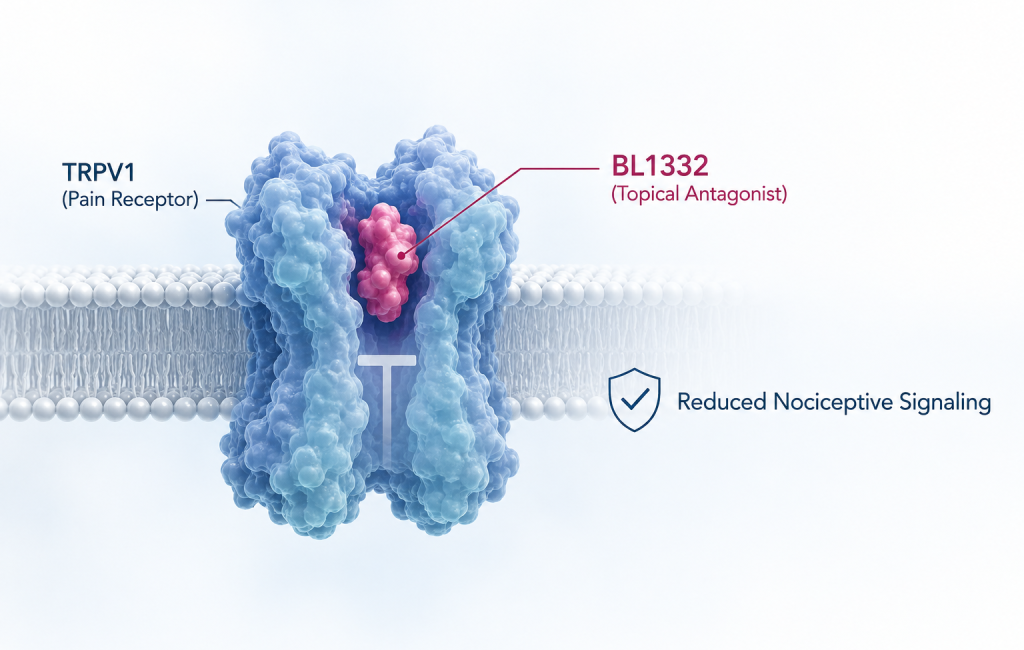
The second program, BL1332, targets TRPV1, a receptor involved in nociceptive signaling and ocular pain. The topical antagonist is being developed for ocular surface pain associated with conditions including post-surgical, acute and chronic disorders.
In a Phase 1b capsaicin-induced ocular pain study (NCT07717918) in healthy adults, BL1332 0.30% ophthalmic solution significantly reduced pain intensity versus vehicle. Five seconds after capsaicin challenge, mean pain intensity was 5.5 points lower with BL1332 (p<0.0001).
Exploratory findings also showed complete pain resolution in 68.2% of BL1332-treated eyes versus none receiving vehicle. Mean pain duration fell to 1.6 seconds from 37.8 seconds with vehicle (p<0.0001).
These findings provide initial human evidence supporting TRPV1 blockade as a mechanism for reducing ocular pain beyond the post-surgical setting.
Phase 3 and Phase 2 Milestones Ahead
Bausch + Lomb plans to take the dual-action dry eye therapy into Phase 3 using Day 15 tCFS as the primary endpoint. The company also expects topline Phase 2 results for BL1332 in patients with pain following photorefractive keratectomy within the coming months.
The programs have estimated peak sales of approximately $700 million for the dry eye therapy and $1.4 billion for BL1332, assuming successful development and commercialization. Both are expected to contribute to growth beyond 2028 if approved.
Reference
Bausch + Lomb Advancing Two First-in-Class Eye Health Therapies Based on Trial Results

About the Writer
Anshu Gupta (LinkedIn) is a PharmD professional and healthcare writer with interests in clinical research, pharmacovigilance, regulatory affairs, and medical writing. She has presented research at academic conferences and completed certifications in Good Clinical Practice (GCP), ICH-GCP, and drug safety. Passionate about clinical trials and evidence-based medicine, she is committed to translating scientific evidence into accurate, reliable, and accessible healthcare content.