
A small JAMA Ophthalmology trial found that RAFT-OS improved ocular surface health in adults with advanced aniridia-related keratopathy, with benefits partly sustained at 12 months.
Written By: Anshu Gupta, PharmD
Reviewed By: Pharmacally Editorial Team
A small open-label clinical trial published in JAMA Ophthalmology provides early clinical evidence that Real Architecture for 3D Tissues–Ocular Surface (RAFT-OS) can improve ocular surface health in adults with advanced aniridia-related keratopathy (ARK). Among nine participants who received the tissue-engineered transplant, the mean Ocular Surface Score (OSS) improved within three months, with part of the improvement maintained through 12 months.
The findings offer an early clinical signal for a regenerative approach to a progressive condition with limited treatment options. However, the study’s small size and nonrandomized design mean that larger controlled trials will be needed to establish the treatment’s efficacy and long-term safety.
Why Does Aniridia Damage the Eye?
Aniridia is a rare genetic disorder that affects multiple parts of the eye and is most often associated with mutations in the PAX6 gene. Although the condition is best known for the partial or complete absence of the iris, it can also damage the limbus, the region at the edge of the cornea that contains stem cells responsible for continuously renewing the corneal surface.
Progressive loss or dysfunction of these cells can cause limbal stem cell deficiency (LSCD). In advanced ARK, the corneal surface may lose its ability to maintain a healthy epithelial barrier, leading to persistent epithelial defects, abnormal blood vessel growth, scarring and severe visual impairment.
How Could RAFT-OS Help?
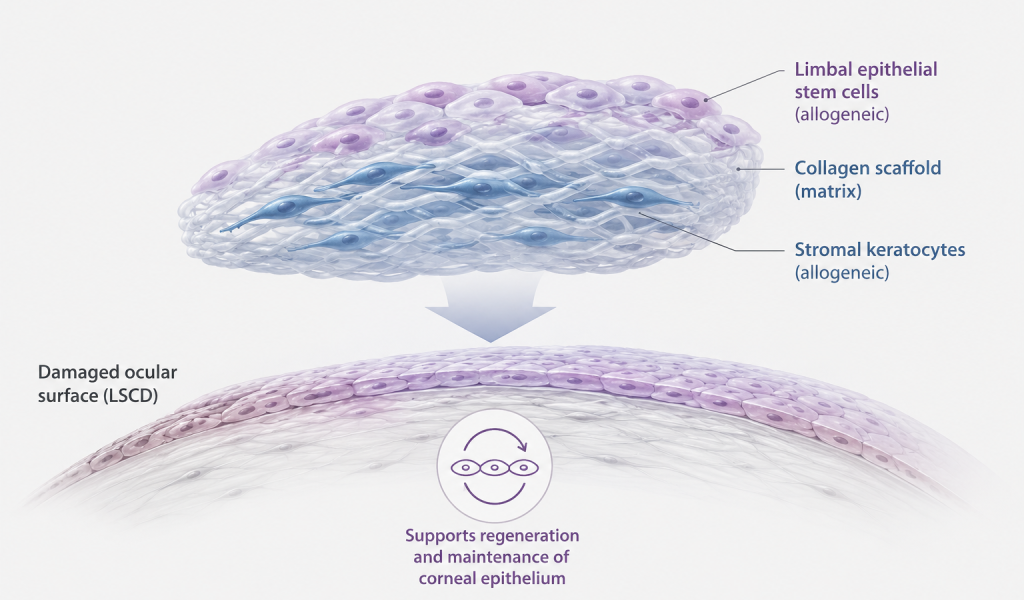
RAFT-OS uses a tissue-engineered collagen scaffold combined with allogeneic limbal epithelial stem cells and human corneal stromal keratocytes.
The construct is manufactured under Good Manufacturing Practice (GMP) standards. Its collagen matrix provides a structural framework intended to support the damaged ocular surface, while the transplanted cells may promote regeneration and maintenance of the corneal epithelium.
During surgery, clinicians graft the engineered construct onto the prepared ocular surface. The therapeutic concept is to provide both a supportive matrix and cellular components that may restore a healthier ocular surface.
What Did the Clinical Trial Show?
The single-arm trial enrolled (NCT05044598) nine adults with congenital aniridia and advanced ARK at a tertiary referral center in London. Participants were followed for 12 months, while untreated fellow eyes served as natural-history comparators.
The primary clinical measure was OSS, with lower scores indicating less severe ocular surface disease.
In treated eyes, the mean OSS fell from 9.4 at baseline to 5.9 at three months, representing a mean reduction of 3.6 points (95% CI, −5.6 to −1.6). At 12 months, the mean score was 6.7, corresponding to a 2.8-point reduction from baseline (95% CI, −4.5 to −1.0). The results indicate that the early improvement was partly maintained, although some regression occurred over time.
The untreated fellow eyes showed little change. Their mean OSS was 8.4 at baseline and three months and 8.0 at 12 months.
Visual Acuity Improvement Was Less Certain
Mean best-corrected visual acuity (BCVA) in treated eyes improved numerically from 2.23 logMAR, equivalent to worse than 20/1600, at baseline to 1.77 logMAR, approximately 20/1280, at 12 months.
The mean change was −0.47 logMAR, but the 95% CI ranged from −0.97 to 0.04. Because the interval crossed zero, the study did not establish a statistically significant improvement in visual acuity.
This distinction is important: the clearest clinical signal from the study was improvement in ocular surface status, not a confirmed improvement in vision.
What Did Researchers Learn About Safety?
Safety remains an important consideration for this early-stage cell therapy.
One serious adverse event occurred early in the study and prompted an amendment to the RAFT-OS manufacturing protocol. Two participants developed persistent epithelial defects during follow-up. After the manufacturing protocol was amended, no additional major RAFT-OS-related safety events were reported.
The findings support the feasibility of the approach but cannot fully define uncommon or longer-term risks in such a small cohort.
What Comes Next for RAFT-OS?
RAFT-OS provides an early clinical signal that combining a tissue-engineered scaffold with limbal epithelial stem cells and stromal cells may improve the ocular surface in advanced ARK.
The results do not yet establish RAFT-OS as an effective standard treatment, nor do they demonstrate that the approach can restore meaningful vision in patients with severe disease. A larger randomized controlled study will be important to separate treatment effects from the natural course of the disease and to better characterize safety.
Longer follow-up will also determine whether improvements in ocular surface health remain durable and whether they translate into meaningful functional benefits for patients.
Reference
About the Writer
Anshu Gupta (LinkedIn) is a PharmD professional and healthcare writer with interests in clinical research, pharmacovigilance, regulatory affairs, and medical writing. She has presented research at academic conferences and completed certifications in Good Clinical Practice (GCP), ICH-GCP, and drug safety. Passionate about clinical trials and evidence-based medicine, she is committed to translating scientific evidence into accurate, reliable, and accessible healthcare content.