
Key Takeways
Progressive Efficacy: Mean daily cornstarch reduction deepened from 41% at Week 48 in the original DTX401 group to 61% at Week 96, with the crossover group also reaching a 61% mean reduction.
Overnight Burden Relief: By Week 96, 33% of the original DTX401 group and 42% of the crossover group had completely eliminated nighttime cornstarch dosing, while 67% in both groups eliminated at least one nighttime dose.
Crossover Findings: Participants who crossed over from placebo achieved a 61% mean reduction in daily cornstarch intake by Week 96, with 72% achieving at least a 50% reduction, supporting consistency of the treatment effect in a setting more representative of post-placebo management.
Written By: Mayuresh Salvi, PharmD
Reviewed By: Pharmacally Editorial Team
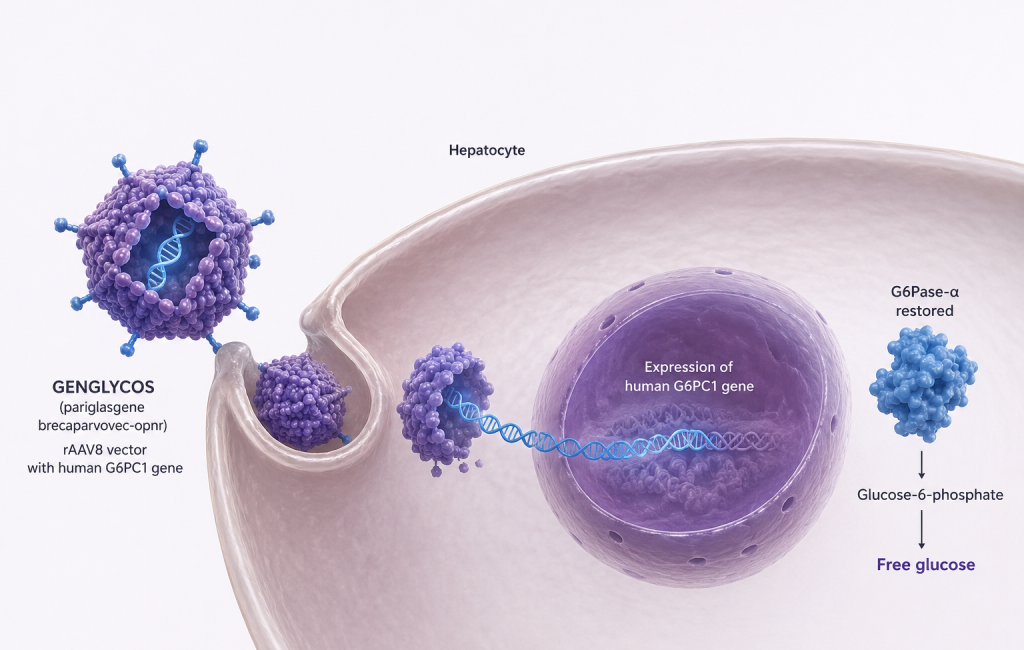
Ultragenyx Pharmaceutical’s AAV gene therapy GENGLYCOS (pariglasgene brecaparvovec-opnr), also known as DTX401, sustained substantial reductions in daily cornstarch requirements through 96 weeks in patients with glycogen storage disease type Ia (GSDIa), while maintaining glycemic control. The data, published in The Journal of Inherited Metabolic Disease, provide longer-term evidence that the therapy can reduce a major treatment burden associated with the disease.
DTX401 delivers sustained cornstarch reduction
The Phase 3 GlucoGene study (NCT05139316) evaluated DTX401 in patients aged 8 years and older with GSDIa. At Week 48, participants treated with DTX401 experienced a mean 41% reduction in daily cornstarch intake from baseline, compared with a 10% reduction in the placebo group (p<0.0001). By Week 96, mean daily cornstarch intake had decreased 61% from baseline in both the original DTX401 group and participants who crossed over from placebo.
At Week 96, 67% of participants in the original DTX401 group and 72% of those in the crossover group achieved at least a 50% reduction in daily cornstarch intake. The authors noted that outcomes during the crossover period may more closely reflect anticipated real-world management after treatment.
Key Efficacy and Clinical Outcomes
Clinical Endpoint / Parameter | Week 48: DTX401 vs. Placebo | Week 96: Original DTX401 Cohort | Week 96: Crossover Cohort |
Mean reduction in daily cornstarch intake | 41% vs. 10% placebo (p<0.0001) | 61% | 61% |
Participants achieving ≥50% reduction in intake | Not reported | 67% | 72% |
Elimination of ≥1 nighttime cornstarch dose | 50% vs. 7% placebo (p=0.031) | 67% | 67% |
Complete elimination of nighttime dosing | Not reported | 33% | 42% |
Patient-reported meaningful reduction | 83% met or exceeded expectations | Continued improvement | Continued improvement |
Glycemic control | Maintained | Maintained | Maintained |
The Week 48 results established the randomized treatment effect, while the Week 96 findings show that the reduction in cornstarch dependence persisted and increased over time. Participants also maintained low levels of hypoglycemia and improved time in the euglycemic range of 70-120 mg/dL during the second year.
Reducing the burden of overnight dosing
GSDIa is caused by pathogenic variants in G6PC, which encodes glucose-6-phosphatase, an enzyme required for releasing glucose from glycogen and other metabolic sources. Its deficiency causes severe hypoglycemia during fasting, including overnight, making frequent cornstarch administration a central part of disease management.
Among participants who required nighttime cornstarch at baseline, 50% of DTX401-treated patients had eliminated at least one nighttime dose by Week 48, compared with 7% of placebo-treated participants (p=0.031). By Week 96, 67% of participants in both treatment groups had eliminated at least one nighttime dose, while complete elimination of nighttime cornstarch dosing occurred in 33% of the original DTX401 group and 42% of the crossover group.
Patient-reported outcomes supported the clinical relevance of the reduction. Participants considered a 45% decrease in daily cornstarch intake meaningful at baseline, and 83% of DTX401-treated participants met or exceeded their own expectations by Week 48. Reduced cornstarch requirements also allowed participants to move toward a more balanced, food-based diet.
Safety profile and corticosteroid considerations
DTX401 demonstrated an acceptable and manageable safety profile through Week 96. The most common treatment-related adverse events were transient elevations in liver enzymes, generally nonserious and managed with prophylactic corticosteroids. No AAV8 class effects involving dorsal root ganglion toxicity, malignancy, or thrombotic microangiopathy were observed through Week 96. Hypertriglyceridemia occurred across all study groups but was more frequent following DTX401 treatment.
Adrenal insufficiency is an important safety consideration, with serious events reported during corticosteroid treatment and tapering. Patients require monitoring for symptoms of adrenal insufficiency or adrenal crisis, and corticosteroid therapy must be tapered gradually rather than discontinued abruptly.
GENGLYCOS is FDA-approved under accelerated approval for reducing daily cornstarch intake as an adjunct to nutritional management in adults and Pediatric patients aged 8 years and older with GSDIa. Continued approval may depend on verification of clinical benefit in confirmatory trials. The therapy is contraindicated in patients with severe hepatic fibrosis or cirrhosis and carries warnings for hypersensitivity and infusion reactions, hepatotoxicity, adrenal insufficiency, and the theoretical risk of tumorigenicity associated with AAV vector integration.
Long-term follow-up will assess durability
The GlucoGene study enrolled 46 participants and administered DTX401 at 1.0 × 10¹³ GC/kg. The randomized, double-blind, placebo-controlled period lasted 48 weeks, after which eligible participants crossed over to the alternate treatment. Follow-up analyses are being conducted through Weeks 96 and 144, with participants expected to be offered enrolment in a 10-year GSDIa Disease Monitoring Program after study completion.
The 96-week results show that DTX401 can substantially reduce reliance on around-the-clock cornstarch while preserving glycemic control. Longer-term follow-up will be important for establishing the durability of the metabolic effect and the therapy’s long-term safety and clinical benefit.
Reference

About the Writer
Mayuresh Sunil Salvi (Linkedin) is a PharmD professional and healthcare writer with a strong interest in pharmacovigilance, drug safety, and emerging medical research. He is passionate about exploring new drug discoveries, clinical research, and advances in evidence-based medicine. His interests also include ward rounds, prescription audits, and treatment analysis to support rational pharmacotherapy and improved patient care.