
Etentamig improved response rates and progression-free survival versus standard therapies in the Phase 3 CERVINO trial for relapsed/refractory multiple myeloma.
Written By: Anamika Koshti, PharmD
Reviewed By: Pharmacally Editorial Team
AbbVie has reported positive topline results from the Phase 3 CERVINO trial (NCT06158841), evaluating etentamig, an investigational BCMA x CD3 bispecific T-cell engager, versus investigator’s choice of standard available therapies (SAT) in patients with triple-class exposed relapsed/refractory multiple myeloma (RRMM).
The study met its dual primary endpoints of objective response rate (ORR) and progression-free survival (PFS). Full results are scheduled for presentation in a plenary session at the 23rd International Myeloma Society Annual Meeting in Glasgow, Scotland, on September 25, 2026.
CERVINO Trial Design
CERVINO is a global, Phase 3, multicenter, randomized, open-label study in patients with RRMM who had received at least two prior lines of therapy, including exposure to a proteasome inhibitor, an immunomodulatory drug and an anti-CD38 monoclonal antibody.
Patients were randomized 1:1 to etentamig administered once every four weeks (Q4W) following a single step-up dose or investigator’s choice of SAT. The comparator therapies included carfilzomib plus dexamethasone, elotuzumab plus pomalidomide and dexamethasone, or selinexor plus bortezomib and dexamethasone.
At the data cutoff, 393 patients had been enrolled, with a median of three prior lines of therapy and median follow-up of 11.4 months. Key secondary endpoints included overall survival (OS), depth of response, measurable residual disease negativity, disease symptoms and physical functioning.
Etentamig Improves ORR and PFS
Etentamig produced a significantly higher ORR than SAT, at 74.0% versus 45.7%, respectively (95% CI, 67.25–79.97 and 38.59–52.91; P<0.0001).
PFS was also significantly improved with etentamig, with a 60% reduction in the risk of disease progression or death compared with SAT (HR, 0.40; 95% CI, 0.29–0.54; P<0.0001). The PFS benefit was observed across all prespecified subgroups evaluated.
At 12 months, OS was 87.9% with etentamig versus 72.0% with SAT (HR, 0.48; 95% CI, 0.29–0.77; nominal P=0.0012). However, the prespecified efficacy boundary for OS had not been crossed at the data cutoff.
This was the first planned efficacy interim analysis. Based on the significant benefit observed, the Independent Data Monitoring Committee recommended unblinding the study.
Safety and Monthly Dosing
Etentamig was administered using a single step-up dose followed by monthly Q4W dosing from initiation.
Among patients receiving the single step-up dose, CRS occurred in 28.3%, with 23.9% experiencing grade 1 events. No grade 3 or higher CRS events were reported.
Immune effector cell-associated neurotoxicity syndrome (ICANS) occurred in one patient (0.9%, grade 1), with no grade 2 or higher events reported.
Grade 3/4 infections occurred in 27.7% of patients receiving etentamig versus 19.2% with SAT, while grade 5 infections occurred in 1.5% versus 3.1%, respectively. Treatment-emergent adverse event-related discontinuations were lower with etentamig (3.6% versus 9.6%).
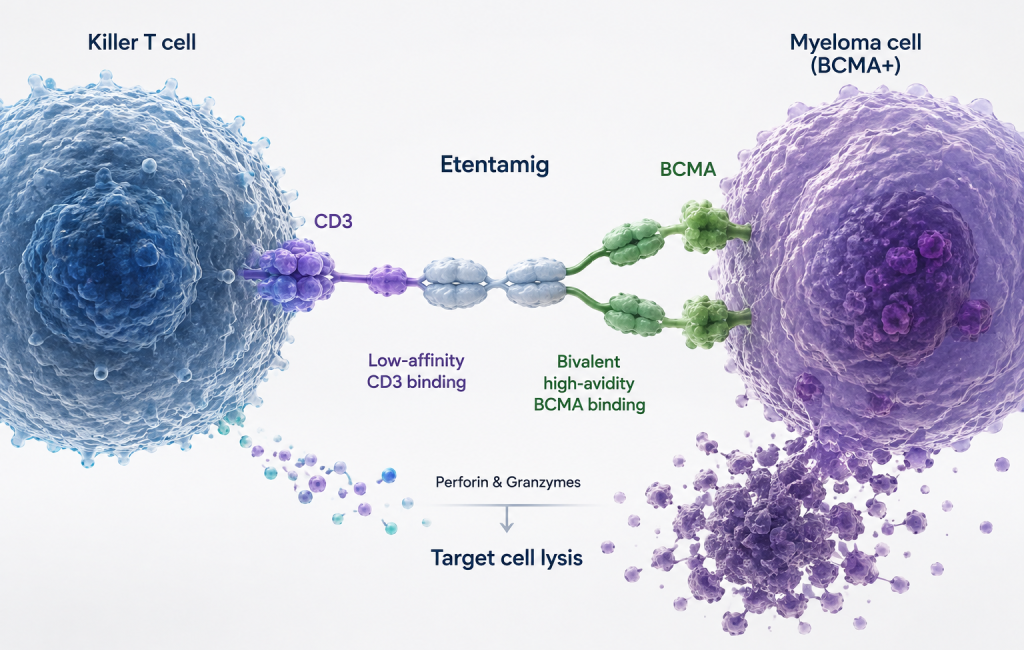
Etentamig is designed with a low-affinity CD3-binding domain, a high-avidity bivalent BCMA-binding domain and retained FcRn binding. AbbVie states that this design is intended to support monthly dosing following a single step-up dose and potentially reduce CRS and infections. The clinical correlations of these structure-activity relationships have not been fully established.
Potential Treatment Option in RRMM
The CERVINO findings support further evaluation of etentamig as a potential treatment option for patients with triple-class exposed RRMM, including its potential use across outpatient and community-based care settings.
AbbVie plans to discuss the results with global regulatory authorities to determine next steps.
Etentamig remains investigational and has not been approved for use by global regulatory authorities. Full CERVINO results are scheduled for presentation during a plenary session at the 23rd International Myeloma Society Annual Meeting on September 25, 2026, at 3 p.m. in Glasgow, Scotland.
Reference

About the Writer
Anamika Koshti (LinkedIn) is a PharmD professional and healthcare writer with interests in clinical research, pharmacovigilance, and evidence-based medicine. She has authored peer-reviewed publications on Alzheimer’s disease and PCOS, presented research at national conferences, and gained hands-on experience in medical content development and clinical data interpretation. She is committed to translating complex medical research into accurate, accessible content for healthcare professionals and patients.