
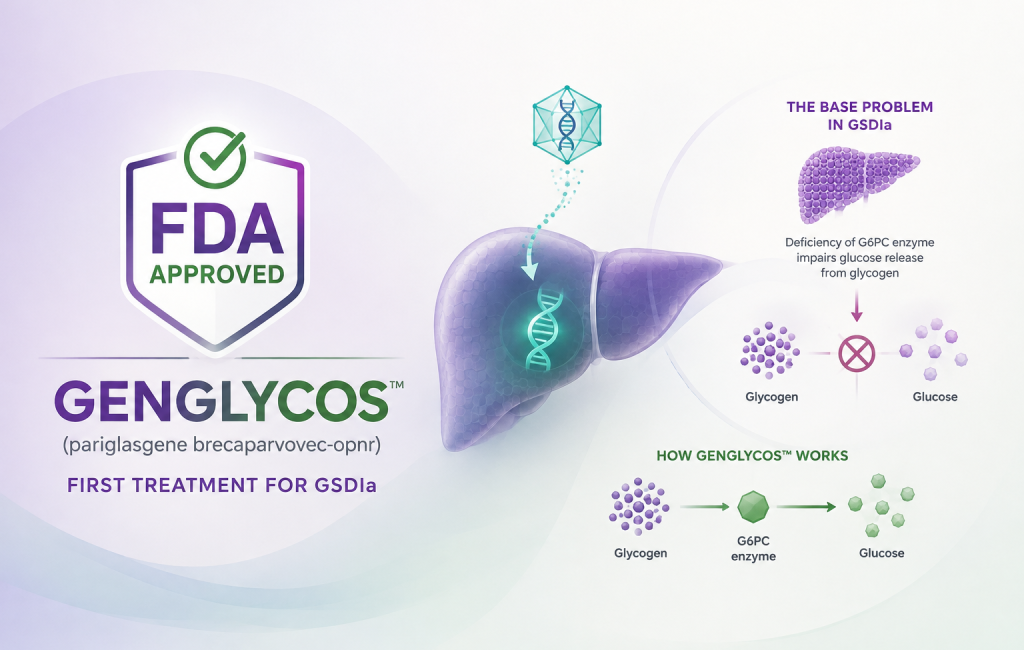
FDA grants accelerated approval to GENGLYCOS, the first treatment for glycogen storage disease type Ia (GSDIa), for patients aged 8 years and older.
Written By: Siddhi Bhadekar, M. Pharm (QA)
Reviewed By: Pharmacally Editorial Team
The U.S. Food and Drug Administration (FDA) has granted accelerated approval to GENGLYCOS™ (pariglasgene brecaparvovec-opnr), also known as DTX401, for adults and pediatric patients aged 8 years and older with glycogen storage disease type Ia (GSDIa).
GENGLYCOS is the first approved treatment for GSDIa and represents Ultragenyx Pharmaceutical’s first gene therapy approval and fifth FDA approval overall. The company also received a Priority Review Voucher following the approval.
The FDA approved GENGLYCOS to reduce daily cornstarch intake as an adjunct to nutritional management in patients aged 8 years and older with GSDIa. The indication was approved under the accelerated approval pathway based on reduction in daily cornstarch intake, with continued approval potentially contingent on confirmation of clinical benefit.
GSDIa Creates a Major Nutritional Management Burden
GSDIa is an ultra-rare inherited metabolic disorder caused by deficiency of glucose-6-phosphatase, an enzyme required for the release of glucose from stored glycogen. The resulting impairment in glucose regulation can cause severe hypoglycemia during fasting and other periods of metabolic stress.
Patients have traditionally relied on strict dietary management and around-the-clock administration of raw cornstarch as an external source of glucose. This regimen is intended to prevent dangerous declines in blood glucose but can impose a substantial burden on patients and families.
According to Ultragenyx, GSDIa affects approximately 1,500 to 2,500 people in the United States and 6,000 to 8,000 worldwide within commercially accessible geographies.
Phase 3 GlucoGene Study Supported the Approval
The approval was supported by data from the 48-week, randomized, double-blind, placebo-controlled Phase 3 GlucoGene study (NCT05139316).
The study treated 46 participants aged 8 years and older with DTX401 at a dose of 1.0 × 10¹³ genome copies per kilogram or placebo. At Week 48, 44 participants were included in the modified intention-to-treat population used for the efficacy analysis, comprising 20 participants who received DTX401 and 24 who received placebo.
The study demonstrated a statistically significant reduction in cornstarch requirements in the DTX401-treated group compared with placebo, with p<0.001.
The FDA reported that GENGLYCOS produced a 31% mean reduction from baseline in daily cornstarch intake compared with placebo, which was the study’s primary endpoint. The FDA also reported a mean reduction equivalent to one cornstarch dose per day compared with placebo as a secondary endpoint.
At Week 48, eligible participants crossed over to receive the alternate treatment. Participants continued to be followed after crossover, with analyses conducted at Weeks 96 and 144.
Accelerated Approval Requires Additional Clinical Evidence
As part of the accelerated approval, Ultragenyx has agreed to provide two years of additional safety and efficacy data through an enhanced GSDIa Disease Monitoring Program (DMP).
The post-marketing program will include 50 patients receiving commercial treatment in an open-label setting and 20 control patients who sought commercial treatment but cannot receive GENGLYCOS because of pre-existing anti-AAV8 antibodies.
The program is intended to generate additional data on cornstarch requirements, fasting tolerance and other measures of disease burden in routine clinical practice. The DMP will also continue to follow previously treated clinical trial participants and newly treated commercial patients for a total of 10 years.
GENGLYCOS Targets the Underlying Cause of GSDIa
GENGLYCOS is an AAV8-based gene therapy designed to address the underlying genetic defect responsible for GSDIa by delivering a functional G6PC gene to the liver. The goal is to restore the deficient enzyme activity required for glucose production from stored glycogen during fasting.
Ultragenyx said the reduced reliance on cornstarch observed in clinical studies demonstrates the therapy’s potential to improve glucose regulation and reduce the burden associated with intensive nutritional management.
Access Through Qualified Treatment Centers
Ultragenyx will make GENGLYCOS available through a national network of Qualified Treatment Centers with specialized expertise and training in gene therapy administration.
The company is also expanding its UltraCare® support program with specially trained Gene Therapy Guides who will assist patients and caregivers with insurance coverage, treatment support and questions related to the treatment process.
GENGLYCOS is manufactured at Ultragenyx’s Gene Therapy Manufacturing Facility in Bedford, Massachusetts.
A New Treatment Option for a Rare Metabolic Disease
The FDA approval of GENGLYCOS introduces the first approved treatment specifically targeting the underlying cause of GSDIa and provides an option aimed at reducing dependence on the intensive cornstarch regimen that has been central to disease management.
The accelerated approval also establishes a requirement for continued evidence generation. Longer-term data from the Disease Monitoring Program and other post-marketing activities will be important in determining the durability of treatment effects and confirming clinical benefit.
For Ultragenyx, the decision marks its first gene therapy approval and adds another approved therapy to its rare-disease portfolio.
Reference

About the Writer
Siddhi Rajendra Bhadekar (Linkedin) is an M.Pharm professional with expertise in medical and scientific writing, literature review, publication writing, and evidence synthesis, supported by four peer-reviewed publications.
She brings working knowledge of ICH-GCP, MedDRA, pharmacovigilance, ADR/AE reporting, clinical data management, and regulatory documentation.
With experience across pharmaceutical R&D, Quality Control, and Quality Assurance, she combines scientific research skills with strong attention to accuracy and detail.
Her background in manuscript development, publication planning, and scientific communication enables her to translate complex healthcare information into clear, reliable content.