
Biogen reports 52-week Phase 2 AMETHYST results showing continued skin clearance and disease activity improvements with investigational litifilimab in cutaneous lupus.
Written By: Saniya Katakdhond, PharmD
Reviewed By: Pharmacally Editorial Team
Biogen has announced 52-week results from the Phase 2 portion of the ongoing AMETHYST Phase 2/3 study evaluating investigational litifilimab (BIIB059) in adults with cutaneous lupus erythematosus (CLE). The findings, presented at the 2026 European Academy of Dermatology and Venereology (EADV) Congress in Vienna, Austria, showed continued improvements in skin disease activity among participants receiving litifilimab through Week 52.
Biogen had previously reported positive 24-week Phase 2 Part A results from AMETHYST in March 2026, with litifilimab meeting the study’s primary endpoint at Week 16 and showing improvements in skin disease activity compared with placebo.
The updated findings also showed that participants who switched from placebo to litifilimab at Week 24 experienced improvements in skin disease activity as early as four weeks after switching treatment.
Continued Skin Clearance Through Week 52
The Phase 2 portion of AMETHYST evaluated 93 adults with active CLE whose standard antimalarial treatments were ineffective or not tolerated.
Among participants who received litifilimab from the beginning of the study, 27.2% achieved clear or almost clear skin at Week 52, based on a Cutaneous Lupus Activity Investigator’s Global Assessment-Revised (CLA-IGA-R) erythema score of 0 or 1. This compared with 19.0% at Week 24.
Disease activity also improved according to the Cutaneous Lupus Erythematosus Disease Area and Severity Index Activity-70 (CLASI-70) measure. At Week 52, 28.8% of participants achieved a 70% or greater reduction in CLASI-A disease activity, compared with 21.7% at Week 24.
Together, these findings showed continued improvement in skin clearance and disease activity among participants receiving litifilimab from the start of treatment.
Improvement After Switching from Placebo
The study also evaluated participants who initially received placebo and switched to litifilimab at Week 24.
Following the switch, Biogen reported improvements in skin disease activity as early as four weeks after initiation of litifilimab, indicating that clinical improvement was observed relatively soon after participants transitioned from placebo to active treatment. By Week 52, 33.7% of participants in the crossover group achieved clear or almost clear skin, based on the CLA-IGA-R endpoint.
These findings provide additional information on both the timing of clinical response after treatment initiation and the skin clearance outcomes observed over the longer-term study period.
Litifilimab Targets the BDCA2 Pathway
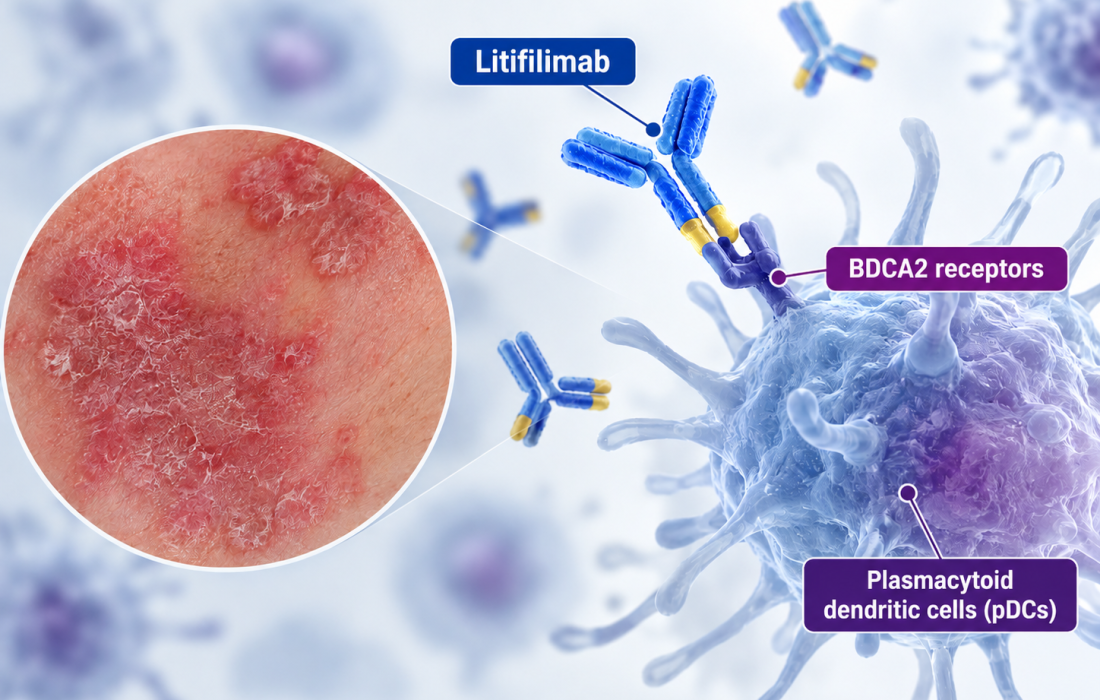
Litifilimab, also known as BIIB059, is an investigational monoclonal antibody designed to selectively target blood dendritic cell antigen 2 (BDCA2) receptors on plasmacytoid dendritic cells (pDCs).
Plasmacytoid dendritic cells play a central role early in inflammatory processes associated with lupus. By targeting BDCA2, litifilimab is being investigated for its potential to reduce inflammatory activity associated with CLE. Biogen is evaluating the therapy in both CLE and systemic lupus erythematosus (SLE).
Earlier results from the CLE portion of the Phase 2 LILAC study showed that litifilimab met its primary endpoint by demonstrating superior efficacy compared with placebo in reducing skin disease activity.
In January 2026, the U.S. Food and Drug Administration granted Breakthrough Therapy Designation to litifilimab for CLE.
Safety Profile Remained Consistent
Across the 52-w eek study period, Biogen reported that litifilimab was generally well tolerated, with no new safety signals identified. Most adverse events were mild or moderate in severity.
Serious adverse events occurred in 3.4% of participants (3/88) during the extended treatment period. The most common adverse events, occurring in at least 5% of participants, were nasopharyngitis, influenza, and arthralgia.
The reported safety findings were consistent with the overall investigational safety profile of litifilimab in the study.
Phase 3 Results Expected in the First Half of 2027
The AMETHYST study (NCT05531565) is a multicenter, randomized, double-blind, placebo-controlled Phase 2/3 study evaluating the efficacy and safety of litifilimab in participants with active subacute cutaneous lupus erythematosus (SCLE) and/or chronic cutaneous lupus erythematosus (CCLE) who are refractory or intolerant to antimalarial therapy.
The Phase 2 and Phase 3 portions are each 52 weeks in duration. Participants are randomized to receive subcutaneous litifilimab or placebo every four weeks for 20 weeks, with an additional dose at Week 2. All participants then receive litifilimab during the extended treatment period from Weeks 24 to 48.
The Phase 3 portion of AMETHYST remains blinded, with results expected in the first half of 2027.
Continued Evaluation of Litifilimab in Cutaneous Lupus
The 52-week Phase 2 findings from AMETHYST provide additional information on the persistence of clinical responses to litifilimab in adults with CLE. The findings also provide insight into the timing of response among participants who transitioned from placebo to litifilimab during the study.
Litifilimab remains an investigational therapy and has not been approved by any regulatory authority. Its safety and effectiveness have not yet been established. The ongoing Phase 3 portion of AMETHYST remains blinded, with results expected in the first half of 2027 and expected to provide further evidence on the efficacy and safety of litifilimab in CLE.
Reference
Biogen’s Litifilimab Demonstrates Rapid and Durable Efficacy in New 52-Week Phase 2 Data from Ongoing Phase 2/3 AMETHYST Study, Reinforcing Its Potential as a First-in-Class Therapy for Cutaneous Lupus Erythematosus, Biogen, 02 October 2026
A 2-Part Study to Learn Whether Litifilimab (BIIB059) Injections Can Improve Symptoms of Adult Participants Who Have Active Cutaneous Lupus Erythematosus (AMETHYST), ClinicalTrials.gov ID NCT05531565

About the Writer
Saniya Sanjay Katakdhond (Linkedin) is a Doctor of Pharmacy professional with hands-on experience in patient case review, clinical documentation, medical record analysis, and patient care.
Her hospital experience has strengthened her understanding of clinical conditions, treatment approaches, and multidisciplinary healthcare practices.
With ICH-GCP certification and a research-oriented approach, she brings clinical insight and attention to detail to healthcare content development.
As a healthcare writer, Saniya focuses on translating clinical knowledge and patient-care experience into clear, accurate, and evidence-informed medical content.