
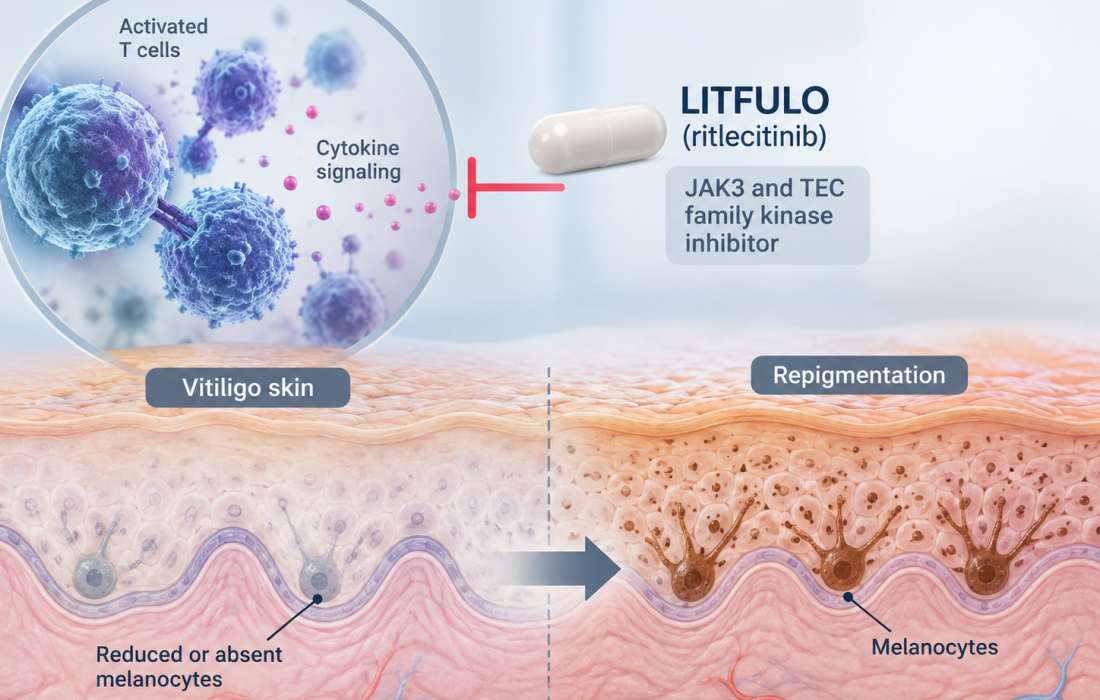
Pfizer reports Phase 3 TRANQUILLO results showing LITFULO (ritlecitinib) improved facial and total-body repigmentation in nonsegmental vitiligo.
Written By: Neha Vishwakarma, PharmD
Reviewed By: Pharmacally Editorial Team
Pfizer has reported Phase 3 results from the TRANQUILLO program evaluating once-daily oral LITFULO® (ritlecitinib) in patients with nonsegmental vitiligo (NSV). The findings, presented as a late-breaking oral presentation at the 35th European Academy of Dermatology and Venereology (EADV) Annual Congress in Vienna on October 2, 2026, showed significantly higher rates of facial and total-body repigmentation with LITFULO than placebo at Week 52.
The TRANQUILLO program is described by Pfizer as the largest Phase 3 program to date evaluating an oral systemic therapy for NSV. LITFULO is currently approved by the U.S. Food and Drug Administration (FDA) for severe alopecia areata in adults and adolescents aged 12 years and older. It is not currently approved for the treatment of NSV.
Phase 3 Trial Design
The TRANQUILLO program (NCT05583526) consists of two pivotal Phase 3 trials, together with a long-term extension study. The two pivotal trials enrolled a total of 2,174 patients with NSV across 271 sites worldwide.
TRANQUILLO 2 evaluated LITFULO 100 mg once daily in 1,567 adults. The study also included an exploratory, descriptive assessment of a 50-mg dose.
The second TRANQUILLO trial evaluated LITFULO 50 mg once daily in 607 patients aged 12 years and older.
In the United States, the co-primary endpoints were the proportions of patients achieving at least a 75% improvement in the Facial Vitiligo Area Scoring Index (F-VASI75) and at least a 50% improvement in the Total Vitiligo Area Scoring Index (T-VASI50) at Week 52. Outside the United States, F-VASI75 was the primary endpoint and T-VASI50 was a key secondary endpoint.
Week 52 Repigmentation Results
At Week 52, both LITFULO doses produced higher response rates than placebo for the key repigmentation endpoints.
Endpoint at Week 52 | LITFULO 100 mg | Placebo | LITFULO 50 mg | Placebo |
F-VASI75 | 21.86% | 2.40% | 12.47% | 2.48% |
T-VASI50 | 13.02% | 2.40% | 8.98% | 1.98% |
The improvements from baseline in F-VASI and T-VASI were statistically significant as early as Week 24 and increased through Weeks 36 and 52. More patients receiving LITFULO also achieved F-VASI75 and T-VASI50 at Weeks 24 and 36 compared with placebo.
At Week 52, patients receiving LITFULO also reported reductions in perceived facial and overall vitiligo severity.
Several additional patient-reported and disease-related endpoints were not controlled for type I error. Patients receiving LITFULO reported greater benefit on the Patient Global Impression of Change for both facial and overall vitiligo. More patients also described their vitiligo as “a lot less” or “no longer” noticeable. Disease stabilization was greater with both LITFULO doses than with placebo from Week 24 onward and was maintained through Week 52.
Safety Profile of LITFULO in Nonsegmental Vitiligo
The safety findings were consistent with the established safety profile of LITFULO in alopecia areata, and Pfizer reported no new safety signals in the NSV trials. Rates of treatment-emergent adverse events (TEAEs) were broadly similar between LITFULO and placebo groups.
Safety finding | LITFULO 100 mg | Placebo | LITFULO 50 mg | Placebo |
Any TEAE | 67.7% | 62.0% | 81.0% | 77.1% |
Upper respiratory tract infection | 8.9% | 3.4% | 14.0% | 10.9% |
Serious TEAEs | 3.4% | 3.4% | 2.0% | 2.5% |
In the 50-mg study, increased blood creatine phosphokinase was reported in 11.0% of patients receiving LITFULO compared with 8.0% receiving placebo, while decreased lymphocyte count occurred in 6.3% and 1.5% of patients, respectively.
LITFULO’s Potential Role in Nonsegmental Vitiligo
LITFULO is an oral inhibitor of Janus kinase 3 (JAK3) and the TEC family of kinases. The Phase 3 TRANQUILLO results provide clinical evidence supporting further evaluation of this mechanism in NSV, with improvements in facial and total-body repigmentation observed over 52 weeks.
Michael Vincent, M.D., Ph.D., Pfizer’s Chief Inflammation & Immunology Officer, said both trials showed increasing improvements in repigmentation over time and improvements in patients’ perceptions of disease severity.
Iltefat Hamzavi, M.D., of Henry Ford Health, said the findings support a treatment approach involving systemic therapy aimed at underlying disease drivers.
Pfizer plans to submit the NSV data to regulatory authorities globally, including the U.S. FDA and the European Medicines Agency (EMA).
Interpretation and Limitations
The Week 52 results showed substantially higher response rates with LITFULO than placebo for the primary and key secondary repigmentation measures. However, the absolute proportion of patients achieving the predefined response thresholds remained limited. Approximately one in five patients receiving 100 mg and one in eight receiving 50 mg achieved F-VASI75 at Week 52.
The two principal dose groups were evaluated in separate trials with different study populations. Therefore, the 100-mg and 50-mg response rates should not be interpreted as a direct comparison of dose efficacy. In addition, the 50-mg assessment within TRANQUILLO 2 was exploratory and descriptive.
The current findings extend only through Week 52 and therefore do not establish the longer-term durability of repigmentation. Long-term safety will also remain an important consideration for a chronic condition, particularly given the established safety considerations associated with JAK inhibition.
The findings are currently based on company-reported Phase 3 data presented at EADV. Further assessment will be possible when detailed clinical results become available through regulatory submissions and peer-reviewed publication.
Reference
Pfizer’s LITFULO Significantly Improved Facial and Total Body Repigmentation in Patients with Nonsegmental Vitiligo, Pfizer, 02 October 2026
A 52-Week Study of Ritlecitinib Oral Capsules in Adults and Adolescents with Nonsegmental Vitiligo (Active and Stable) Tranquillo (Tranquillo), ClinicalTrials.gov ID NCT05583526

About the Writer
Neha Vishwakarma is a Pharm.D professional with experience in clinical pharmacy, pharmacovigilance, and clinical research. She has hands-on experience in ADR assessment, ICSR processing, medication safety, and clinical data evaluation. Her research background in surgical site infections and antibiotic use supports her focus on evidence-based healthcare writing.