
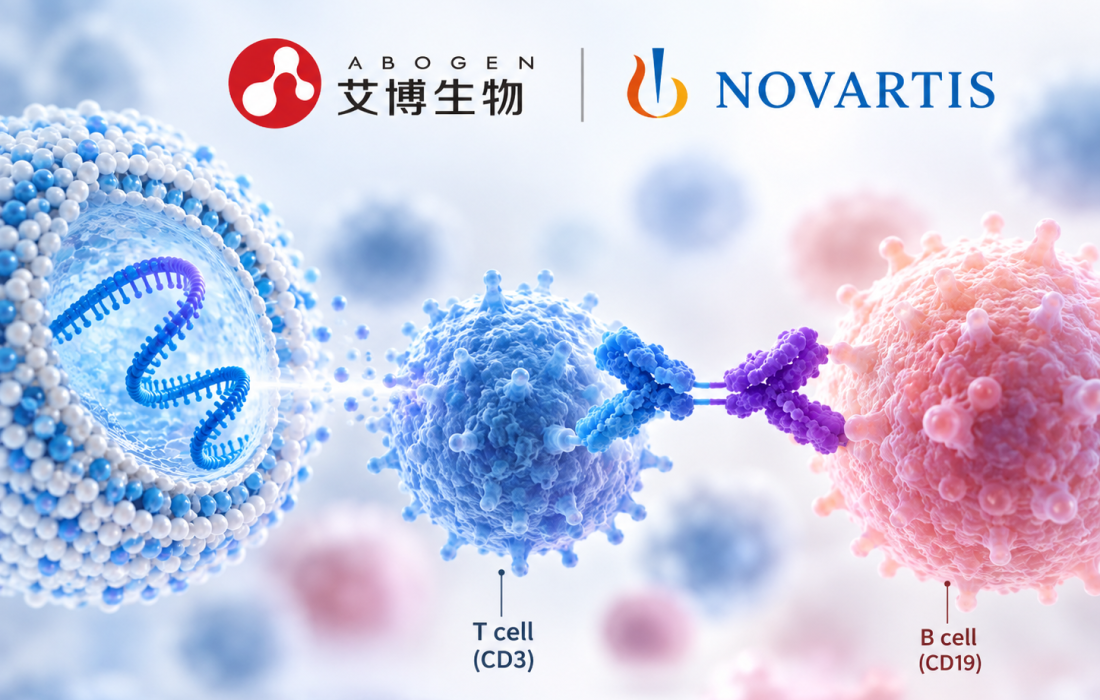
Abogen and Novartis enter a licensing agreement for ABO2203, an mRNA-encoded CD19×CD3 T-cell engager, with $575 million upfront and up to $7.2 billion in potential milestones.
Written By: Rishabh Sonawane, BPharm
Reviewed By: Pharmacally Editorial Team
Abogen Biosciences announced on October 2, 2026, that it had entered into a licensing and option agreement with Novartis to advance RNA-encoded therapeutics. The proposed transaction includes an exclusive worldwide license to ABO2203, Abogen’s lead investigational asset, as well as exclusive options for Novartis to license additional therapeutic programs developed using Abogen’s proprietary RNA platform.
ABO2203 Targets B-Cell Depletion in Autoimmune Disease
ABO2203 is an investigational mRNA-encoded CD19×CD3 T-cell engager designed to direct the body’s own cells to produce the therapeutic molecule in vivo. By targeting CD19 on B cells and CD3 on T cells, the approach is intended to bring T cells into contact with B cells and promote their depletion. The broader development strategy is focused on B-cell-mediated disorders, where controlled B-cell depletion is being investigated as a means of modifying abnormal immune activity.
Rather than administering a recombinant T-cell engager as a conventional protein therapeutic, ABO2203 uses mRNA to enable in vivo production of the CD19×CD3 engager. Abogen describes this strategy as a differentiated approach to B-cell depletion and immune modulation. The company has also stated that ABO2203 is the first mRNA-encoded T-cell engager to enter clinical evaluation for autoimmune diseases. This remains a company-reported development claim rather than an established regulatory designation.
The autoimmune-disease program is currently being evaluated in an ongoing early Phase 1 study (NCT06747156) in patients with refractory autoimmune diseases. The trial is designed to assess the safety, tolerability, pharmacokinetics, pharmacodynamics and preliminary efficacy of ABO2203, with dose-escalation and dose-expansion components.
Strategic Rationale and Financial Terms
Fiona Marshall, President of Biomedical Research at Novartis, said mRNA-encoded T-cell engagers could complement existing therapeutic modalities by enabling in vivo production of these molecules. For Abogen, the agreement extends its RNA platform beyond its established vaccine activities and provides a pathway for further development of its therapeutic programs through Novartis.
Under the proposed agreement, Abogen will receive an upfront payment of US$575 million. If Novartis exercises all available options across the covered programs, Abogen could become eligible for approximately US$7.2 billion in potential milestone payments. These milestone payments are contingent on the achievement of specified development, regulatory and commercial milestones, and Abogen may also be eligible for royalties on future product sales. Therefore, the approximately US$7.2 billion represents potential future payments rather than committed revenue.
The transaction remains subject to customary closing conditions, including required regulatory clearances. It is therefore not itself a regulatory approval for ABO2203, nor does the agreement establish clinical efficacy of the investigational therapy.
Abogen Expands RNA Platform Beyond Vaccines
The agreement also highlights the broader scope of Abogen’s RNA technology platform. According to the company, its platform incorporates AI- and automation-driven mRNA and lipid nanoparticle capabilities, with integrated activities spanning mRNA design, formulation development and large-scale GMP manufacturing.
Abogen’s pipeline includes programs across oncology, autoimmune diseases and prophylactic vaccines. Its lead vaccine candidate, ABO1108, is a lyophilized mRNA shingles vaccine currently undergoing Phase 3 clinical trials in China.
Future development decisions, regulatory progress and the achievement of milestone payments will depend on clinical development, regulatory review and the exercise of the agreement’s options. Abogen has also noted that its statements regarding ABO2203, additional programs, regulatory progress and future clinical outcomes are subject to the uncertainties inherent in drug discovery and development.
Reference
Abogen Announces Licensing and Option Agreement with Novartis to Advance mRNA-Encoded T-Cell Engager and Other RNA Programs, Abogen, 02 October 2026
A Study of mRNA Encoding CD19/CD3 T Cell Engager (ABO2203) in Patients With Refractory Autoimmune Diseases, ClinicalTrials.gov ID NCT06747156

About the Writer
Rishabha Sonawane, B.Pharm (LinkedIn) is healthcare writer with a strong interest in medical writing, regulatory affairs, clinical research, and AI-driven drug discovery. He has completed specialized training from the NIH and ICMR in clinical pharmacology, clinical research, and scientific writing. Passionate about evidence-based healthcare communication, he focuses on translating complex scientific research into clear, accurate, and engaging medical content.