
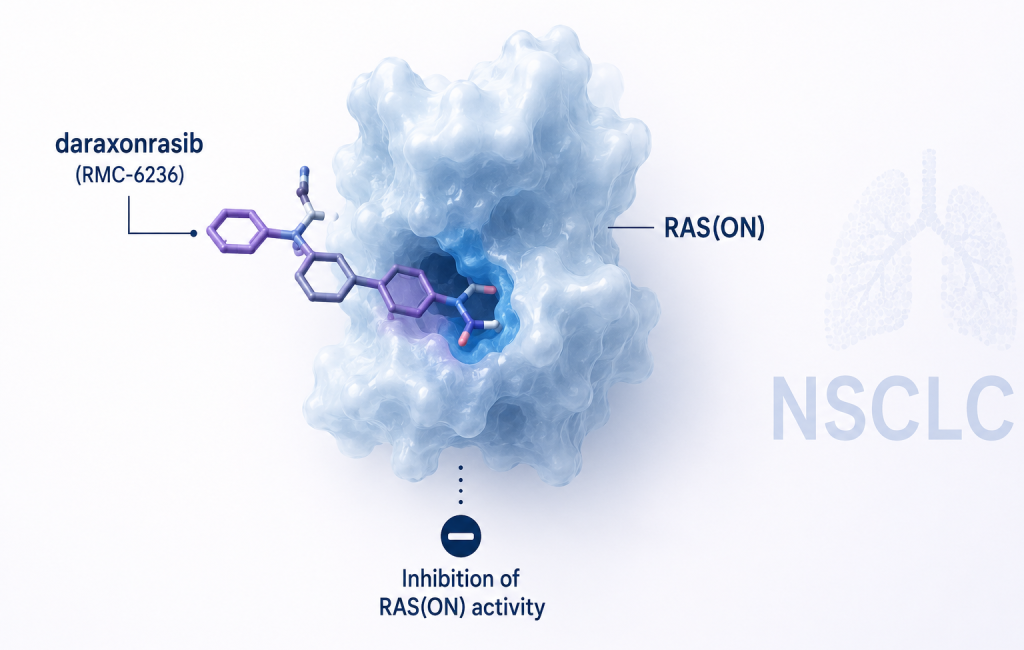
NEJM published Phase 1/2 data for daraxonrasib in previously treated RAS-mutant NSCLC, showing objective responses across dose groups and supporting Phase 3 evaluation.
Written By: Anshu Gupta, PharmD
Reviewed By: Pharmacally Editorial Team
Revolution Medicines’ daraxonrasib (RMC-6236), an oral RAS(ON) multiselective inhibitor, has been published in the New England Journal of Medicine based on Phase 1/2 data in previously treated advanced RAS-mutant non-small-cell lung cancer (NSCLC). The study showed objective responses across evaluated dose groups, with higher response rates in the 300-mg and 160-to-220-mg ranges, supporting continued development in a setting with limited targeted treatment options.
From Pancreatic Cancer to RAS-Mutant NSCLC
The NSCLC program comes at an important point in daraxonrasib’s development. After demonstrating clinical benefit in previously treated metastatic pancreatic ductal adenocarcinoma, where the drug improved overall and progression-free survival versus chemotherapy and subsequently received FDA approval, Revolution Medicines is now testing whether RAS(ON) inhibition can extend beyond pancreatic cancer.
NSCLC represents a different and important test of that strategy. RAS mutations occur in roughly 30% of NSCLC cases, but targeted treatment remains limited largely to tumors carrying RAS G12C mutations. The Phase 1/2 findings therefore provide an early assessment of whether a multiselective RAS(ON) inhibitor can produce meaningful activity across other RAS-mutant lung cancers. The ongoing Phase 3 RASolve 301 trial will provide the more definitive test of that hypothesis.
Peer-Reviewed Data in Previously Treated NSCLC
The publication reports results from RMC-6236-001 (NCT05379985), a multicenter Phase 1/2 dose-escalation and dose-expansion study. Investigators evaluated once-daily oral daraxonrasib at doses ranging from 10 to 400 mg in 21-day cycles.
As of the July 21, 2025 data cutoff, 136 patients with advanced RAS-mutant NSCLC treated at doses of 300 mg or less were evaluated for safety and efficacy. Patients had received prior treatment and had progressed after, or were intolerant to, platinum-based chemotherapy and anti-PD-(L)1 therapy. The study included tumors carrying diverse RAS mutations other than RAS G12C.
RAS mutations collectively occur in approximately 30% of NSCLC cases and represent a major group of oncogenic drivers. Although targeted treatment has improved outcomes for patients with RAS G12C disease, patients with other RAS mutations have lacked established targeted therapies.
Daraxonrasib Demonstrated Antitumor Activity Across Dose Groups
The primary endpoint was safety, while secondary endpoints included investigator-assessed objective response and duration of response, with responses evaluated according to RECIST version 1.1.
Key efficacy findings:
- Objective response rate: 31% at doses of 120 mg or less
- Objective response rate: 34% at 160 to 220 mg
- Objective response rate: 37% at 300 mg
- Docetaxel-naïve subgroup at 160 to 220 mg: 42% confirmed ORR and 89% disease control rate
- Median PFS: 8.3 months in the 38-patient docetaxel-naïve subgroup
- Median OS: 16.0 months in the same 38-patient subgroup
The 38-patient subgroup had previously received platinum-based chemotherapy and anti-PD-(L)1 therapy but had not received docetaxel. In this cohort, the confirmed ORR was 42% (95% CI, 26%-59%) and the disease control rate was 89% (95% CI, 75%-97%). Median progression-free survival was 8.3 months (95% CI, 4.0-12.5), while median overall survival was 16.0 months (95% CI, 9.5-not estimable).
This subgroup is particularly relevant to the subsequent Phase 3 development program, which is evaluating daraxonrasib against docetaxel.
Safety Profile Requires Continued Monitoring
Across the 136-patient population treated at doses of 300 mg or less, adverse events of any grade occurred in 99% of patients. Rash, diarrhea, nausea, vomiting, and mucositis or stomatitis each occurred in at least 30% of patients.
Grade 3 or higher adverse events occurred in 54% of patients. Pneumonia occurred in 10%, diarrhea in 9%, rash in 8%, and anemia in 5%. Four Grade 5 adverse events were reported.
The safety findings should be distinguished from the treatment-related adverse-event analysis in the 160-to-220 mg dose range. In that group, Grade 3 treatment-related adverse events occurred in 25% of patients, most commonly rash (8%) and diarrhea (3%). No Grade 4 or Grade 5 treatment-related adverse events were reported at these dose levels.
Phase 3 Evaluation Underway
The Phase 1/2 findings informed the design and initiation of RASolve 301 (NCT06881784), an ongoing global, randomized, open-label Phase 3 trial comparing daraxonrasib with docetaxel in patients with previously treated locally advanced or metastatic RAS-mutant NSCLC.
The NEJM publication provides a peer-reviewed and more detailed account of the Phase 1/2 clinical experience. While the underlying findings had been disclosed previously, the publication uses the later July 2025 data cutoff and presents the clinical results in a formal peer-reviewed setting. The ongoing Phase 3 trial will determine whether the observed activity translates into a clinically meaningful benefit over docetaxel.
Reference
About the Writer
Anshu Gupta (LinkedIn) is a PharmD professional and healthcare writer with interests in clinical research, pharmacovigilance, regulatory affairs, and medical writing. She has presented research at academic conferences and completed certifications in Good Clinical Practice (GCP), ICH-GCP, and drug safety. Passionate about clinical trials and evidence-based medicine, she is committed to translating scientific evidence into accurate, reliable, and accessible healthcare content.