
Roche’s Vabysmo improved vision and retinal health in PCV patients, with 61% reaching 20-week dosing intervals after two years in SALWEEN.
Written By: Kirti Kumbhar, M. Pharm (QA)
Reviewed By: Pharmacally Editorial Team
Roche’s Vabysmo (faricimab) delivered sustained improvements in visual acuity and retinal health in Asian patients with polypoidal choroidal vasculopathy (PCV), while enabling more than 60% of patients to reach a 20-week treatment interval by year two in the Phase IIIb/IV SALWEEN study.
Two-Year SALWEEN Data Show Durable Disease Control
Two-year findings from SALWEEN, presented at the 19th Asia-Pacific Vitreo-retina Society Congress in Australia, showed clinically meaningful improvements in vision and retinal anatomy among patients with PCV, an aggressive subtype of neovascular age-related macular degeneration (nAMD).
Across weeks 100–108, patients gained an average of 7.3 letters in best-corrected visual acuity (BCVA) from baseline, while central subfield thickness (CST) decreased by 127 µm. By year two, 74% of patients had no retinal fluid, indicating sustained control of retinal leakage.
Vabysmo also produced substantial effects on the abnormal polypoidal lesions characteristic of PCV. At two years, 62% of eyes achieved complete regression of polypoidal lesions, while 86% achieved lesion inactivation.
PCV Represents a Significant Treatment Challenge
PCV involves abnormal blood vessels in the choroid that can leak fluid or blood into the retina, potentially causing severe and permanent visual damage. The condition is particularly prevalent in Asian populations, where it accounts for up to 60% of nAMD cases, compared with up to 20% among people of European descent.
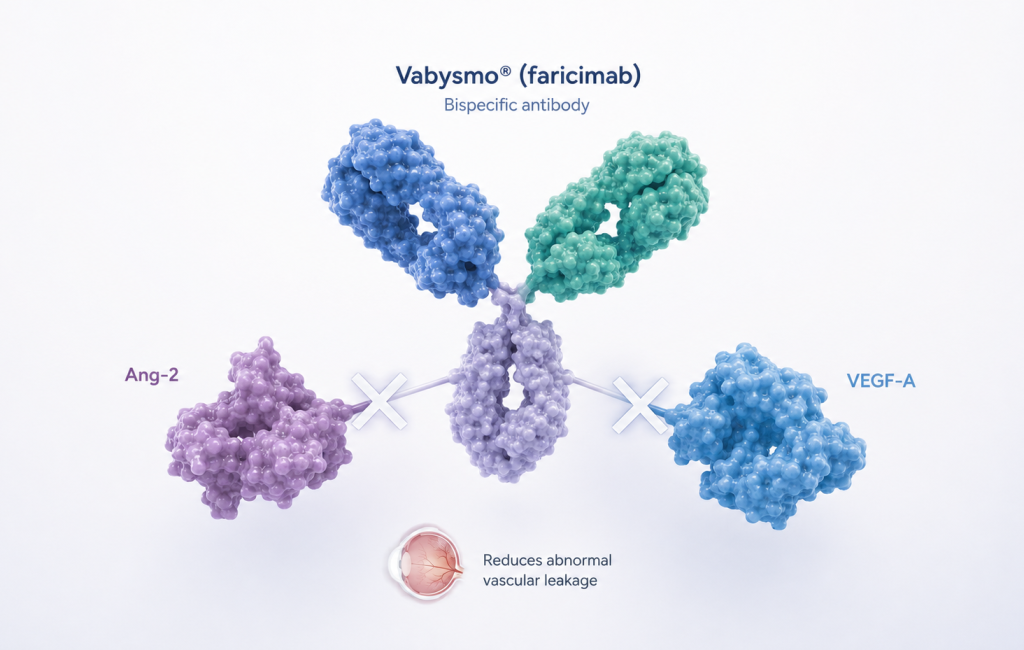
Vabysmo is a bispecific antibody that inhibits two pathways involved in retinal vascular disease: angiopoietin-2 (Ang-2) and vascular endothelial growth factor-A (VEGF-A). These signalling pathways contribute to abnormal blood-vessel growth, vascular leakage and retinal instability. Dual inhibition provides a therapeutic approach to controlling these processes in retinal vascular disorders.
Longer Treatment Intervals May Reduce Treatment Burden
SALWEEN also showed that Vabysmo could maintain disease control while allowing treatment intervals to extend over time.
Patients first received four loading doses of Vabysmo 6 mg during the initial 12 weeks. Following this loading phase, treatment was personalised according to disease status, with dosing intervals of 8, 12 or 16 weeks. From weeks 44 through 104, intervals could be further extended to 20 weeks based on the individual treatment plan.
The proportion of patients assigned to a 20-week interval increased from 51% at the end of year one to 61% by year two. Longer intervals could reduce injection and monitoring frequency for patients requiring chronic treatment.
Roche Chief Medical Officer and Head of Global Product Development Levi Garraway said the two-year results demonstrate sustained efficacy and durability with Vabysmo in PCV. Professor Gemmy Cheung of Duke-NUS Medical School highlighted the potential clinical significance of achieving polypoidal lesion control while allowing most patients to maintain extended treatment intervals.
SALWEEN Study Design and Safety
SALWEEN (ISRCTN69073386) was a Phase IIIb/IV, multicentre, open-label, single-arm study that enrolled 135 patients aged 50 years and older across 38 sites in nine Asian markets: China, Hong Kong SAR, India, Japan, Malaysia, Singapore, South Korea, Taiwan and Thailand.
The primary endpoint was the change from baseline in BCVA averaged over weeks 40–48. The study evaluated Vabysmo 6 mg using an initial loading regimen followed by personalised treatment intervals extending up to 20 weeks.
Vabysmo was well tolerated, with a safety profile in patients with PCV consistent with its established safety profile in nAMD.
Regulatory Status & Path Forward
The SALWEEN findings add two-year evidence supporting faricimab’s efficacy, retinal disease control and dosing durability in PCV, a condition that disproportionately affects Asian populations. Vabysmo is already approved in more than 100 countries for nAMD and diabetic macular edema, while it is approved in more than 60 countries for macular edema following retinal vein occlusion.
The latest data could further support the use of extended, personalised treatment intervals in PCV while reducing the long-term treatment burden associated with frequent intravitreal therapy.
Reference

About the Writer
Kirti Kumbhar (LinkedIn) is an M.Pharm graduate with experience in Quality Assurance at Lupin Limited and a strong interest in clinical research, regulatory affairs, and Trial Master File (TMF) management. She has developed knowledge of regulatory documentation, quality systems, compliance, and healthcare research through her professional experience. Passionate about clinical development and continuous learning, Kirti is committed to supporting high-quality healthcare documentation, regulatory excellence, and research-driven healthcare advancements.