
Bristol Myers Squibb’s ZENBEXUS (iberdomide) regimen doubled MRD-negative complete responses in relapsed or refractory multiple myeloma in Phase 3 EXCALIBER-RRMM.
Written By: Creola Gonsalves, PharmD
Reviewed By: Pharmacally Editorial Team
Bristol Myers Squibb’s ZENBEXUS (iberdomide) combined with daratumumab and dexamethasone produced a significantly higher rate of minimal residual disease (MRD)-negative complete response (CR) than daratumumab, bortezomib and dexamethasone in patients with relapsed or refractory multiple myeloma (RRMM), according to prespecified Phase 3 EXCALIBER-RRMM results.
At a median follow-up of 15.7 months, MRD-negative CR occurred in 41.1% of patients receiving the ZENBEXUS-based triplet compared with 20.7% receiving the comparator regimen, corresponding to an odds ratio of 2.75 (95% CI, 1.77–4.30; p<0.0001).
The findings, presented as a late-breaking oral presentation at International Myeloma Society (IMS) 2026 in Glasgow and published simultaneously in The Lancet Oncology, support the clinical activity of the ZENBEXUS regimen in patients treated after one to two prior lines of therapy. The EXCALIBER-RRMM trial has dual primary endpoints of MRD-negative CR and progression-free survival (PFS), with the confirmatory PFS analysis still ongoing.
ZENBEXUS Targets the Cereblon Pathway
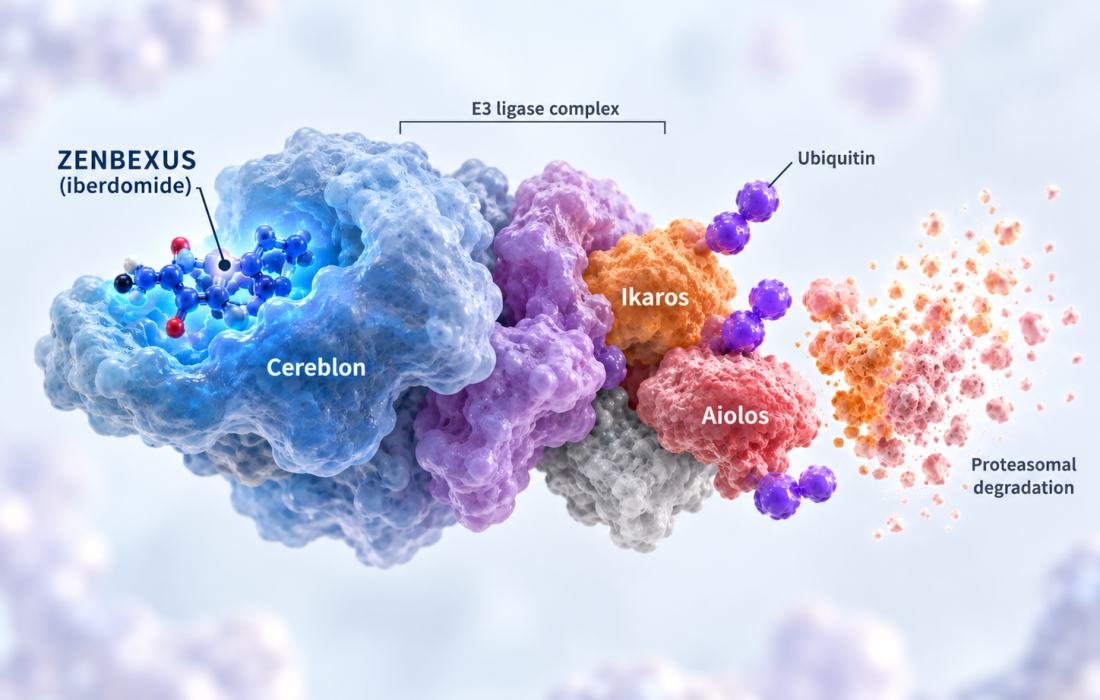
Iberdomide is a cereblon E3 ligase modulator (CELMoD), a class of targeted protein degraders that enhances cereblon-mediated degradation of transcription factors involved in myeloma cell survival, including Ikaros and Aiolos. This mechanism distinguishes iberdomide from conventional immunomodulatory drugs and provides a strategy for treating disease that has become resistant to earlier therapies.
The EXCALIBER-RRMM study evaluated iberdomide in combination with daratumumab, an anti-CD38 monoclonal antibody, and dexamethasone. The comparator combined daratumumab with the proteasome inhibitor bortezomib and dexamethasone.
Deeper Responses with the ZENBEXUS Triplet
A total of 939 patients were randomized in the Phase 3 trial. The prespecified MRD-negative CR analysis included the first 420 randomized patients, with 207 receiving ZENBEXUS 1 mg plus daratumumab and dexamethasone (ZDd) and 213 receiving daratumumab, bortezomib and dexamethasone (DVd).
Beyond the MRD-negative CR endpoint, the ZDd regimen produced an overall response rate (ORR) of 88.9%, compared with 76.1% with DVd. Complete response or better occurred in 45.9% and 24.9% of patients, respectively.
The treatment effect remained consistent across prespecified subgroups, including patients previously exposed to lenalidomide and those whose disease was refractory to lenalidomide, including in the most recent treatment line.
Neutropenia Increased, While Neuropathy Was Lower
The safety profile reflected the known effects of the combination. Grade 3 or 4 neutropenia occurred in 84.3% of patients receiving ZDd compared with 11.3% receiving DVd, predominantly during the first two treatment cycles. Most cases were managed with granulocyte colony-stimulating factor (G-CSF) support and temporary treatment interruptions. ZENBEXUS dose reduction because of neutropenia occurred in 13.2% of patients, while discontinuation because of neutropenia occurred in 1.0%.
Grade 3 or 4 infections occurred in 39.2% of patients in the ZDd group versus 21.6% in the DVd group. Fatal infections were reported in 2.0% and 1.5% of patients, respectively.
In contrast, peripheral sensory neuropathy was substantially less frequent with ZDd. Any-grade peripheral sensory neuropathy occurred in 12.3% of patients compared with 42.6% with DVd, while Grade 3 or 4 events occurred in 2.9% versus 5.4%.
FDA Approval and Ongoing PFS Evaluation
The EXCALIBER-RRMM findings follow the U.S. Food and Drug Administration’s August 13, 2026 accelerated approval of ZENBEXUS in combination with daratumumab and hyaluronidase-fihj and dexamethasone for adults with multiple myeloma who have received at least one prior line of therapy containing a proteasome inhibitor and an immunomodulatory agent.
The ongoing confirmatory analysis includes 800 patients and will evaluate PFS, the second dual primary endpoint. Overall survival, sustained MRD negativity, response outcomes and safety are also being assessed.
The current data establish MRD-negative CR as the first reported primary endpoint on which ZENBEXUS has demonstrated superiority in this Phase 3 setting, while the ongoing PFS analysis will provide additional evidence on whether the deeper responses translate into longer disease control.
Reference
Bristol Myers Squibb Announces First Presentation of Results for ZENBEXUS™ (iberdomide) in Combination with Daratumumab from Phase 3 EXCALIBER-RRMM Trial in Relapsed or Refractory Multiple Myeloma, Bristol Myers Squibb, 25 September 2026
Open-label Study Comparing Iberdomide, Daratumumab and Dexamethasone (IberDd) Versus Daratumumab, Bortezomib, and Dexamethasone (DVd) in Participants with Relapsed or Refractory Multiple Myeloma (RRMM) (EXCALIBER-RRMM), ClinicalTrials.gov ID NCT04975997
Lonial S, Dimopoulos M, Gavriatopoulou M et al., Iberdomide plus daratumumab and dexamethasone versus daratumumab, bortezomib, and dexamethasone in patients with relapsed or refractory multiple myeloma (EXCALIBER-RRMM): an open-label, randomised, controlled, phase 3 trial, The Lancet Oncology, Published September 25, 2026, https://doi.org/10.1016/S1470-2045(26)00450-X

About the Writer
Creola Gonsalves (Linkedin) is an M.S. Biotechnology postgraduate with a strong interest in clinical research, evidence interpretation, and healthcare writing, with a focus on translating life-science knowledge into meaningful real-world insights.
She is trained in Good Clinical Practice (GCP), clinical research principles, and critical interpretation of randomized clinical trials, with certifications from NIH and Stanford University.
Her research background in biotechnological applications and microbial research strengthens her ability to understand scientific evidence and develop clear, accurate, and research-driven healthcare content.