
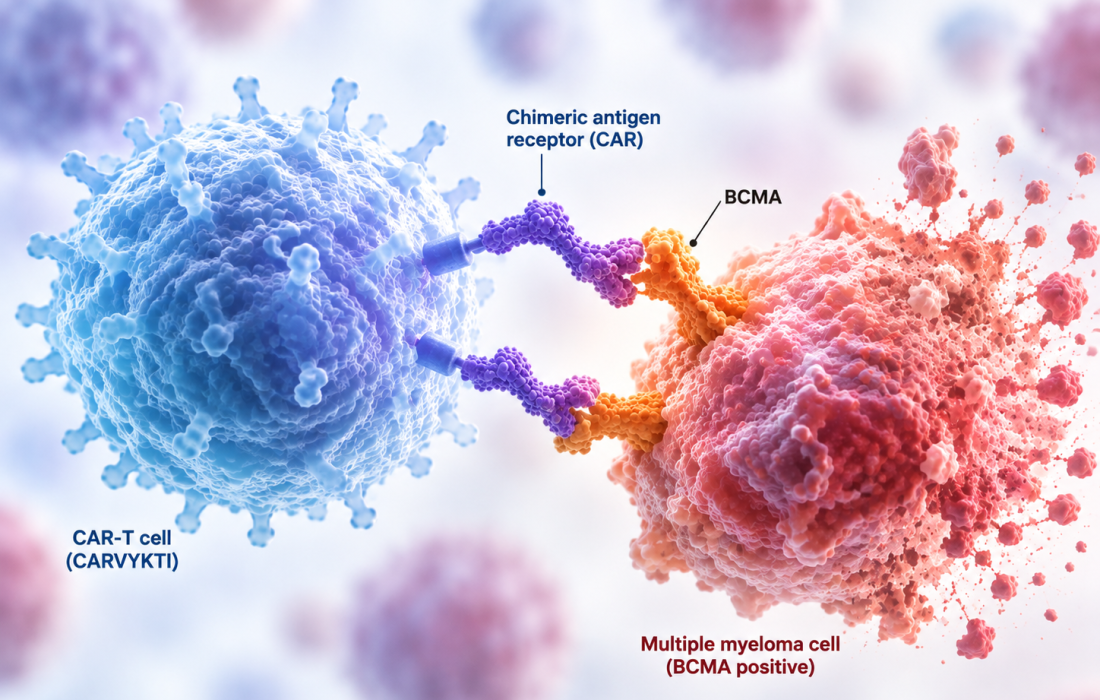
CARVYKTI showed five-year treatment-free disease control in 50% of patients in the CARTITUDE-2 early-line multiple myeloma subgroup.
Written By: Khushi Patel, PharmD
Reviewed By: Pharmacally Editorial Team
Johnson & Johnson has reported five-year follow-up data from the initial 20-patient subgroup of the Phase 2 CARTITUDE-2 study, showing that 50% of patients with early-line relapsed or refractory multiple myeloma (RRMM) remained alive and progression-free for at least five years after a single infusion of CARVYKTI® (ciltacabtagene autoleucel; cilta-cel) without maintenance therapy. The findings were presented as Abstract PA-288 at the 2026 International Myeloma Society (IMS) Annual Meeting.
The analysis included patients who had received one to three prior lines of therapy, had been exposed to a proteasome inhibitor, and were refractory to lenalidomide. The results provide long-term follow-up of the initial Cohort A subgroup and add to evidence evaluating CARVYKTI earlier in the treatment course of multiple myeloma.
Five-Year Progression-Free Outcomes After a Single Infusion
At a median follow-up of 60.7 months, 10 of the 20 patients remained alive and progression-free at five years following a single CARVYKTI infusion without maintenance therapy. The reported five-year overall survival rate was 69.2%, while median progression-free survival was 60.5 months.
The findings represent long-term outcomes from the initial 20-patient subgroup of Cohort A. Earlier CARTITUDE-2 analyses reported a 95% overall response rate and an 85% stringent complete response rate in this subgroup, with durable responses observed during follow-up.
MRD Negativity at Five Years
Minimal residual disease (MRD) was assessed by bone marrow testing in three patients at five years. All three were MRD-negative at the deepest level tested, 10⁻⁶. The five-year MRD assessment was not required by the study protocol.
These findings provide additional evidence of deep disease control in individual patients, although the five-year MRD assessment involved only three patients and should not be interpreted as representative of the entire 20-patient subgroup.
Durable Disease Control in Patients with High-Risk Features
Long-term disease control was also observed among patients with high-risk cytogenetic abnormalities. Of the 10 patients who remained alive and progression-free at five years, five had at least one high-risk cytogenetic abnormality, including four patients with two or more high-risk features.
Because these observations come from a small subgroup, they are descriptive and do not establish comparative efficacy in patients with high-risk cytogenetic disease.
Long-Term Safety Remained Consistent
The safety profile with longer follow-up remained consistent with the known safety profile of CARVYKTI, and no new CAR T-cell-related neurotoxicity was reported during the extended follow-up. Since the previous analysis, one patient developed a new hematologic malignancy, acute myeloid leukemia (AML), while two deaths occurred due to progressive disease and new cancer.
CARVYKTI’s established safety profile includes important risks associated with CAR-T cell therapy, including cytokine release syndrome, neurologic toxicities, hemophagocytic lymphohistiocytosis/macrophage activation syndrome, prolonged or recurrent cytopenias, and secondary hematologic malignancies.
Earlier Use of CARVYKTI in Multiple Myeloma
CARVYKTI is a BCMA-directed autologous CAR-T cell therapy that uses a patient’s own T cells, genetically modified to express a chimeric antigen receptor targeting B-cell maturation antigen (BCMA). BCMA is expressed on malignant multiple myeloma cells as well as late-stage B cells and plasma cells.
CARTITUDE-2 (NCT04133636) is an ongoing, multicohort Phase 2 study evaluating CARVYKTI in different clinical settings. Cohort A evaluated patients with RRMM who had received one to three prior lines of therapy and were refractory to lenalidomide.
The five-year findings add to the longer-term CARVYKTI clinical program, including CARTITUDE-1, which evaluated the therapy in patients with more heavily pretreated multiple myeloma. Johnson & Johnson said the findings support continued evaluation of CARVYKTI earlier in the treatment course, where some patients may achieve deep and durable disease control without maintenance therapy.
Current U.S. Regulatory Status
In the United States, CARVYKTI is approved for adults with relapsed or refractory multiple myeloma who have received at least one prior line of therapy, including a proteasome inhibitor and an immunomodulatory agent, and whose disease is refractory to lenalidomide.
The five-year CARTITUDE-2 findings do not themselves constitute a new regulatory approval. Instead, they provide additional long-term clinical evidence from an earlier-line treatment setting and contribute to the ongoing evaluation of CAR-T therapy in the treatment sequence for multiple myeloma.
Reference
Single infusion of CARVYKTI® (ciltacabtagene autoleucel) delivered five-year treatment-free remissions in 50% of patients in early line relapsed/refractory multiple myeloma, Johnson and Johnson, 25 September 2026
A Study of JNJ-68284528, a Chimeric Antigen Receptor T Cell (CAR-T) Therapy Directed Against B-cell Maturation Antigen (BCMA) in Participants with Multiple Myeloma (CARTITUDE-2), ClinicalTrials.gov ID NCT04133636

About the Writer
Khushi Patel is a Pharm.D (Linkedin) professional with a strong foundation in clinical pharmacy, patient-centered care, regulatory affairs, and pharmacovigilance, with published work on Brugada syndrome.
Her interests include regulatory affairs, pharmacovigilance, guideline integration, multimodal therapy, pharmacogenomics, and antibiogram utilization, with a focus on evidence-based clinical decision-making and medication safety.
As a Pharmacally healthcare writer, she translates clinical and scientific evidence into clear, accurate, and clinically relevant healthcare content, while continuously developing her expertise in evolving pharmacy practice.