
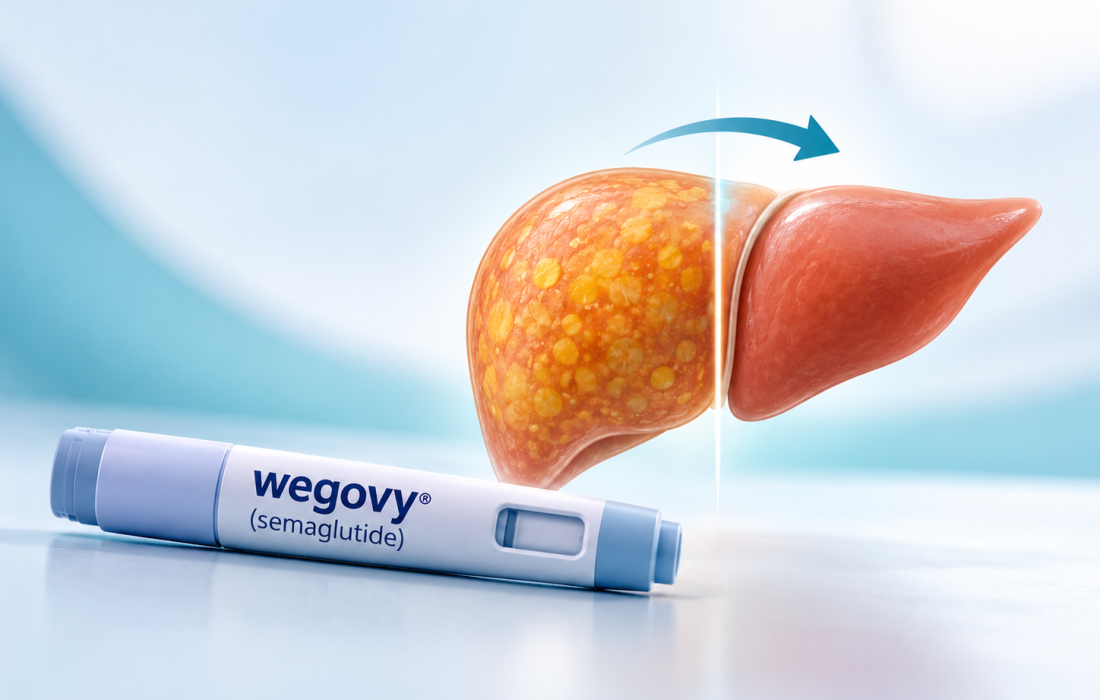
Novo Nordisk reports reduced liver fat with Wegovy in adults with obesity, including an 88.5% rate below 5% in an exploratory STEP-UP analysis.
Written By: Anshu Gupta, PharmD
Reviewed By: Pharmacally Editorial Team
Novo Nordisk presented a post hoc analysis from the STEP-UP trial (NCT05646706) programme showing a reduction in liver fat among adults with obesity treated with Wegovy (injectable semaglutide) 7.2 mg or 2.4 mg. The findings were presented at the European Association for the Study of Diabetes (EASD) Annual Meeting 2026 in Milan, Italy.
The analysis included a 55-participant subgroup of adults with obesity without diabetes and excess liver fat. Liver fat was directly assessed using magnetic resonance imaging-proton density fat fraction (MRI-PDFF), a non-invasive imaging technique for quantifying hepatic steatosis.
The broader pooled analysis included 1,919 adults from the STEP UP and STEP UP T2D trials. Of these, 1,312 participants received semaglutide 7.2 mg, 304 received semaglutide 2.4 mg and 303 received placebo. More than 94% of participants across the treatment groups were classified as being at high risk for fatty liver according to the Fatty Liver Index (FLI), while fewer than 1% met criteria for advanced fibrosis risk according to the FIB-4 index.
Liver Fat Fell From 8.8% to 3.1%
Among participants in the 55-person subgroup receiving pooled semaglutide 7.2 mg or 2.4 mg, mean liver fat declined from 8.8% at baseline to 3.1% at week 72.
The analysis also examined participants who entered the trials with liver fat above 5%. Of the 26 participants meeting this criterion at baseline, 23 participants, or 88.5%, had liver fat below 5% at week 72. Novo Nordisk described the below-5% level as normal liver fat in the analysis.
The findings indicate that the reduction in liver fat was observed not only among participants with higher baseline liver fat but also in the broader population assessed for liver-related measures. Novo Nordisk reported improvements in liver-related measures even among participants with relatively low baseline liver fat.
What Was the STEP-UP Analysis Designed to Evaluate?
STEP-UP and STEP UP T2D were phase 3b, randomised, double-blind, placebo-controlled trials evaluating once-weekly semaglutide 7.2 mg versus semaglutide 2.4 mg and placebo for weight management.
STEP-UP enrolled adults with obesity, defined as a body mass index (BMI) of at least 30 kg/m², without diabetes. STEP UP T2D enrolled adults with obesity and type 2 diabetes.
The primary endpoints of the parent trials were change in body weight and the proportion of participants achieving at least 5% weight loss at week 72. The liver-related measures reported at EASD 2026 were therefore an additional analysis of the STEP-UP programme rather than the primary efficacy outcomes for which the trials were originally designed.
Why the Liver Findings Are Considered Exploratory
The liver findings came from a post hoc exploratory analysis of liver-related indices and metabolic measures from the STEP-UP programme. They were not pre-specified primary or secondary endpoints of the parent trials.
This distinction is important when interpreting the results. The direct liver-fat measurement was performed in a relatively small subgroup of 55 participants, rather than across the entire 1,919-participant pooled population.
The 1,919-participant analysis provided broader information on liver-related indices, while direct quantification of liver fat by MRI-PDFF was performed in the 55-participant subgroup. Therefore, the 8.8% to 3.1% liver-fat reduction and the 88.5% figure should be understood as findings from the smaller liver-fat assessment subgroup.
Semaglutide’s Separate MASH Development Programme
The STEP-UP findings add liver-related data to a separate clinical development programme investigating semaglutide 2.4 mg in metabolic dysfunction-associated steatohepatitis (MASH).
Novo Nordisk stated that semaglutide 2.4 mg is approved for the treatment of MASH under the Wegovy brand in the United States, Canada, the United Kingdom, China and several other markets. Semaglutide 7.2 mg is not being investigated for MASH.
The ongoing phase 3 ESSENCE trial is evaluating once-weekly injectable semaglutide 2.4 mg in people with MASH and moderate-to-advanced liver fibrosis, classified as stage F2 or F3. The trial randomised 1,197 participants in a 2:1 ratio to semaglutide 2.4 mg or placebo, alongside standard of care, for a total treatment period of 240 weeks.
In the first part of ESSENCE, the objective was to assess liver histology at 72 weeks using biopsy samples from the first 800 randomised participants. Semaglutide 2.4 mg showed greater improvement in liver fibrosis without worsening steatohepatitis and greater resolution of steatohepatitis without worsening liver fibrosis compared with placebo. Results from the second part are expected in 2029.
The ESSENCE programme is distinct from the STEP-UP liver-fat analysis. ESSENCE is specifically designed to evaluate semaglutide in people with established MASH and moderate-to-advanced fibrosis, whereas the STEP-UP analysis examined liver-fat and other liver-related measures in a population enrolled primarily for obesity treatment.
What the Findings Add
The STEP-UP analysis provides additional evidence on the effect of semaglutide on liver fat in adults with obesity. In the 55-participant subgroup assessed directly for liver fat, mean liver fat declined from 8.8% to 3.1% after 72 weeks, while 23 of 26 participants with liver fat above 5% at baseline reached levels below 5%.
The findings are relevant to the relationship between obesity and metabolic liver disease, but their interpretation is limited by the exploratory nature of the analysis and the relatively small subgroup in which liver fat was directly quantified.
The results also provide additional context for semaglutide’s broader liver-disease development programme, including the dedicated ESSENCE trial evaluating semaglutide 2.4 mg in people with MASH and liver fibrosis.
Reference
Novo’s Wegovy® (semaglutide) reduced liver fat to normal levels in 9 out of 10 adults with obesity and excess liver fat – EASD2026, Novo Nordisk, 01 October 2026
A Research Study to See How Semaglutide Helps People with Excess Weight, Lose Weight (STEP UP) (STEP UP), ClinicalTrials.gov ID NCT05646706

About the Writer
Anshu Gupta (LinkedIn) is a PharmD professional and healthcare writer with interests in clinical research, pharmacovigilance, regulatory affairs, and medical writing. She has presented research at academic conferences and completed certifications in Good Clinical Practice (GCP), ICH-GCP, and drug safety. Passionate about clinical trials and evidence-based medicine, she is committed to translating scientific evidence into accurate, reliable, and accessible healthcare content.