
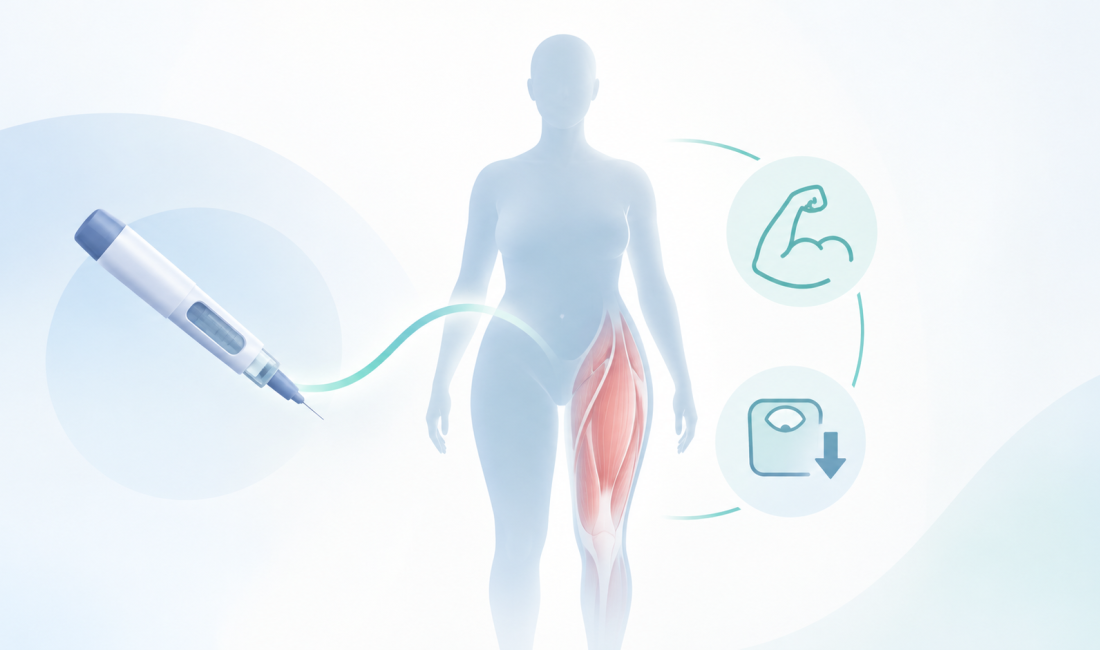
Regeneron reports 52-week Phase 2 COURAGE results showing trevogrumab preserved lean mass and thigh muscle during semaglutide weight loss.
Written By: Siddhi Bhadekar, M. Pharm (QA)
Reviewed By: Pharmacally Editorial Team
Regeneron Pharmaceuticals announced on October 1, 2026, new results from its Phase 2 COURAGE trial (NCT06299098), evaluating trevogrumab, an anti-myostatin antibody, for its potential to preserve lean mass during semaglutide-induced weight loss in adults with obesity. The findings were presented at a scientific symposium during the European Association for the Study of Diabetes (EASD) Annual Meeting and are in press with The Lancet.
The newly reported results came from the lower-dose portion of COURAGE, in which trevogrumab 25 mg or 75 mg was administered with semaglutide 2.4 mg and compared with semaglutide alone over 52 weeks. Regeneron reported that lower-dose trevogrumab preserved lean mass at both 26 and 52 weeks, while an MRI sub study showed preservation of approximately 70% of the thigh muscle that otherwise would have been lost with semaglutide alone. The treatment did not meaningfully increase the amount of weight lost with semaglutide, indicating that the principal effect was on the composition of weight loss rather than its overall magnitude.
Trevogrumab: Mechanism and Clinical Development
Trevogrumab is a monoclonal antibody targeting growth differentiation factor 8 (GDF8), also known as myostatin. Myostatin acts as a negative regulator of skeletal muscle growth. By blocking GDF8 signaling, trevogrumab is being investigated as a potential approach to preserve muscle during pharmacologically induced weight loss.
COURAGE also included a treatment arm combining semaglutide, trevogrumab and an Activin-A inhibitor. Results from that triplet regimen had been reported previously and were not part of the October 1 announcement.
Clinical Context of Lean Mass Loss During Weight Reduction
GLP-1 receptor agonist-based therapies have substantially expanded pharmacological options for obesity treatment. However, weight reduction can include losses of both fat mass and lean tissue. Regeneron is therefore investigating whether muscle-preserving therapies can alter the composition of weight loss while maintaining the reduction in body weight achieved with GLP-1-based treatment.
This question may be particularly relevant for older adults and people with low muscle mass or other factors associated with frailty. Regeneron described the COURAGE findings as supporting the potential of trevogrumab to improve the composition, or “quality,” of weight loss.
COURAGE Trial Design
COURAGE evaluated adults with obesity, defined as a body mass index (BMI) of at least 30 kg/m². The obesity efficacy program included two independent treatment portions over 52 weeks.
The higher-dose portion evaluated trevogrumab 200 mg or 400 mg combined with semaglutide 2.4 mg for 26 weeks, compared with semaglutide alone. After semaglutide was discontinued, trevogrumab was compared with placebo for a further 26 weeks.
The lower-dose portion evaluated trevogrumab 25 mg or 75 mg combined with semaglutide 2.4 mg against semaglutide monotherapy for the full 52 weeks. The October 1 results were from this lower-dose portion, and Regeneron reported that the findings replicated the lean-mass preservation observed in the earlier higher-dose analysis.
DXA Results Showed Sustained Lean Mass Preservation
Lean mass measured by dual-energy X-ray absorptiometry (DXA) was the primary endpoint for the reported analysis.
Participants receiving placebo plus semaglutide experienced a 6.7% reduction in lean mass at 26 weeks and a 7.3% reduction at 52 weeks.
With trevogrumab 25 mg plus semaglutide, lean mass decreased by 4.7% at 26 weeks and 5.8% at 52 weeks. This corresponded to 29.9% and 20.5% relative lean-mass preservation compared with placebo plus semaglutide.
The 75 mg dose produced a 3.3% reduction at 26 weeks and a 4.2% reduction at 52 weeks, corresponding to 50.7% and 42.5% relative lean-mass preservation, respectively.
Regeneron also reported that the greatest reduction in lean mass occurred during the first six months, when weight loss was most rapid.
MRI Sub Study Supported Thigh Muscle Preservation
A predefined MRI sub study provided an additional assessment of thigh muscle volume.
Among participants with evaluable MRI data, the mean absolute change from baseline in fat-free muscle volume was −0.88 at 26 weeks and −1.03 at 52 weeks with placebo plus semaglutide.
With trevogrumab 25 mg, the corresponding changes were −0.32 and −0.29, while trevogrumab 75 mg produced changes of −0.24 and −0.32.
Relative to placebo plus semaglutide, the 25 mg dose corresponded to 63.6% muscle preservation at 26 weeks and 71.8% at 52 weeks. The corresponding figures for 75 mg were 72.7% and 68.9%. Regeneron reported these findings as preservation of almost 70% of the thigh muscle that otherwise would have been lost with semaglutide alone.
Safety and Tolerability
Lower-dose trevogrumab was generally well tolerated in the reported analysis. At least one adverse event occurred in 77% of participants receiving trevogrumab compared with 82% of participants receiving placebo.
The most common adverse events occurring in at least 10% of participants were nausea, constipation, diarrhea and vomiting.
Findings in Participants with Low Lean Mass
A prespecified subgroup analysis evaluated participants with low lean mass at baseline. Low lean mass was defined using the imaging component of the sarcopenia definition established by the Foundation for the National Institutes of Health, based on appendicular lean mass relative to BMI measured by DXA.
Participants with low lean mass experienced greater lean-mass loss with semaglutide alone than those without low lean mass. Regeneron reported numerically greater lean-mass preservation when trevogrumab was added to semaglutide in this subgroup. The October 1 announcement did not provide detailed numerical subgroup results.
Regulatory Status and Next Phase of Development
Trevogrumab remains an investigational therapy. The October 1 announcement stated that its safety and efficacy have not been evaluated by a regulatory authority. The COURAGE findings therefore represent clinical-development data and do not constitute a regulatory approval or filing.
Regeneron said it plans to initiate another Phase 2 study evaluating trevogrumab in combination with GLP-1 receptor agonist-based therapies in older adults with obesity and decreased muscle mass and/or strength.
What the COURAGE Results Show
The 52-week COURAGE findings indicate that lower-dose trevogrumab can reduce the amount of lean mass and thigh muscle lost during semaglutide-associated weight reduction, while not meaningfully increasing overall weight loss. The DXA and MRI findings provide complementary measures of body-composition preservation over one year.
However, the reported results primarily assess body composition. The October 1 announcement does not establish whether preserving lean mass or thigh muscle volume translates into improvements in muscle strength, physical performance or other functional outcomes. The detailed findings also remain company-reported pending publication of the full analysis in The Lancet.
Reference
Phase 2 COURAGE Trial Confirms Trevogrumab Prevents Lean Mass and Muscle Loss During GLP-1 Receptor Agonist-induced Weight Loss, Regeneron, 01 October 2026
A Study to Test if Trevogrumab or Trevogrumab with Garetosmab When Taken with Semaglutide is Safe and How Well They Work in Adult Patients with Obesity for Weight Loss, Fat Loss, and Lean Mass Preservation (COURAGE), ClinicalTrials.gov ID NCT06299098

About the Writer
Siddhi Rajendra Bhadekar (Linkedin) is an M.Pharm professional with expertise in medical and scientific writing, literature review, publication writing, and evidence synthesis, supported by four peer-reviewed publications.
She brings working knowledge of ICH-GCP, MedDRA, pharmacovigilance, ADR/AE reporting, clinical data management, and regulatory documentation.
With experience across pharmaceutical R&D, Quality Control, and Quality Assurance, she combines scientific research skills with strong attention to accuracy and detail.
Her background in manuscript development, publication planning, and scientific communication enables her to translate complex healthcare information into clear, reliable content.