
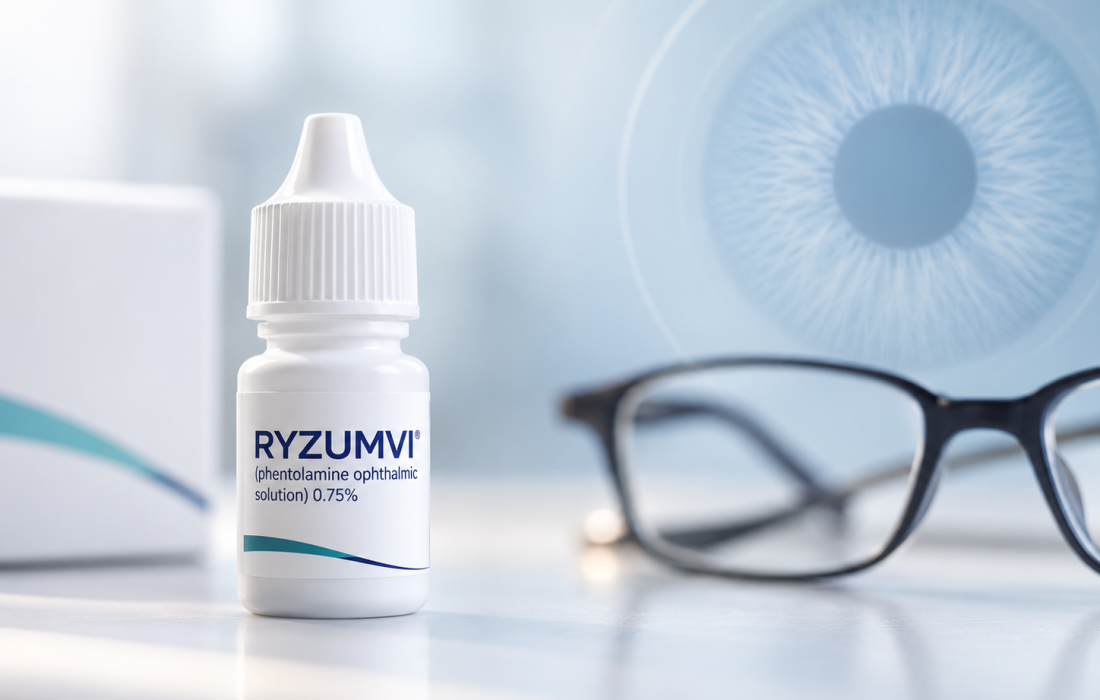
The FDA approves Viatris’ RYZUMVI for adult presbyopia based on Phase 3 VEGA-2 and VEGA-3 trials, expanding its existing eye care indication.
Written By: Mayuresh Salvi, PharmD
Reviewed By: Pharmacally Editorial Team
Viatris has secured US Food and Drug Administration (FDA) approval for RYZUMVI (phentolamine ophthalmic solution 0.75%) to treat presbyopia in adults, expanding the eye drop’s existing indication for pharmacologically induced mydriasis. The approval adds a pharmacological option for age-related near-vision impairment. Viatris is exploring a US commercialisation partner for the newly approved indication.
FDA Approval Expands RYZUMVI’s Indications
Presbyopia is the gradual loss of near-focusing ability associated with ageing, typically becoming noticeable in the early to mid-40s. The condition can cause blurred near vision and eye strain, affecting everyday activities such as reading and using digital devices.
RYZUMVI already holds US approval for treating pharmacologically induced mydriasis, or pupil dilation caused by certain ophthalmic agents. The expanded indication establishes phentolamine ophthalmic solution 0.75% as an additional treatment option for adults with presbyopia.
How Phentolamine Improves Near Vision
Phentolamine is an alpha-adrenergic receptor antagonist that reduces pupil diameter by blocking adrenergic stimulation of the iris dilator muscle. This effect can increase depth of focus, potentially improving near vision without directly engaging the ciliary muscle responsible for changing the eye’s focus.
The approach differs from treatments that target the eye’s focusing muscle. Its clinical value depends on whether improved near vision can be achieved while preserving distance vision and maintaining an acceptable safety profile.
Phase 3 VEGA Trials Supported the Approval
The FDA approval was supported by positive results from two pivotal Phase 3 studies, VEGA-2 (NCT05646719) and VEGA-3 (NCT06542497). Both trials met their primary and key secondary efficacy endpoints. In VEGA-3, 27.2% of participants receiving phentolamine achieved an improvement of at least 15 letters in binocular distance-corrected near visual acuity, while losing fewer than five letters in best-corrected distance visual acuity, 12 hours after dosing on Day 8. The corresponding response rate was 11.5% with placebo (p<0.0001). The study also showed no evidence of tachyphylaxis over six weeks of follow-up, supporting sustained efficacy during the period studied.
Dosing and Regulatory Scope
In the VEGA-3 trial, phentolamine ophthalmic solution 0.75% was administered once daily in the evening. This schedule provides context for its use as a presbyopia treatment, although comparative adherence advantages over other eye drops have not been established.
The approved indications have distinct age scopes. RYZUMVI is indicated for presbyopia in adults, while its existing indication for reversing pharmacologically induced mydriasis covers adults and paediatric patients aged three years and older.
Safety Profile and Precautions
In the presbyopia studies, the most common ocular adverse reactions reported in more than 5% of subjects were conjunctival hyperemia, reported in 21%, and instillation-site irritation, reported in 16%.
RYZUMVI is not recommended for patients with active ocular inflammation, such as iritis. Patients should avoid touching the vial tip to the eye or other surfaces to reduce the risk of injury or contamination. Contact lens wearers should remove their lenses before administration and wait 10 minutes after dosing before reinserting them.
For the existing mydriasis indication, the most common ocular adverse reactions were instillation-site discomfort, including pain, stinging and burning, in 16% of subjects, and conjunctival hyperemia in 12%. Dysgeusia, or altered taste, was reported in 6% as the most common non-ocular adverse reaction. Most reported reactions were mild, transient and self-resolving.
Commercialisation Outlook
Under a global licensing agreement with Opus Genetics, Viatris holds exclusive US commercialisation rights to phentolamine ophthalmic solution 0.75%. The company is exploring a US partner for the presbyopia indication, leaving its commercialisation strategy for the expanded label under evaluation.
The approval advances a pupil-modulating approach to presbyopia treatment. Its clinical relevance will depend on the magnitude and duration of near-vision improvement, preservation of distance vision, tolerability and uptake relative to existing corrective and pharmacological options.
Reference
Viatris Receives U.S. FDA Approval for RYZUMVI® for the Treatment of Presbyopia, Viatris, 16 October 2026
Safety and Efficacy of Nyxol Eye Drops as a Single Agent and With Adjunctive Low-Dose Pilocarpine Eye Drops in Subjects with Presbyopia (VEGA-2), ClinicalTrials.gov ID NCT05646719
Evaluate Efficacy and Safety of POS to Improve Distance-corrected Near Visual in Participants with Presbyopia (VEGA-3), ClinicalTrials.gov ID NCT06542497

About the Writer
Mayuresh Sunil Salvi (Linkedin) is a PharmD professional and healthcare writer with a strong interest in pharmacovigilance, drug safety, and emerging medical research. He is passionate about exploring new drug discoveries, clinical research, and advances in evidence-based medicine. His interests also include ward rounds, prescription audits, and treatment analysis to support rational pharmacotherapy and improved patient care.