
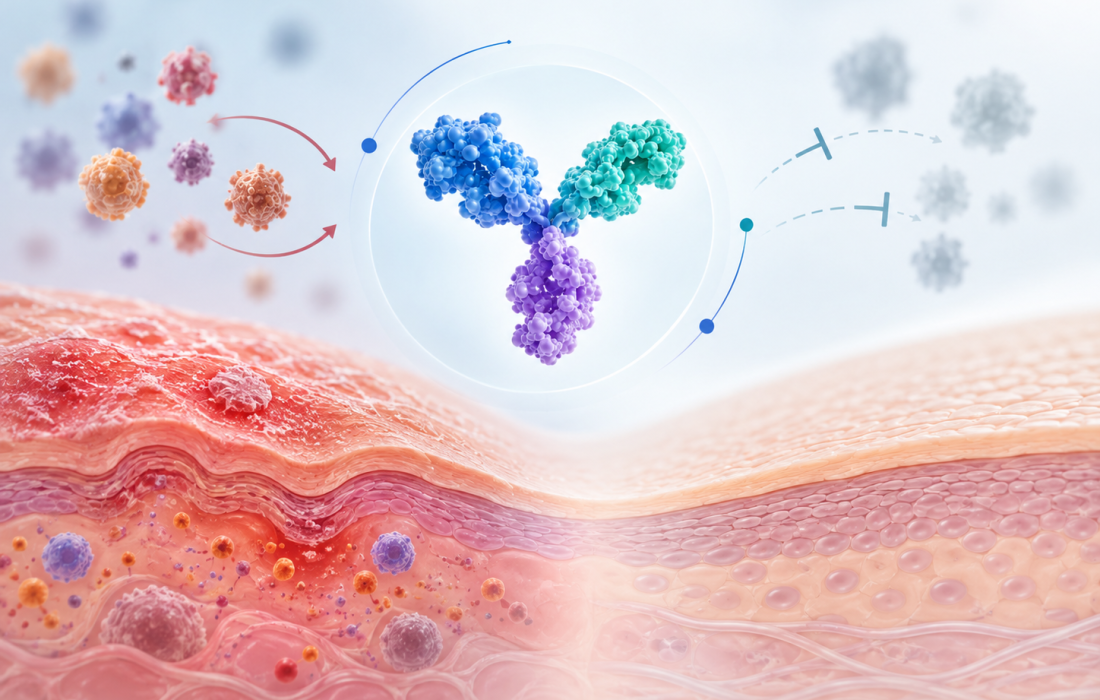
Pfizer’s investigational tilrekimig achieved EASI-75 across doses in a Phase 2 atopic dermatitis study, supporting continued development in AD.
Written By: Charvi Kalal, PharmD
Reviewed By: Pharmacally Editorial Team
Pfizer has presented detailed results from an ongoing Phase 2 study evaluating tilrekimig (PF-07275315) in adults with moderate-to-severe atopic dermatitis (AD). The study met its primary endpoint, with significantly more participants achieving EASI-75, defined as at least a 75% reduction in the Eczema Area and Severity Index, at Week 16 across all evaluated doses compared with placebo.
The data were presented in an oral session at the 35th European Academy of Dermatology and Venereology (EADV) Congress 2026 in Vienna, Austria. Tilrekimig remains investigational and has not been approved by any regulatory authority.
A Trispecific Approach to Type 2 Inflammation
Atopic dermatitis is a chronic inflammatory skin disease characterized by itching, skin lesions and recurrent disease activity. Tilrekimig is an investigational trispecific antibody designed to simultaneously target interleukin-4 (IL-4), interleukin-13 (IL-13), and thymic stromal lymphopoietin (TSLP).
By targeting TSLP together with the downstream cytokines IL-4 and IL-13, the approach is designed to address multiple components of type 2 inflammation. Pfizer also reports that tilrekimig has an extended half-life of approximately 37 days, supporting investigation of less frequent dosing, including monthly administration.
Design of the Phase 2 Study
The ongoing Phase 2 trial is a randomized, double-blind, placebo-controlled study in adults with moderate-to-severe AD. The EADV data covered the first two stages of the study, which enrolled biologic-naïve patients.
In Stage 1, participants received subcutaneous tilrekimig 450 mg every two weeks (Q2W) or placebo. Stage 2 evaluated three monthly regimens: 400 mg, 200 mg, or 50 mg every four weeks (Q4W), each compared with placebo.
EASI-75 Endpoint Met Across All Evaluated Doses
In Stage 1, 62.5% of participants receiving tilrekimig 450 mg Q2W achieved EASI-75 at Week 16, compared with 19.9% receiving placebo (p=0.0008).
In Stage 2, EASI-75 responses were observed in 58.5% of participants receiving 400 mg Q4W, 61.0% receiving 200 mg Q4W, and 47.8% receiving 50 mg Q4W, compared with 9.1% for placebo. All comparisons were statistically significant (p<0.003).
The corresponding absolute differences versus placebo were 49.4, 51.9, and 38.7 percentage points, respectively.
Secondary and Exploratory Findings
The key secondary endpoint was validated Investigator Global Assessment (vIGA) 0/1, indicating clear or almost clear skin with at least a two-point improvement from baseline.
In Stage 1, 30.3% of patients receiving tilrekimig 450 mg Q2W achieved vIGA 0/1 compared with 11.8% on placebo (p=0.0251). In Stage 2, approximately 26% to 27% of participants across the three Q4W dose groups achieved vIGA 0/1, compared with 0% in the placebo group, with all comparisons meeting statistical significance (p<0.006).
An exploratory analysis also assessed itch using the Peak Pruritus Numerical Rating Scale (PP-NRS). Among patients receiving 400 mg Q4W, 42.5% achieved at least a four-point reduction in weekly average PP-NRS compared with 7.2% on placebo, representing a treatment difference of 35.3 percentage points. With 200 mg Q4W, the corresponding rates were 50.8% versus 7.2%, a treatment difference of 43.6 percentage points.
Safety and Tolerability
Pfizer reported that tilrekimig was well tolerated across the two study stages presented at EADV, with no dose-dependent safety signals identified.
In Stage 1, treatment-emergent adverse events (TEAEs) occurred in 46.7% of participants receiving 450 mg Q2W compared with 28.9% receiving placebo. In Stage 2, TEAEs occurred in 42.2%, 47.7%, and 47.8% of participants receiving 400 mg, 200 mg, and 50 mg Q4W, respectively, compared with 52.2% receiving placebo.
At doses up to 400 mg Q4W, Pfizer reported that conjunctivitis and injection-site reactions occurred at frequencies comparable with placebo and lower than rates reported with IL-4 receptor alpha inhibitors. No serious adverse events related to tilrekimig were reported in either stage.
Phase 3 Program Underway
Pfizer has initiated its Phase 3 development program for tilrekimig, with patients dosed in three studies: two evaluating atopic dermatitis, including one with dupilumab as an active comparator, and one evaluating asthma. Pfizer is also conducting a Phase 2b/3 study in chronic obstructive pulmonary disease (COPD).
The Phase 2 findings support further evaluation of tilrekimig across less frequent dosing regimens and provide clinical evidence for continued investigation of its multi-target approach to type 2 inflammation. However, the efficacy and safety findings remain based on an ongoing Phase 2 program, with longer-term and larger-scale studies needed to further characterize the treatment’s clinical profile.
Reference
Pfizer’s Tilrekimig Shows Significant Skin Clearance in Phase 2 Atopic Dermatitis Study, Pfizer Inc., Pfizer, 1 October 2026
A Study to Learn About Two Study Medicines (PF-07275315 And PF-07264660) In People Who Have Moderate to Severe Atopic Dermatitis, ClinicalTrials.gov ID NCT05995964

About the Writer
Charvi Kalal (LinkedIn) is a Pharm.D intern and aspiring medical writer with hands-on experience in medical writing, clinical research, pharmacovigilance, and clinical pharmacy. She has experience in medical content writing through CliMed, along with exposure to ADR monitoring, prescription analysis, patient counselling, literature review, and research documentation. Her research focuses on ADR monitoring and reporting in breast cancer patients receiving targeted therapy. With certifications in GCP, biomedical research, scientific writing, and clinical research, she is passionate about transforming scientific evidence into accurate, engaging, and accessible healthcare content.