
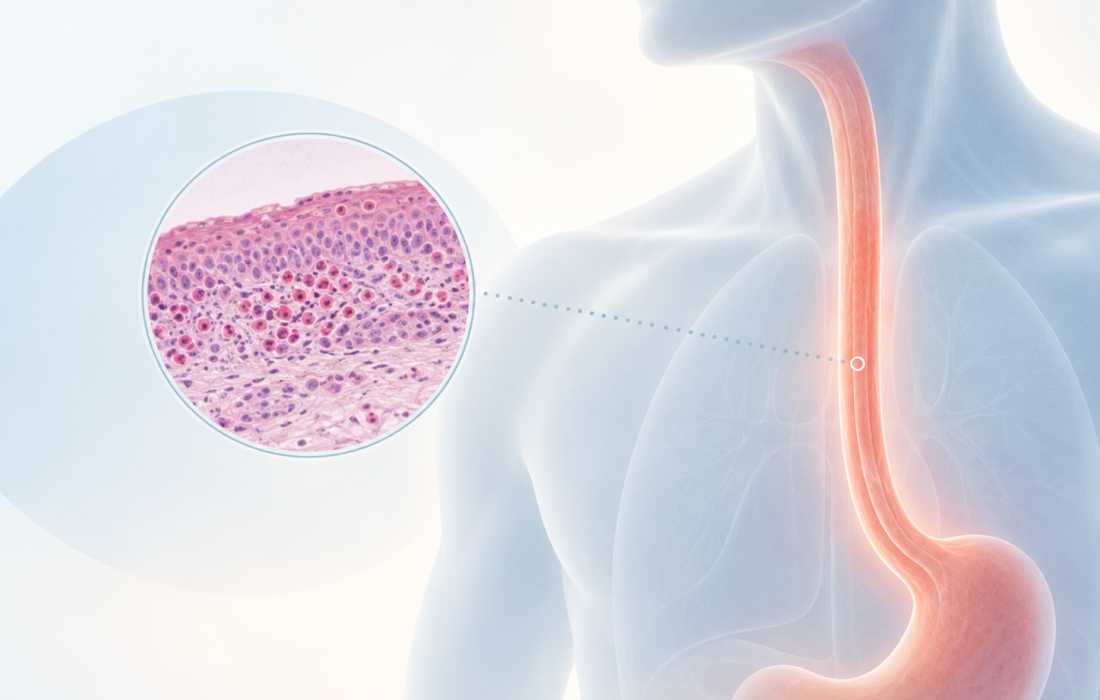
Tezspire met both primary endpoints in the Phase III CROSSING trial, showing histologic remission and sustained symptom and endoscopic improvements in eosinophilic esophagitis.
Written By: Neha Vishwakarma, PharmD
Reviewed By: Pharmacally Editorial Team
AstraZeneca and Amgen reported full results from the Phase III CROSSING trial showing that Tezspire (tezepelumab) improved histologic remission and swallowing symptoms in patients with eosinophilic esophagitis (EoE). The trial met both co-primary endpoints at Week 24, with improvements in histologic and endoscopic outcomes sustained through Week 52. The results were presented at United European Gastroenterology (UEG) Week 2026 in Barcelona, Spain, on October 20, 2026.[1]
The findings support further evaluation of thymic stromal lymphopoietin (TSLP) inhibition in EoE, although the magnitude of symptom improvement differed between doses and requires careful interpretation.
Addressing Unmet Needs in Eosinophilic Esophagitis
EoE is a chronic inflammatory disease of the esophagus characterised by epithelial dysfunction, inflammation and tissue remodelling. Patients commonly experience difficulty or pain when swallowing and food impaction, which can require emergency medical intervention.
The disease affects more than 470,000 people in the United States, according to the companies, and its prevalence has increased substantially since 2009. Current management includes proton pump inhibitors (PPIs), swallowed topical corticosteroids and dietary restriction. Nearly half of patients do not achieve adequate disease control with existing approaches.[1]
Tezspire is a human monoclonal antibody that inhibits TSLP, an epithelial cytokine involved in multiple inflammatory pathways. The drug is approved for severe asthma and chronic rhinosinusitis with nasal polyps in specified markets, but it is not approved for EoE. The US Food and Drug Administration granted it Orphan Drug Designation for EoE in 2021.[1]
CROSSING Trial Design
CROSSING (NCT05583227) was a randomised, double-blind, placebo-controlled Phase III trial involving 368 patients aged 12 to 80 years with symptomatic and histologically active EoE. Participants were assigned to subcutaneous Tezspire 210 mg, Tezspire 420 mg or placebo every four weeks. Patients could continue stable background treatment, including PPIs and swallowed topical corticosteroids.[2]
The co-primary endpoints at Week 24 were histologic remission, defined as a peak esophageal eosinophil count of six or fewer per high-power field, and change from baseline in the Dysphagia Symptom Questionnaire (DSQ). The DSQ measures swallowing symptom frequency and severity on a scale from 0 to 84, with higher scores indicating worse symptoms.
Week 24 Results: Strong Histologic Response, Different Symptom Effects
Histologic remission occurred in 64.8% of patients receiving 210 mg and 68.9% receiving 420 mg, compared with 3.5% receiving placebo. Both comparisons were statistically significant (p<0.001), with absolute treatment differences of 60.5 and 65.8 percentage points, respectively.[1]
DSQ scores decreased by 18.8 points with 210 mg and 22.0 points with 420 mg, compared with 14.7 points with placebo. The treatment differences were −4.1 points for 210 mg (95% CI, −8.1 to approximately 0; p=0.049) and −7.3 points for 420 mg (95% CI, −11.3 to −3.3; p<0.001).
Although the lower-dose result met the conventional statistical significance threshold, its estimated incremental symptom benefit was modest and its confidence interval approached zero. The placebo group’s substantial improvement also highlights the importance of distinguishing within-group symptom changes from treatment effects relative to placebo.
Week 52 Results: Sustained Histologic and Endoscopic Improvement
Histologic remission was maintained in 67.8% of patients receiving 210 mg and 63.3% receiving 420 mg, compared with 5.4% on placebo. DSQ scores decreased by 22.1 and 24.0 points, respectively, versus 13.2 points with placebo; both treatment comparisons were statistically significant (p<0.001).[1]
Endoscopic findings also improved. At Week 52, the EoE Endoscopic Reference Score (EREFS) decreased by 3.9 points with 210 mg and 3.7 points with 420 mg, compared with 0.6 points with placebo. Total endoscopic remission, defined as the absence of assessed visible EoE features, occurred in 34.4% and 29.5% of patients, respectively, versus 4.1% on placebo (p<0.001 for both comparisons).[1]
These results extend the histologic findings by demonstrating improvements in visible esophageal disease features. However, the numerical differences between doses do not establish that either dose is superior, as the reported results do not provide a direct statistical comparison between the treatment groups.
Safety and Regulatory Outlook
The companies reported that Tezspire’s safety profile was consistent with its approved indications. The most frequently reported adverse events were upper respiratory infection (nasopharyngitis), headache and diarrhoea. The public announcement did not provide detailed event frequencies, serious adverse-event rates or discontinuation data, limiting a fuller assessment of safety in this trial.[1]
AstraZeneca said it plans to share the CROSSING results with regulatory authorities. No submission date or approval for EoE has been announced.[1]
Clinical Interpretation
CROSSING provides evidence that TSLP inhibition can produce substantial histologic improvement alongside symptom and endoscopic benefits in EoE. The large treatment-placebo differences in histologic remission and the persistence of improvements through Week 52 strengthen the efficacy signal.
However, the lower dose’s Week 24 symptom difference was marginal, and the clinical importance of the DSQ changes cannot be determined from statistical significance alone. The findings also come from a company-reported trial presentation and require assessment alongside the complete safety dataset and future peer-reviewed publication. Because dupilumab is already approved for EoE, Tezspire’s potential role will depend on regulatory review and evidence establishing its benefit-risk profile, rather than indirect comparisons between separate trials.
References
AstraZeneca. Tezspire positive results from Phase III CROSSING trial in eosinophilic esophagitis including symptom improvement, histologic and endoscopic remission presented at United European Gastroenterology Week. October 20, 2026.
ClinicalTrials.gov. Efficacy and Safety of Tezepelumab in Patients with Eosinophilic Esophagitis (CROSSING). NCT05583227

About the Writer
Neha Vishwakarma (LinkedIn) is a Pharm.D professional with experience in clinical pharmacy, pharmacovigilance, and clinical research. She has hands-on experience in ADR assessment, ICSR processing, medication safety, and clinical data evaluation. Her research background in surgical site infections and antibiotic use supports her focus on evidence-based healthcare writing.