
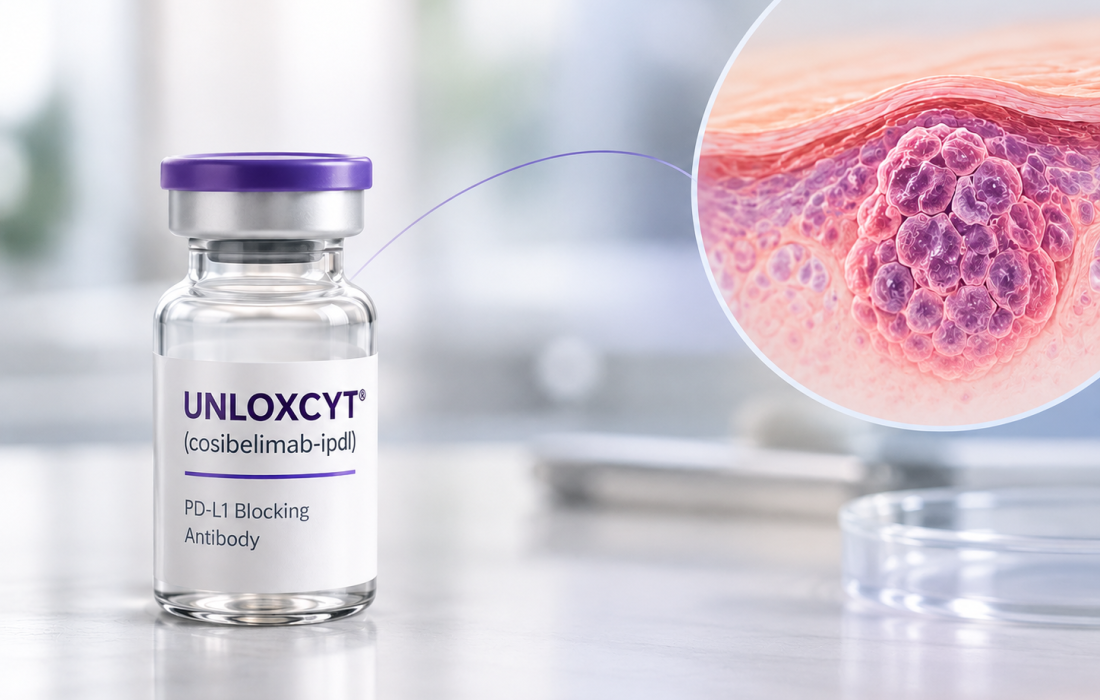
Sun Pharma’s UNLOXCYT gains an NCCN Category 2A preferred recommendation for locally advanced CSCC, expanding its guideline recognition.
Written By: Mayuresh Salvi, PharmD
Reviewed By: Pharmacally Editorial Team
Sun Pharmaceutical announced on October 20, 2026, that UNLOXCYT® (cosibelimab-ipdl) has received a Category 2A preferred recommendation in the updated National Comprehensive Cancer Network (NCCN) Clinical Practice Guidelines for locally advanced cutaneous squamous cell carcinoma (laCSCC). The recommendation applies to adults whose disease cannot be treated with curative surgery or curative radiation.
The update extends UNLOXCYT’s existing Category 2A recommendation for metastatic CSCC (mCSCC), assigned in 2025. The US Food and Drug Administration (FDA) approved cosibelimab-ipdl in December 2024 for adults with metastatic or locally advanced CSCC who are not candidates for curative surgery or radiation. The guideline update is therefore not a new regulatory approval, but an expansion of the drug’s recognition in NCCN treatment guidance.
UNLOXCYT is a programmed death-ligand 1 (PD-L1)-blocking antibody. Sun Pharma describes it as the first and only FDA-approved PD-L1-blocking antibody for advanced CSCC. The recommended dose is 1,200 mg by intravenous infusion over 60 minutes every three weeks.
Pivotal Study Reports Tumour Responses and Durability
The recommendation is supported by evidence from the pivotal CK-301-101 study (NCT03212404), a multicentre, open-label, multicohort Phase 1 study. In the locally advanced cohort, 31 evaluable patients had an objective response rate of 54.8%, including a complete response rate of 25.8%. These results are consistent with the rounded figures of 55% and 26% cited in Sun Pharma’s announcement.
At a median follow-up of 24.1 months, median duration of response had not been reached. The reported range was 8.3 to 31.3 months or longer. This indicates that some responses continued beyond 31.3 months at the time of analysis, although it does not mean that every patient experienced a long-lasting response. Objective response rate includes patients whose tumours achieved either a complete or partial response; complete response refers to the disappearance of detectable disease according to the study’s response criteria.
Sun Pharma also reported that fewer than 1% of patients experienced Grade 3–5 immune-mediated adverse reactions, with no Grade 4 or Grade 5 immune-mediated reactions reported. This is a specific safety measure and should not be interpreted as the incidence of all severe adverse events. The findings may be relevant when assessing treatment options for a population that is often older and may have additional health conditions.
Mechanism and Safety Considerations
Cosibelimab blocks PD-L1, a protein involved in regulating immune responses. Sun Pharma’s proposed mechanism includes restoring adaptive immune activity, engaging innate immunity through antibody-dependent cellular cytotoxicity (ADCC), and preserving PD-L2 signalling, which may contribute to immune tolerance in non-tumour tissues. The mechanistic explanation is based on preclinical evidence and should not be taken as proof that these processes directly account for the clinical outcomes observed.
Despite the low reported incidence of high-grade immune-mediated reactions, UNLOXCYT carries warnings for potentially severe or fatal toxicities affecting multiple organ systems. These include pneumonitis, colitis, hepatitis, endocrinopathies, nephritis and renal dysfunction, and dermatologic reactions. Severe or life-threatening infusion-related reactions may also occur. Prescribing information recommends monitoring liver enzymes, creatinine and thyroid function at baseline and periodically during treatment. Suspected immune-mediated reactions require prompt assessment and management, with treatment interruption or discontinuation guided by severity.
Common adverse reactions reported in at least 10% of patients include fatigue, musculoskeletal pain, rash, diarrhoea, hypothyroidism, constipation, nausea, headache, pruritus, oedema, localised infection and urinary tract infection.
What the Guideline Update Means
NCCN guidelines provide evidence-based recommendations developed by experts and can inform payer coverage policies, prior-authorisation criteria, institutional formularies and clinical pathways. The additional Category 2A recommendation may strengthen consideration of UNLOXCYT for eligible patients with laCSCC. However, the update does not itself guarantee reimbursement, remove access barriers or establish superiority over other treatment options.
The expanded recommendation gives UNLOXCYT guideline recognition in both locally advanced and metastatic CSCC. The locally advanced cohort’s response rate, complete responses and unreached median duration of response support evidence of antitumour activity and potentially durable benefit. The low reported incidence of high-grade immune-mediated reactions is relevant to treatment assessment, but serious toxicities remain possible. These data support consideration in appropriately selected patients, rather than a conclusion that the drug is more effective or safer than alternative therapies.
References
Sun Pharmaceutical Industries Limited. Sun Pharma Announces UNLOXCYT® (cosibelimab-ipdl) Has Received a Category 2A Preferred Designation in the Updated NCCN Guidelines for Locally Advanced Cutaneous Squamous Cell Carcinoma (laCSCC) Patients Who Are Not Candidates for Curative Surgery or Curative Radiation. October 20, 2026.
Phase 1 Study of CK-301 (Cosibelimab) as a Single Agent in Subjects With Advanced Cancers, ClinicalTrials.gov ID NCT03212404

About the Writer
Mayuresh Sunil Salvi (Linkedin) is a PharmD professional and healthcare writer with a strong interest in pharmacovigilance, drug safety, and emerging medical research. He is passionate about exploring new drug discoveries, clinical research, and advances in evidence-based medicine. His interests also include ward rounds, prescription audits, and treatment analysis to support rational pharmacotherapy and improved patient care.