
Tenax’s TNX-103 improved 6-minute walk distance by 26.3 meters in a lower-functioning PH-HFpEF subgroup after the overall LEVEL trial missed its primary endpoint.
Written By: Mayuresh Salvi, PharmD
Reviewed By: Pharmacally Editorial Team
Tenax Therapeutics reported additional Phase 3 data showing that TNX-103 produced a statistically significant improvement in exercise capacity among patients with pulmonary hypertension associated with heart failure with preserved ejection fraction (PH-HFpEF) who entered the LEVEL trial with lower functional capacity.
Among 119 patients with baseline 6-minute walk distance (6MWD) below the trial median of 333 meters, TNX-103 improved 6MWD by 26.3 meters versus placebo at Week 12 (p=0.0112). The subgroup also showed improvements in measures of cardiac stress and pulmonary pressure, strengthening the evidence that levosimendan has biological activity in this population.
The findings were presented in a Late-Breaking Clinical Science session at the European Society of Cardiology (ESC) Congress 2026 in Munich.
PH-HFpEF Has No Disease-Specific FDA-Approved Therapy
PH-HFpEF combines elevated pulmonary pressures with the impaired cardiac function and exercise intolerance associated with HFpEF. The condition is common among older adults with multiple cardiovascular comorbidities and is associated with substantial morbidity.
Despite this burden, no therapy is currently FDA-approved specifically for PH-HFpEF, leaving patients without a disease-targeted treatment option. This unmet need provides important context for the LEVEL findings, particularly as the overall trial did not meet its primary endpoint.
Oral Levosimendan Targets Cardiac and Vascular Dysfunction
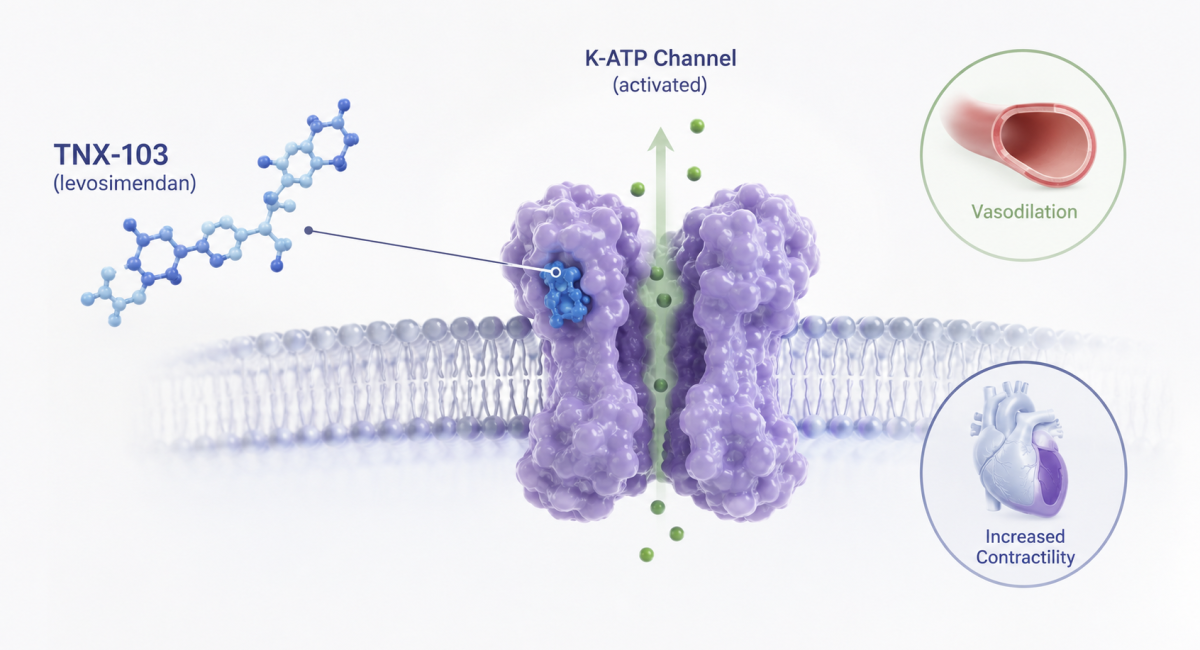
Levosimendan is a K-ATP channel activator and calcium sensitizer that increases cardiac contractility while promoting vasodilation. TNX-103 is Tenax’s oral formulation being developed for PH-HFpEF.
The mechanism could address multiple components of the disease by improving cardiac performance and reducing vascular resistance. In the Phase 2 HELP study (NCT03541603), intravenous and oral levosimendan produced sustained improvements in exercise capacity, quality of life and other clinical measures.
LEVEL Misses Primary Endpoint but Shows Biological Effects
LEVEL (NCT05983250) randomized 241 patients with PH-HFpEF across 41 sites in the United States and Canada. The primary endpoint, change in 6MWD at Week 12, did not achieve statistical significance in the overall population. The key secondary endpoint, change in Kansas City Cardiomyopathy Questionnaire total symptom score (KCCQ-TSS), also failed to reach statistical significance.
However, the prespecified lower-6MWD subgroup showed a clearer functional response. TNX-103 increased 6MWD by 23.7 meters from baseline compared with a 2.6-meter decline with placebo, producing the 26.3-meter treatment difference. KCCQ-TSS improved by 9.8 versus 4.1 points, respectively.
Exploratory analyses of cardiac and pulmonary measures also showed substantial biological effects in the subgroup. RVSP declined by 4.4 mmHg with TNX-103 versus a 0.5 mmHg increase with placebo, a 4.9 mmHg treatment difference (p=0.009). NT-proBNP showed a geometric least-squares mean ratio of 0.53 from baseline with TNX-103, corresponding to a 47% reduction versus placebo (p<0.0001).
NT-proBNP reflects myocardial wall stress and is widely used to assess heart failure severity and prognosis. The company also reported improvements across approximately 20 echocardiographic parameters, including measures spanning multiple domains of cardiac function.
TNX-103 was safe and well tolerated across the overall population, with no significant arrhythmia signal reported.
Subgroup Findings Drive Development Strategy
Principal investigator Sanjiv Shah, MD, said the reductions in NT-proBNP and pulmonary pressure suggest that TNX-103 could have effects beyond improving walking distance. He also highlighted the magnitude of the NT-proBNP reduction relative to findings reported with other heart failure therapies.
Tenax Chief Medical Officer Stuart Rich, MD, said the treatment effect was concentrated among patients with baseline 6MWD below 333 meters. The company intends to use the LEVEL findings to enrich the population enrolled in LEVEL-2 for patients in whom the treatment effect is more clearly demonstrable.
FDA Meeting to Guide LEVEL-2 and Registration Path
The LEVEL results will now feed directly into Tenax’s regulatory planning. The company plans to hold a Type C meeting with the U.S. Food and Drug Administration to discuss incorporating the subgroup findings into the LEVEL-2 protocol and to align on changes to the broader registrational strategy.
LEVEL-2 (NCT07288398) is a Phase 3, double-blind, randomized, placebo-controlled study evaluating TNX-103 in PH-HFpEF. The next development phase will therefore focus on defining a patient population that more closely matches the subgroup in LEVEL where TNX-103 demonstrated its clearest functional benefit, while assessing whether the associated reductions in cardiac stress and pulmonary pressure translate into broader clinical benefit.
Reference

About the Writer
Mayuresh Sunil Salvi (Linkedin) is a PharmD professional and healthcare writer with a strong interest in pharmacovigilance, drug safety, and emerging medical research. He is passionate about exploring new drug discoveries, clinical research, and advances in evidence-based medicine. His interests also include ward rounds, prescription audits, and treatment analysis to support rational pharmacotherapy and improved patient care.