
Syntis Bio reports 28-day Phase 1 data for SYNT-101, showing greater weight loss than placebo and a multi-hormonal satiety response in obesity.
Written By: Mansi Nakum, PharmD
Reviewed By: Pharmacally Editorial Team
Syntis Bio’s 28-day multiple ascending dose (MAD) portion of the Phase 1/1b SYNTIETY-1 study showed that SYNT-101 was well tolerated and produced greater weight loss than placebo across all three dose cohorts in adults with overweight or obesity.
The randomized, double-blind, placebo-controlled MAD portion enrolled 23 participants across three ascending dose cohorts. Participants received SYNT-101 once daily at 857 mg, 1,714 mg, or 2,571 mg, corresponding to one, two, or three tablets.
The company reported no treatment discontinuations or dose reductions at any dose level. Gastrointestinal adverse events occurred at similar rates among SYNT-101-treated participants and those receiving placebo.
SYNT-101 Reproduces a Multi-Hormonal Satiety Response
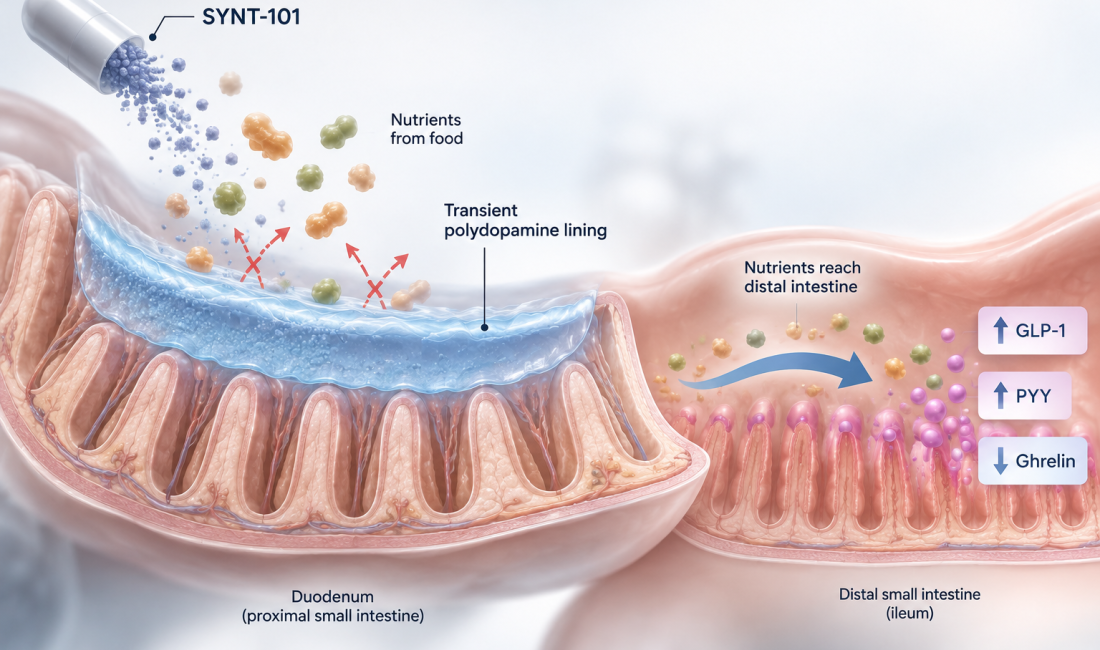
SYNT-101 uses Syntis Bio’s SYNT™ synthetic tissue-lining technology to act locally in the proximal small intestine rather than maintaining systemic drug exposure.
After oral administration, the technology forms a transient polydopamine lining in the duodenum. This temporarily blocks nutrient absorption in the proximal small intestine and redirects nutrients toward the distal intestine, where they can stimulate endogenous hormones involved in satiety and metabolic regulation.
Exploratory pharmacodynamic assessments showed a coordinated hormonal response, including two- to five-fold increases in GLP-1 and peptide YY (PYY), together with a reduction in ghrelin. The company said this pattern is consistent with hormonal changes observed following gastric bypass surgery.
The findings support the proposed mechanism observed previously in the single ascending dose (SAD) portion of SYNTIETY-1. The reported hormone changes should not be interpreted as evidence of sustained increases in circulating hormone levels, as the company has not provided detailed kinetic data in its topline announcement.
Human Weight Loss Findings Remain Early
Participants receiving SYNT-101 lost more weight than those receiving placebo in each of the three dose cohorts during the 28-day treatment period. The company characterized the observed weight loss as comparable with that reported for GLP-1 therapies over a similar treatment duration.
However, the MAD population was small, with only 23 participants, and the company has not disclosed detailed numerical weight-loss data or statistical analyses in the topline announcement. The findings therefore remain early clinical evidence of potential efficacy rather than a basis for direct comparison with approved obesity therapies.
The MAD results build on the SAD portion of SYNTIETY-1, which previously showed tolerability, preliminary weight loss and modulation of metabolic hormones.
Preclinical Lean-Mass Findings Remain Unconfirmed in Humans
Preclinical studies provide additional support for the development program but have not established the same effects in humans. In rodent models, SYNT-101 produced approximately 1% weekly weight loss with reported preservation of lean muscle mass.
These findings remain exploratory preclinical evidence and will require confirmation through body-composition assessments in clinical studies.
Local Gut Action Differentiates the Development Approach
Syntis Bio Chief Development Officer David Rosenbaum said the MAD results reproduced the multi-hormonal response observed in the SAD study while maintaining tolerability across dose cohorts.
CEO Rahul Dhanda emphasized that SYNT-101 differs mechanistically from systemic incretin therapies by triggering endogenous hormone release through local intestinal activity rather than relying on sustained circulating drug exposure.
Whether this approach can produce durable weight loss with a favorable long-term safety profile remains to be established in larger and longer studies.
Phase 2 Planned for 2027
Syntis Bio plans to initiate a Phase 2 study of SYNT-101 in obesity in 2027. Future studies will need to establish the durability and magnitude of weight loss, dose-response relationships, longer-term gastrointestinal and systemic safety, and effects on body composition and metabolic parameters.
Detailed results from the 28-day MAD portion of SYNTIETY-1 are scheduled for a late-breaking presentation at The Obesity Society’s 44th Annual Meeting, Obesity Week 2026, in Washington, DC, from November 14–17, 2026.
Reference
Syntis Bio Reports Phase 1/1b Results Demonstrating Weight-Loss and Satiety Hormone Modulation with Oral SYNT-101 in Patients with Obesity, Syntis Bio, 15 September 2026
A Study of SYNT-101 to Test Safety, Tolerability and Pharmacodynamics of SYNT-101 in Healthy and Overweight Adults, ClinicalTrials.gov ID NCT07307274

About the Writer
Mansi Nakum (Linkedin) is a Pharm.D professional with a strong foundation in clinical pharmacy, evidence-based healthcare writing, and clinical data interpretation.
She has published work on Brugada syndrome and has a keen interest in guideline integration, multimodal therapy, pharmacogenomics, and antibiogram utilization.
As a healthcare writer, she focuses on translating clinical evidence into clear, accurate, and clinically relevant content, while continuously developing her expertise in evolving pharmacy practice.