
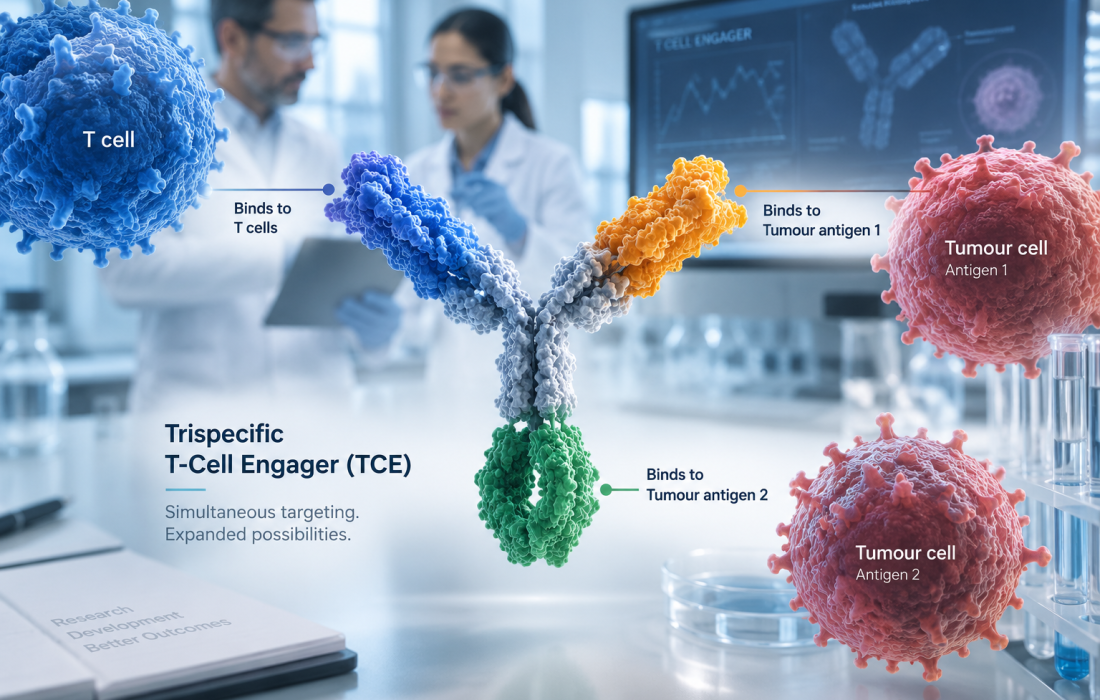
GSK will acquire Chimagen’s trispecific T-cell engager for multiple myeloma, with Phase I clinical development expected to begin in 2027.
Written By: Mayuresh Salvi, PharmD
Reviewed By: Pharmacally Editorial Team
GSK has agreed to acquire global rights to a trispecific T-cell engager (TCE) from Chimagen Biosciences, expanding its multiple myeloma pipeline with a next-generation molecule that simultaneously engages T cells and two tumour-associated antigens. The programme is expected to enter Phase I clinical development in 2027.
Trispecific Approach Targets Two Tumour Antigens
TCEs have produced substantial responses in multiple myeloma by redirecting T cells toward malignant plasma cells. However, treatment can be limited by tolerability challenges associated with immune activation, including cytokine release syndrome and other immune-mediated toxicities.
Chimagen’s investigational trispecific TCE uses a three-target binding strategy. One arm engages T cells, while the other two bind separately to validated tumour-associated antigens. GSK expects this dual-antigen targeting to improve tumour-cell engagement and potentially support deeper and more durable responses while maintaining a more manageable tolerability profile.
The approach could also provide greater flexibility in treatment sequencing if clinical development confirms meaningful efficacy and safety advantages over existing TCEs.
Multiple Myeloma Remains a Significant Unmet Need
Multiple myeloma is the third most common blood cancer globally, with approximately 180,000 new cases diagnosed each year. Although treatment has improved substantially, the disease remains incurable and frequently becomes refractory after successive lines of therapy.
The expanding use of TCEs has created a new treatment class for patients with relapsed or refractory disease, but additional approaches remain important as resistance and treatment-related toxicity can restrict therapeutic options.
The US TCE market for multiple myeloma is projected to exceed $10 billion by 2032, highlighting the commercial significance of differentiated TCE programmes.
Phase I Trial Expected in 2027
The Chimagen programme remains preclinical, with GSK planning to advance the asset into a first-in-human Phase I study in 2027. No clinical efficacy or safety data are currently available for the trispecific candidate.
As a result, the proposed benefits over existing TCEs remain hypotheses that will require validation through clinical development. Early trials will be particularly important for establishing the molecule’s safety profile, dose range, pharmacodynamic activity and preliminary antitumour effects.
The programme will ultimately need to demonstrate whether simultaneous targeting of two tumour antigens can translate into clinically meaningful improvements in response depth, durability and tolerability.
Deal Expands GSK-Chimagen Relationship
GSK’s agreement builds on an existing collaboration with Chimagen. The companies previously agreed to the acquisition of CMG1A46, a clinical-stage dual CD19/CD20-targeted TCE currently being evaluated in Phase I studies for B-cell malignancies and B-cell-dependent autoimmune disorders.
Hesham Abdullah, GSK’s Senior Vice President and Global Head of Oncology R&D, said the new transaction adds another potential option to the company’s multiple myeloma portfolio and supports its broader blood-cancer strategy.
Chimagen CEO Zhenhao Zhou said the agreement combines the company’s Mult specific antibody platform with GSK’s global development and commercial capabilities.
Up to $750 Million in Potential Payments
Under the agreement, GSK will pay an upfront fee for full global rights to the trispecific TCE programme. Chimagen will also be eligible for development and commercial milestone payments.
The transaction has a total potential value of up to $750 million. Closing remains subject to customary conditions.
With Phase I testing targeted for 2027, the next major milestone will be clinical validation of whether the trispecific format can deliver the proposed balance of antitumour activity and tolerability.
Reference
GSK to acquire potential best-in-class T cell-engager (TCE) for multiple myeloma from Chimagen Biosciences, GSK, 15 September 2026

About the Writer
Mayuresh Sunil Salvi (Linkedin) is a PharmD professional and healthcare writer with a strong interest in pharmacovigilance, drug safety, and emerging medical research. He is passionate about exploring new drug discoveries, clinical research, and advances in evidence-based medicine. His interests also include ward rounds, prescription audits, and treatment analysis to support rational pharmacotherapy and improved patient care.