
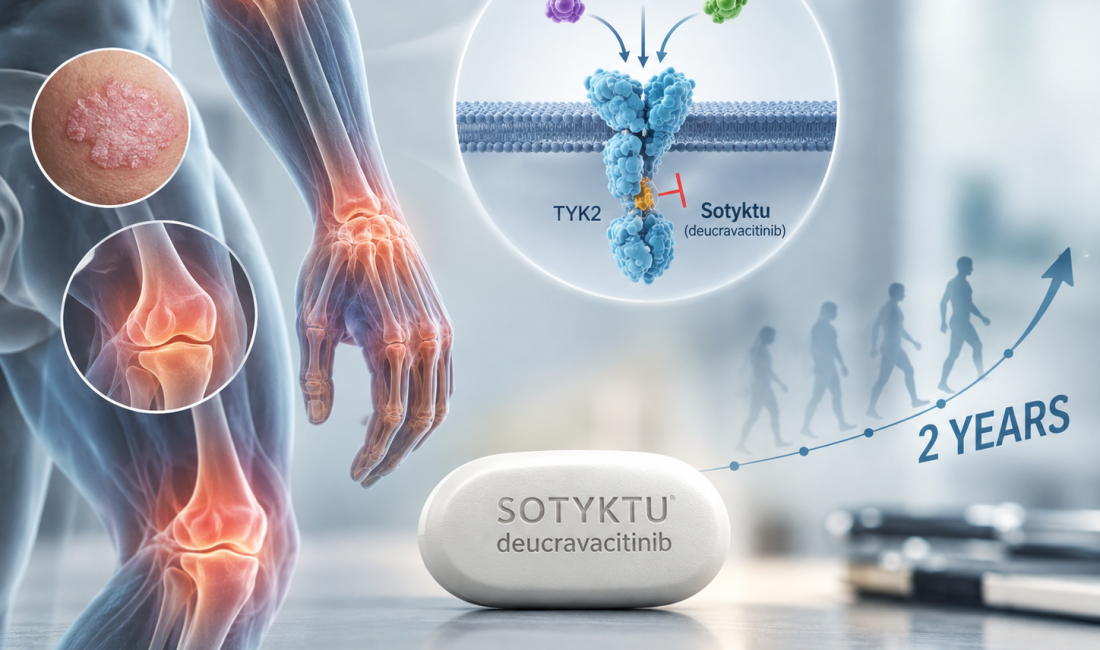
Bristol Myers Squibb reports two-year POETYK PsA-2 data showing sustained Sotyktu efficacy and consistent safety in adults with active psoriatic arthritis.
Written By: Saniya Katakdhond, PharmD
Reviewed By: Pharmacally Editorial Team
Bristol Myers Squibb reported two-year results from the POETYK PsA-2 open-label extension, with Sotyktu (deucravacitinib) maintaining ACR20/50/70 and minimal disease activity responses in adults with active psoriatic arthritis.
Two-Year Efficacy Remains Sustained
The Phase 3 POETYK PsA-2 open-label extension showed sustained clinical responses with once-daily Sotyktu 6 mg in adults with active psoriatic arthritis (PsA). Responses continued to increase from Week 16 through Week 52 and remained generally stable through Week 104.
Among patients who received Sotyktu continuously from the beginning of POETYK PsA-2, observed ACR20, ACR50 and ACR70 response rates at Week 104 were 76.2%, 52.6% and 34.6%, respectively. Using nonresponder imputation (NRI), the corresponding rates were 65.3%, 44.9% and 29.4%.
Minimal disease activity (MDA) was achieved by 51.2% of patients using observed data and 43.7% with NRI.
Patients who initially received placebo and switched to Sotyktu at Week 16 also maintained substantial responses. At Week 104, observed ACR20/50/70 response rates were 76.9%, 54.6% and 37.7%, compared with 69.3%, 49.2% and 33.9% using NRI. MDA rates were 48.7% and 43.7%, respectively.
POETYK PsA-2 Evaluated Broad PsA Activity
PsA is a chronic immune-mediated disease that can involve peripheral joints, entheses, digits, skin and nails. Up to 30% of people with psoriasis develop PsA, and persistent inflammation can contribute to pain, fatigue and impaired physical function.
POETYK PsA-2 enrolled 729 adults with active PsA who were either biologic DMARD-naïve or had previously received a TNF-alpha inhibitor. Patients met CASPAR classification criteria, had at least three swollen and three tender joints, and had active or documented plaque psoriasis.
The randomized, double-blind phase included placebo-controlled treatment through Week 16, followed by treatment reallocation through Week 52. Patients completing 52 weeks could enter an open-label extension receiving Sotyktu 6 mg once daily through Week 156.
Of the 312 patients assigned to continuous Sotyktu and 312 assigned to placebo followed by Sotyktu, 245 and 254, respectively, entered the OLE. An additional 70 of 105 patients in the apremilast-to-Sotyktu group entered the extension.
Selective TYK2 Inhibition Underpins Sotyktu
Deucravacitinib is an oral selective TYK2 inhibitor that binds the regulatory domain of TYK2, producing allosteric inhibition. This suppresses signaling mediated by IL-23, IL-12 and type 1 interferons, cytokine pathways involved in immune-mediated inflammation.
Unlike JAK1, JAK2 and JAK3 inhibitors, Sotyktu does not inhibit these JAK family members at therapeutic doses.
Safety Profile Remained Consistent
Safety findings through Week 104 were consistent with the 52-week PsA-2 results and the established long-term safety experience in psoriasis. No new safety signals emerged.
Across 604 patients with Sotyktu exposure during the cumulative two-year period, adverse events occurred in 86.6%, serious adverse events in 12.6%, and adverse events leading to discontinuation in 7.6%. The most frequently reported adverse events were upper respiratory tract infection, nasopharyngitis and COVID-19.
Next Development Milestones
The two-year findings add longer-term data to the clinical evidence supporting Sotyktu in active PsA following its approval for the indication earlier in 2026.
The POETYK PsA-1 open-label extension is also scheduled for presentation at an upcoming medical meeting. Both PsA trials continue to provide longer-term evidence on efficacy and safety across patients with active PsA, with the extensions planned to follow participants through Week 156.
Reference
Bristol Myers Squibb Presents Sotyktu (deucravacitinib) Data Showing Durable Efficacy, Consistent Safety in Adults with Psoriatic Arthritis Over Two Years, Bristol Myers Squibb, 17 September 2026
A Study to Determine the Efficacy and Safety of Deucravacitinib Compared With Placebo in Participants With Active Psoriatic Arthritis (PsA) Who Are Naïve to Biologic Disease Modifying Anti-rheumatic Drugs or Had Previously Received TNFα Inhibitor Treatment, ClinicalTrials.gov ID NCT04908189

About the Writer
Saniya Sanjay Katakdhond (Linkedin) is a Doctor of Pharmacy professional with hands-on experience in patient case review, clinical documentation, medical record analysis, and patient care.
Her hospital experience has strengthened her understanding of clinical conditions, treatment approaches, and multidisciplinary healthcare practices.
With ICH-GCP certification and a research-oriented approach, she brings clinical insight and attention to detail to healthcare content development.
As a healthcare writer, Saniya focuses on translating clinical knowledge and patient-care experience into clear, accurate, and evidence-informed medical content.