
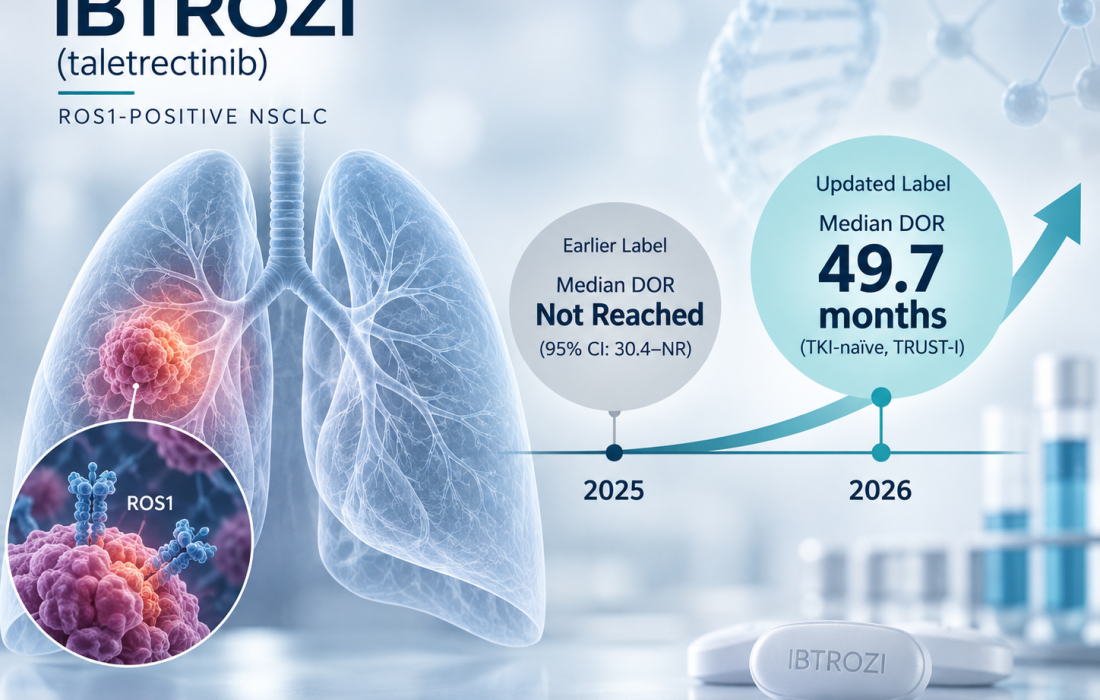
FDA updates the IBTROZI (taletrectinib) label with a 49.7-month median duration of response in TKI-naïve ROS1+ NSCLC patients from TRUST-I.
Written By: Umesh Hanumante,
M.Pharm (Reg. Affairs)
Reviewed By: Pharmacally Editorial Team
The U.S. Food and Drug Administration has approved a supplemental New Drug Application (sNDA) for IBTROZI (taletrectinib), updating its label with longer-term duration-of-response data from the pivotal TRUST-I study in patients with ROS1-positive (ROS1+) non-small cell lung cancer (NSCLC). In TKI-naïve patients, median duration of response reached 49.7 months, with the updated label reflecting more than four years of sustained response.
FDA Label Update Adds Long-Term TRUST-I Data
The approval, secured four months ahead of the drug’s PDUFA date, incorporates an additional 14 months of follow-up from the pivotal TRUST-I and TRUST-II studies, based on an August 2025 data cutoff. TRUST-I had a median follow-up of 51 months.
The FDA did not require changes to the safety sections of the IBTROZI label. Nuvation Bio reported that longer follow-up identified no new safety signals, supporting continued characterization of the treatment’s safety profile.
IBTROZI received full FDA approval on June 11, 2025, for adults with locally advanced or metastatic ROS1+ NSCLC across lines of therapy.
Taletrectinib Targets ROS1-Driven NSCLC
Taletrectinib is an oral, selective, next-generation ROS1 tyrosine kinase inhibitor (TKI) with central nervous system (CNS) activity. ROS1 rearrangements occur in approximately 2% of NSCLC cases and define a molecularly distinct subset of the disease that can respond to targeted ROS1 inhibition.
CNS involvement remains an important clinical challenge. Approximately 35% of patients newly diagnosed with metastatic ROS1+ NSCLC have brain metastases, while the CNS represents a common site of progression in previously treated patients.
The CNS activity of ROS1 inhibitors is therefore clinically relevant, particularly because intracranial disease can limit treatment durability and contribute to progression despite systemic disease control.
TRUST-I Shows Durable Responses
TRUST-I (NCT04395677) is a registrational Phase 2 study evaluating taletrectinib in patients with advanced ROS1+ NSCLC. TRUST-II (NCT04919811) is another Phase 2 single-arm registrational study conducted globally.
Both studies evaluated confirmed objective response rate (cORR) as the primary endpoint, with responses assessed by an independent review committee.
The latest TRUST-I follow-up showed a median duration of response of 49.7 months among TKI-naïve patients. This means that half of responding patients remained in response for at least 49.7 months at the time of analysis, although the median does not predict an individual patient’s treatment duration.
The extended follow-up also showed that some patients remained on treatment for multiple years with continued responses. The updated data were presented at the 2026 American Association for Cancer Research (AACR) Annual Meeting and published in the Journal of Clinical Oncology.
Broader Taletrectinib Development Program
Nuvation Bio continues to evaluate taletrectinib in earlier-stage and additional treatment settings.
TRUST-III (NCT06564324) is a randomized Phase 3 study comparing taletrectinib with crizotinib in 194 patients in China with advanced ROS1+ NSCLC who have not previously received ROS1 TKIs.
TRUST-IV (NCT07154706) is a Phase 3 placebo-controlled study evaluating taletrectinib as adjuvant treatment after resection of early-stage ROS1+ NSCLC. The trial is expected to enroll approximately 180 patients across the United States, Canada, Europe, Japan and China, with disease-free survival as the primary endpoint and primary completion currently estimated for 2030.
Regulatory Expansion Continues
Taletrectinib is also approved for advanced ROS1+ NSCLC in Japan, where Nippon Kayaku markets the drug, and in China, where Innovent Biologics markets it as DOVBLERON.
In Europe, the marketing authorisation application submitted with Eisai was validated by the European Medicines Agency in March 2026 for full approval consideration under the standard review timeline. The UK Medicines and Healthcare products Regulatory Agency validated the corresponding application in June 2026.
With the FDA label now incorporating nearly four years of median response duration in TKI-naïve patients, the updated evidence provides additional long-term clinical data for taletrectinib in advanced ROS1+ NSCLC while ongoing Phase 3 studies assess its role in earlier disease and comparative treatment settings.
Reference
Nuvation Bio Announces FDA Approval of Supplemental New Drug Application for IBTROZI® (taletrectinib) with Updated Duration of Response in TKI-Naïve Advanced ROS1-Positive Non-Small Cell Lung Cancer, Nuvation Bio, 17 September 2026
A Study of AB-106 in Subjects With Advanced NSCLC Harboring ROS1 Fusion Gene, ClinicalTrials.gov ID NCT04395677

About the Writer
Umesh Hanumante (M.Pharm) (LinkedIn) is a pharmacy professional and healthcare writer with a background in Regulatory Affairs, pharmaceutical innovation, and clinical research. He has around two years of industry experience as an Executive PMT at Troikaa Pharmaceuticals Ltd and qualified GPAT 2024. His areas of interest include regulatory compliance, dossier preparation, clinical trials, emerging therapies, and advancements in the global pharmaceutical and healthcare sector.