
SHR-A2102, Hengrui’s nectin-4-directed ADC, showed antitumor activity across advanced solid tumors in a phase 1 trial published in The Lancet Oncology.
Written By: Mayuresh Salvi, PharmD
Reviewed By: Pharmacally Editorial Team
Jiangsu Hengrui Pharmaceuticals’ investigational nectin-4-directed antibody-drug conjugate (ADC) SHR-A2102 showed antitumor activity across multiple pretreated advanced solid tumors in a phase 1 trial published in The Lancet Oncology. The study also identified 6 mg/kg and 8 mg/kg every three weeks for pharmacokinetic expansion, while hematologic toxicities emerged as the most common treatment-related adverse events.
Nectin-4 ADC Uses a Topoisomerase I Payload
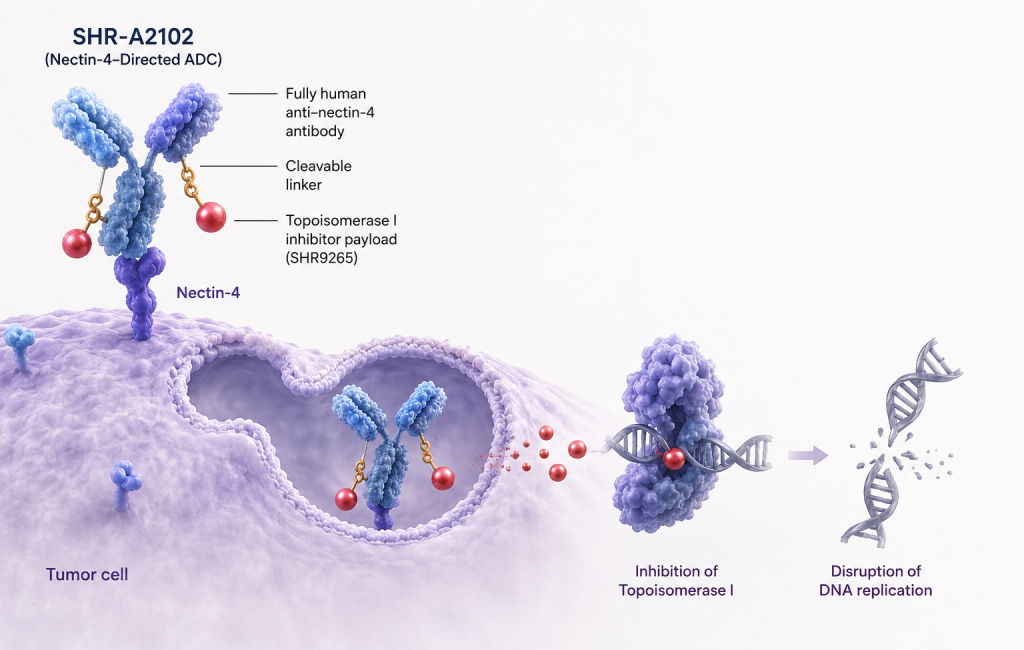
SHR-A2102 combines a fully human nectin-4-directed monoclonal antibody with a cleavable linker and a topoisomerase I inhibitor payload, SHR9265. After binding nectin-4 on tumor cells, the ADC is internalized and releases the cytotoxic payload, which inhibits DNA topoisomerase I and disrupts DNA replication.
The payload differentiates SHR-A2102 from enfortumab vedotin (EV), an established nectin-4 ADC that delivers the microtubule inhibitor MMAE. This distinction is clinically relevant because MMAE-based nectin-4 therapy is associated with adverse events including peripheral neuropathy and skin reactions. The SHR-A2102 study instead showed a toxicity profile dominated by hematologic abnormalities, consistent with its topoisomerase I payload.
Phase 1 Study Enrolled 395 Patients
The multicentre, single-arm phase 1 trial (NCT05701709) was conducted at 39 hospitals in China and included dose escalation, pharmacokinetic expansion and efficacy expansion stages.
Between April 17, 2023, and Feb. 20, 2025, investigators treated 395 patients with unresectable, locally advanced or metastatic solid tumors that had progressed after treatment, were intolerant to available therapy, or had no standard treatment option.
The cohort included 197 patients with non-small-cell lung cancer (NSCLC), 36 with triple-negative breast cancer (TNBC), 32 with hormone receptor-positive, HER2-negative breast cancer, 77 with oesophageal squamous cell carcinoma and 26 with head and neck squamous cell carcinoma.
Patients received intravenous SHR-A2102 at 2–10 mg/kg once every three weeks. The primary endpoints were safety, dose-limiting toxicity, maximum tolerated dose and recommended phase 2 dose.
Responses Seen Across Several Tumor Types
Among 304 patients evaluable for response in earlier trial reporting, SHR-A2102 produced an objective response rate of 35.2% and a disease control rate of 84.2%. Median progression-free survival was 4.7 months among 369 patients in the full analysis set.
Activity was observed across multiple tumor types. The ORR reached 65.0% in hormone receptor-positive, HER2-negative breast cancer, 56.3% in TNBC and 43.5% in EGFR-mutated nonsquamous NSCLC. These responses included one complete response and 106 partial responses, although responses were still subject to confirmation in the reported analysis.
Hematologic Toxicity Dominated the Safety Profile
At the June 20, 2025, data cutoff, median follow-up was 7.2 months.
One dose-limiting toxicity occurred at 10 mg/kg, involving grade 4 decreased platelet count. The maximum tolerated dose was not reached. Investigators selected 6 mg/kg and 8 mg/kg every three weeks for pharmacokinetic expansion, but the published study did not formally establish either dose as the overall recommended phase 2 dose.
Grade 3–4 treatment-related adverse events occurred in 54% of patients. Decreased neutrophil count was reported in 30%, decreased white blood cell count in 19% and anaemia in 17%. Treatment-related serious adverse events occurred in 25%, most commonly pneumonia. Two treatment-related deaths, representing less than 1% of patients, resulted from pulmonary embolism and pneumonia.
Development Continues Across Solid Tumors
The Lancet Oncology findings support continued evaluation of SHR-A2102 as monotherapy and in combination regimens across advanced solid tumors. The ongoing development programme will help determine which tumor types, doses and treatment combinations can best translate the early activity into later-stage clinical benefit.
For now, the phase 1 results establish SHR-A2102 as a differentiated nectin-4 ADC whose TOP1 inhibitor payload produces a distinct toxicity pattern from MMAE-based approaches, while demonstrating activity across a broad pretreated solid-tumor population.
Reference

About the Writer
Mayuresh Sunil Salvi (Linkedin) is a PharmD professional and healthcare writer with a strong interest in pharmacovigilance, drug safety, and emerging medical research. He is passionate about exploring new drug discoveries, clinical research, and advances in evidence-based medicine. His interests also include ward rounds, prescription audits, and treatment analysis to support rational pharmacotherapy and improved patient care.