
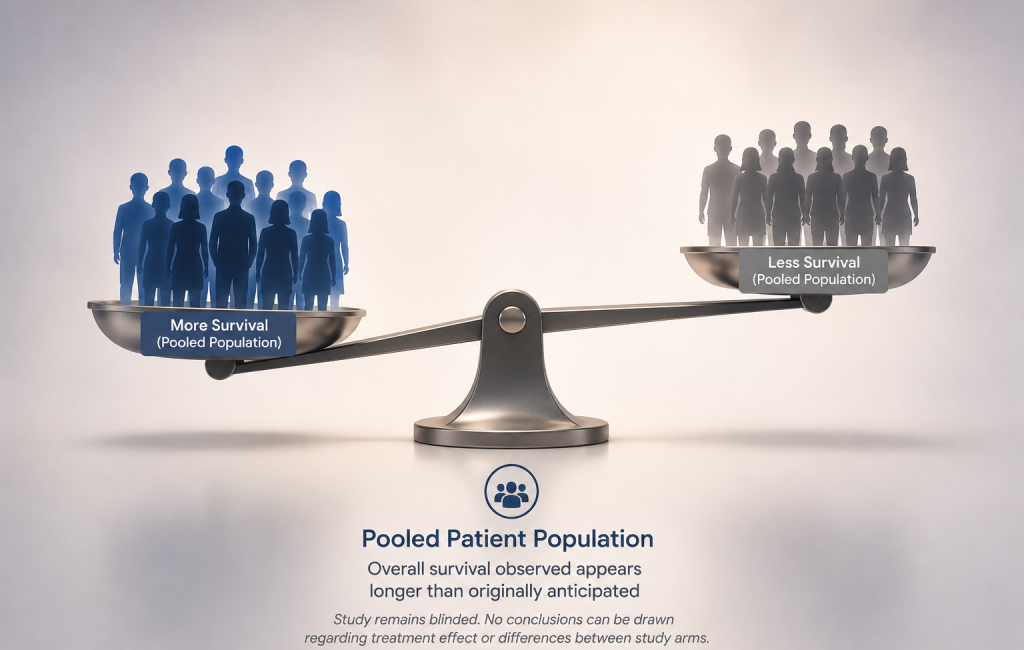
Can-Fite reports longer-than-anticipated overall survival in its blinded Phase III Namodenoson study in advanced hepatocellular carcinoma.
Written By: Kalyani Boharapi,
M.Pharm (Reg. Affairs)
Reviewed By: Pharmacally Editorial Team
Can-Fite BioPharma has reported that overall survival (OS) observed across the pooled patient population in its ongoing pivotal Phase III study of Namodenoson (NCT05201404) in advanced hepatocellular carcinoma (HCC) appears longer than originally anticipated based on original trial design assumptions.
The observation stems from blinded data across the entire study population, prompting the company to evaluate whether the planned interim analysis can be conducted ahead of schedule. Crucially, because the study remains blinded, the observed survival duration cannot currently be attributed to Namodenoson or used to establish a treatment benefit over placebo.
Study Design & Blinded Observations
The pivotal Phase III trial is a randomized, double-blind, placebo-controlled study evaluating oral Namodenoson in patients with advanced HCC and underlying Child-Pugh B7 cirrhosis. Patients are randomized in a 2:1 ratio to receive either Namodenoson or placebo, with OS serving as the primary efficacy endpoint.
Because current data remain pooled across both the investigational and control arms, no definitive conclusions can be drawn regarding drug efficacy or survival variance between the treatment groups.
Evaluation of Accelerated Interim Analysis
In light of the extended survival trend, Can-Fite is assessing an earlier timeline for the planned interim analysis. The unblinded interim evaluation will be conducted independently in accordance with the study’s statistical analysis plan (SAP) and regulatory guidelines to formally compare OS between the Namodenoson and placebo cohorts.
“We are encouraged by the longer overall survival being observed among patients participating in this pivotal study,” stated Motti Farbstein, CEO and CFO of Can-Fite BioPharma. “However, the study remains fully blinded, and these observations do not predict a specific treatment effect. Conducting the planned interim analysis earlier could provide vital clarity regarding the potential clinical benefit of Namodenoson in a patient population with substantial unmet medical need.”
About Namodenoson
Namodenoson is a small-molecule, orally bioavailable agonist that selectively binds with high affinity to the A3 adenosine receptor (). is highly expressed in pathological cells compared to low expression levels in normal tissue—a differential expression profile that may contribute to the drug’s observed safety profile.
Beyond the pivotal Phase III trial in advanced HCC, Can-Fite has completed a Phase IIa study in pancreatic cancer and is actively enrolling patients in a Phase IIb trial evaluating Namodenoson for metabolic dysfunction-associated steatohepatitis (MASH).
Clinical Significance
While the longer-than-anticipated OS observation does not yet constitute evidence of therapeutic efficacy, it marks an important operational milestone for the Namodenoson program. Moving up the interim analysis timeline will allow an independent Data Monitoring Committee to evaluate unblinded comparative data sooner, potentially accelerating clinical clarity for advanced HCC patients with Child-Pugh B7 liver dysfunction.
Reference

About the Writer
Kalyani Boharapi (LinkedIn) is a pharmacy professional and healthcare writer currently pursuing an M.Pharm in Regulatory Affairs at Dr. D. Y. Patil College of Pharmacy, with interests in pharmaceutical regulations, drug development, and healthcare innovation. She has academic exposure to dossier preparation, scientific writing, and regulatory documentation. Kalyani has also completed certification courses in Generative AI, AI in Pharma, and Bioinformatics, and actively participates in pharmaceutical conferences to stay updated with emerging trends and advancements in the healthcare and pharmaceutical industry.