
FDA grants accelerated approval to sevabertinib for first-line HER2-mutant NSCLC after Phase I/II SOHO-01 showed a 75% objective response rate
Written By: Mayuresh Salvi, PharmD
Reviewed By: Pharmacally Editorial Team
The U.S. Food and Drug Administration has granted accelerated approval for oral sevabertinib as a first-line treatment for adults with locally advanced or metastatic non-squamous non-small cell lung cancer (NSCLC) whose tumors carry activating HER2/ERBB2 tyrosine kinase domain (TKD) mutations detected by an FDA-authorized test.
The decision follows FDA Priority Review and Breakthrough Therapy Designation and expands the drug’s U.S. use beyond previously treated HER2-mutant NSCLC.
HER2 mutations occur in approximately 2% to 4% of patients with advanced NSCLC and represent a distinct molecular subset with limited treatment options and generally poor outcomes. The disease also frequently occurs in people who have never smoked, underscoring the importance of molecular testing at diagnosis.
75% Response Rate in Treatment-Naïve Patients
The accelerated approval rests on efficacy data from 69 treatment-naïve patients enrolled in the ongoing Phase I/II SOHO-01 trial (NCT05099172).
Sevabertinib produced an objective response rate (ORR) of 75%, including complete responses in 6% of patients and partial responses in 70%. Among responders, 73% maintained their response for at least six months.
The safety profile remained consistent with earlier findings from the clinical development program. The FDA granted accelerated approval based on ORR and duration of response, making confirmation of clinical benefit an important next step.
That confirmation is being evaluated in the Phase III SOHO-02 trial (NCT06452277), which compares sevabertinib with standard of care in treatment-naïve patients with advanced HER2-mutant NSCLC.
Targeting Mutant HER2
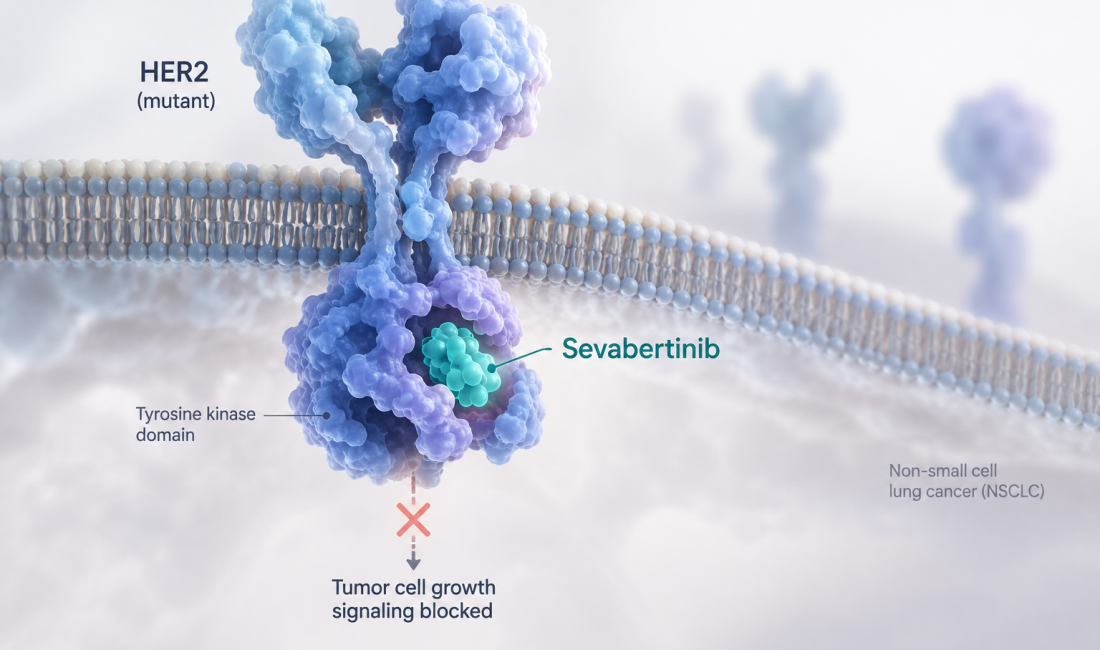
Sevabertinib is an oral, reversible small-molecule tyrosine kinase inhibitor that targets mutant HER2, including HER2 exon 20 insertions and point mutations.
By inhibiting mutant HER2 signaling, the drug interferes with kinase-dependent pathways that support cancer-cell growth. Its reversible mechanism distinguishes it from irreversible HER2 TKIs and provides a pharmacologic approach to selectively suppress mutant HER2 activity.
The program originated from Bayer’s strategic research alliance with the Broad Institute of MIT and Harvard.
Broader Global Development
The new FDA decision builds on sevabertinib’s November 2025 accelerated approval in the U.S. for previously treated patients with advanced HER2-mutant NSCLC, based on SOHO-01 data from patients who had not received HER2-targeted therapy and those previously treated with HER2-directed antibody-drug conjugates.
Sevabertinib has also received regulatory approval in China for adults with unresectable, locally advanced or metastatic NSCLC harboring HER2 activating mutations after one prior systemic therapy, while the UK Medicines and Healthcare products Regulatory Agency (MHRA) approved sevabertinib in April 2026 for adults with advanced NSCLC with HER2 mutations whose disease has progressed following prior treatment. Japan has approved the drug as a targeted therapy that can be used across treatment lines, including first-line therapy.
Beyond NSCLC, the panSOHO study (NCT06760819) is evaluating sevabertinib in patients with metastatic or unresectable solid tumors carrying HER2 activating mutations, excluding advanced NSCLC.
Molecular Testing Becomes More Important
The first-line indication strengthens the clinical relevance of identifying HER2 mutations before treatment begins. Xiuning Le, MD, PhD, the SOHO-01 lead investigator at MD Anderson Cancer Center, emphasized comprehensive molecular testing at diagnosis so patients with activating HER2 mutations can be identified early.
For Bayer, the immediate development priority is the Phase III SOHO-02 confirmatory study. Under the accelerated approval pathway, continued approval may depend on verification and description of clinical benefit in that trial.
Reference
U.S. FDA grants accelerated approval to Bayer’s targeted therapy sevabertinib as a first-line treatment option for adults with HER2-mutant non-small cell lung cancer, Bayer, 09 September 2026

About the Writer
Mayuresh Sunil Salvi (Linkedin) is a PharmD professional and healthcare writer with a strong interest in pharmacovigilance, drug safety, and emerging medical research. He is passionate about exploring new drug discoveries, clinical research, and advances in evidence-based medicine. His interests also include ward rounds, prescription audits, and treatment analysis to support rational pharmacotherapy and improved patient care.