
Roche’s tambotatug pelitecan cut the risk of death by 54% and disease progression or death by 71% versus topotecan in phase III SCLC.
Written By: Anshu Gupta, PharmD
Reviewed By: Pharmacally Editorial Team
Roche’s B7-H3-targeted antibody-drug conjugate tambotatug pelitecan (Tam-Peli, YL201) significantly improved overall survival, progression-free survival, and response rates versus topotecan in patients with relapsed small-cell lung cancer (SCLC), strengthening the case for global development of the investigational therapy.
Tam-Peli delivers significant survival benefit
The phase III TAISHAN-302 trial met its primary overall survival (OS) endpoint, with Tam-Peli reducing the risk of death by 54% compared with topotecan. Median OS reached 13.3 months versus 9.4 months, corresponding to a stratified hazard ratio of 0.46 (95% CI, 0.35–0.62; p<0.0001).
The ADC also produced a substantial progression-free survival advantage, reducing the risk of disease progression or death by 71% (HR 0.29; p<0.0001). Median PFS was 7.4 months with Tam-Peli versus 2.8 months with topotecan.
The randomised, open-label trial enrolled 451 patients across 85 sites in China whose SCLC had progressed after one prior line of platinum-based chemotherapy, with or without a PD-L1 inhibitor.
The benefit extended to patients with brain metastases. Median intracranial PFS was 6.1 versus 4.2 months, while intracranial response rates were 32.4% and 2.9% for Tam-Peli and topotecan, respectively.
B7-H3 ADC uses dual payload release
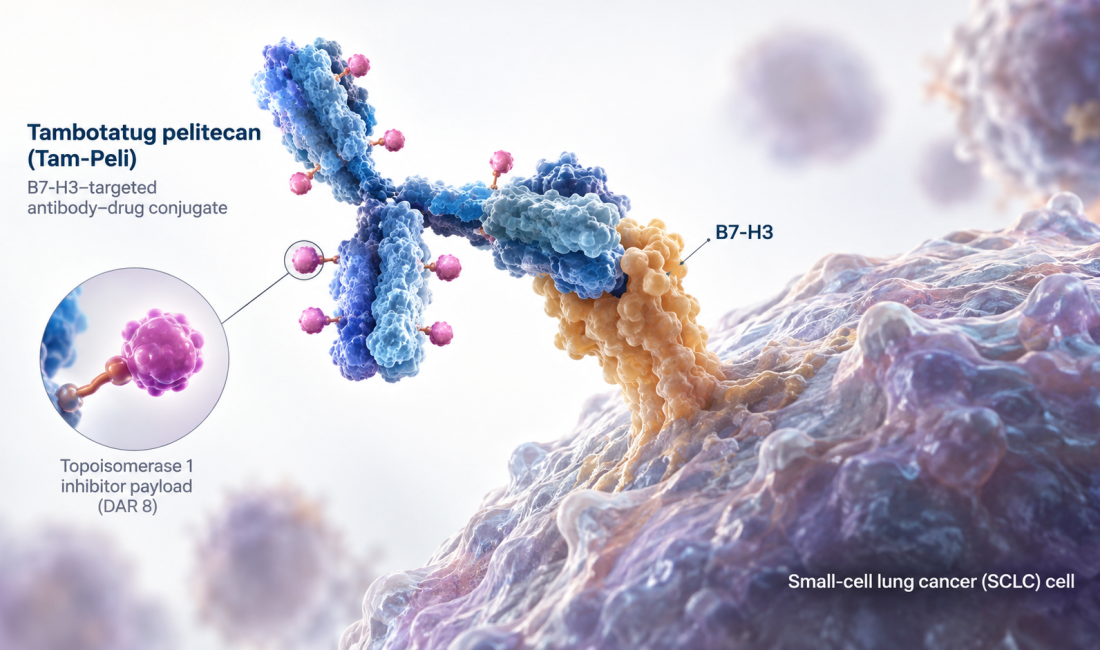
Tam-Peli targets B7-H3, a protein widely expressed across solid tumours but present at relatively low levels in healthy tissues. The ADC couples a B7-H3-specific antibody to a topoisomerase 1 inhibitor payload at a drug-to-antibody ratio of 8.
MediLink Therapeutics developed Tam-Peli using its TMALIN® (Tumour Microenvironment-Activatable Linker) platform. Its hydrophilic linker and dual-release mechanism allow the payload to act both within tumour cells and extracellularly in the tumour microenvironment, potentially extending cytotoxic activity beyond cells directly bound by the ADC.
Manageable safety profile
Tam-Peli produced fewer severe treatment-related adverse events than topotecan. Grade 3 or higher treatment-related adverse events occurred in 46.4% of patients receiving Tam-Peli compared with 74.7% in the topotecan arm. Serious treatment-related adverse events occurred in 25.9% and 36.4%, respectively.
Interstitial lung disease or pneumonitis occurred in 4.9% of Tam-Peli-treated patients versus 1.4% with topotecan. Grade 3 events occurred in 0.9% of patients in each arm, with no grade 4 or grade 5 events reported.
Roche prepares global expansion
Levi Garraway, Roche’s chief medical officer and head of global product development, said the second positive phase III readout for Tam-Peli reinforces the company’s confidence in the programme and supports rapid initiation of global phase III studies.
The TAISHAN-302 results will be presented as a late-breaking abstract at the IASLC 2026 World Conference on Lung Cancer in Seoul and published simultaneously in The New England Journal of Medicine. China’s Center for Drug Evaluation has also accepted the New Drug Application for filing.
The result follows the positive phase III TAISHAN-301 study in nasopharyngeal carcinoma, giving Tam-Peli two positive phase III readouts in China.
Under its January 2026 licensing agreement with MediLink, Roche holds development, manufacturing, and commercialisation rights outside mainland China, Hong Kong, and Macau. The programme spans multiple solid tumours, with global phase III trials planned. Tam-Peli has also received U.S. FDA and China CDE Breakthrough Therapy Designations in relapsed SCLC, alongside additional regulatory designations in nasopharyngeal carcinoma, esophageal squamous cell carcinoma, and pancreatic cancer.
Reference
Roche’s collaborator MediLink announces phase III data for Tam-Peli showing significantly improved overall survival in Chinese patient population with relapsed small-cell lung cancer, Roche, 13 September 2026
A Phase III Study of YL201 in Relapsed Small Cell Lung Cancer(TAISHAN-30), ClinicalTrials.gov ID NCT06612151
A Phase III Study of YL201 in Recurrent or Metastatic Nasopharyngeal Carcinoma (TAISHAN-301), ClinicalTrials.gov ID NCT06629597

About the Writer
Anshu Gupta (LinkedIn) is a PharmD professional and healthcare writer with interests in clinical research, pharmacovigilance, regulatory affairs, and medical writing. She has presented research at academic conferences and completed certifications in Good Clinical Practice (GCP), ICH-GCP, and drug safety. Passionate about clinical trials and evidence-based medicine, she is committed to translating scientific evidence into accurate, reliable, and accessible healthcare content.