
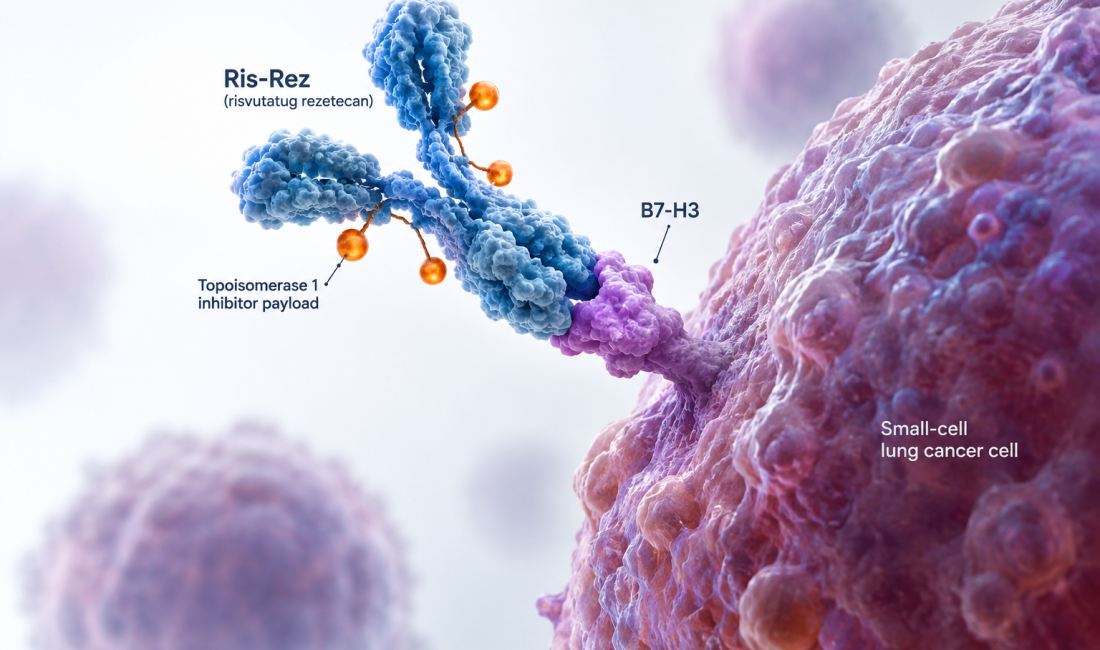
Ris-Rez improved overall survival to 18.5 months versus 10.3 months with topotecan in phase III ARTEMIS-008 for relapsed small cell lung cancer.
Written By: Siddhi Bhadekar, M. Pharm (QA)
Reviewed By: Pharmacally Editorial Team
GSK and Hansoh Pharmaceutical Group reported that the B7-H3 antibody-drug conjugate (ADC) risvutatug rezetecan (Ris-Rez) significantly improved overall survival versus topotecan in patients with relapsed small cell lung cancer (SCLC). Median survival reached 18.5 months with Ris-Rez versus 10.3 months with topotecan, marking the first phase III evidence of an overall survival benefit for a B7-H3 ADC in any tumour type.
Phase III trial delivers a clear survival benefit
The results come from ARTEMIS-008, a multicentre, randomised, open-label phase III trial conducted in China in patients with limited- or extensive-stage SCLC whose disease progressed after first-line platinum-based therapy.
After a median follow-up of 12.2 months, Ris-Rez reduced the risk of death by 54% versus topotecan (HR 0.46; 95% CI, 0.35–0.62; p<0.0001), meeting the trial’s primary endpoint.
The survival advantage was accompanied by consistent improvements in secondary efficacy measures. Independent review committee (IRC)-assessed median progression-free survival was 7.2 months with Ris-Rez versus 3.0 months with topotecan (HR 0.33; 95% CI, 0.25–0.42). The objective response rate was 58.3% versus 12.6%, while disease control rates reached 90.4% and 60.2%, respectively.
The findings were presented in a Presidential Symposium at the 2026 World Conference on Lung Cancer in Seoul.
B7-H3 ADC targets an aggressive cancer
Ris-Rez is an investigational ADC that targets B7-H3, a protein highly expressed across more than 10 solid tumour types. The approach links tumour targeting through the antibody component with delivery of a cytotoxic payload, providing a mechanism for selectively exposing B7-H3-positive tumour cells to anticancer therapy.
SCLC remains particularly difficult to treat because of its rapid growth, early metastatic spread and high rate of relapse. Around 10% to 15% of lung cancers are classified as SCLC, and approximately 70% of patients present with extensive-stage disease. Once SCLC relapses after platinum-based treatment, therapeutic options remain limited and prognosis is poor.
Fewer severe treatment-related adverse events
Ris-Rez also showed a more favourable rate of severe treatment-related adverse events (TRAEs) than topotecan. Grade 3 or higher TRAEs occurred in 60.9% of patients receiving Ris-Rez compared with 78.2% in the comparator arm.
The most frequent grade 3 or higher TRAEs with Ris-Rez were decreased neutrophils, white blood cells, lymphocytes, platelets and haemoglobin. These haematologic toxicities were considered manageable and consistent with the known safety profile of the drug class.
Hesham Abdullah, GSK’s senior vice president and global head of oncology R&D, said the survival findings strengthen the company’s broader development programme for Ris-Rez in SCLC.
Global development moves beyond China
GSK holds exclusive rights to develop and commercialise Ris-Rez outside mainland China, Hong Kong, Macau and Taiwan. The company is evaluating the ADC across lung cancer, prostate cancer and other solid tumours.
Its global EMBOLD programme includes the phase III EMBOLD SCLC-301 trial in relapsed extensive-stage SCLC, with pivotal data expected in 2027. Additional phase III studies are planned in earlier-line SCLC and metastatic prostate cancer.
Ris-Rez has also received orphan drug designations in the US, Japan and EU for SCLC, as well as US Breakthrough Therapy and EMA PRIME designations for relapsed or refractory extensive-stage SCLC.
The ARTEMIS-008 results provide the first phase III validation of B7-H3 ADC activity through an overall survival endpoint, while the ongoing global programme will determine whether that benefit can be reproduced across broader populations and treatment settings.
Reference
Ris-Rez reduced risk of death by 54% versus topotecan in patients with relapsed small cell lung cancer in China, GSK, 13 September 2026
ARTEMIS-008:HS-20093 Compared with Topotecan in Subjects with Relapsed Small Cell Lung Cancer, ClinicalTrials.gov ID NCT06498479

About the Writer
Siddhi Rajendra Bhadekar (Linkedin) is an M.Pharm professional with expertise in medical and scientific writing, literature review, publication writing, and evidence synthesis, supported by four peer-reviewed publications.
She brings working knowledge of ICH-GCP, MedDRA, pharmacovigilance, ADR/AE reporting, clinical data management, and regulatory documentation.
With experience across pharmaceutical R&D, Quality Control, and Quality Assurance, she combines scientific research skills with strong attention to accuracy and detail.
Her background in manuscript development, publication planning, and scientific communication enables her to translate complex healthcare information into clear, reliable content.