
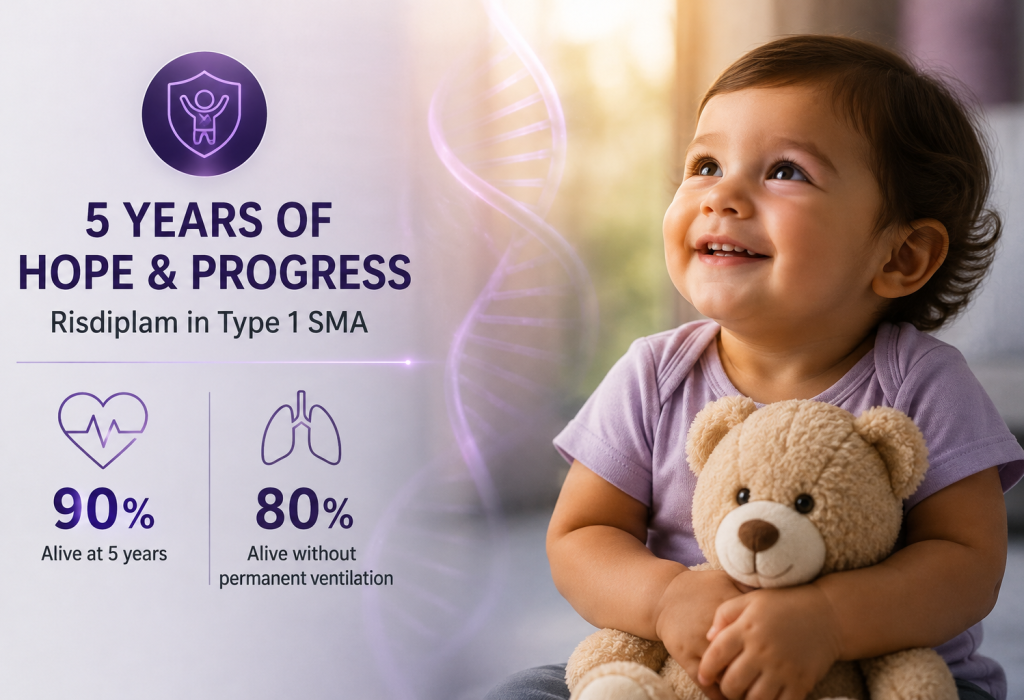
Five-year FIREFISH data show sustained survival, motor function and respiratory outcomes with risdiplam in children with type 1 SMA.
Written by: Mayuresh Salvi, PharmD
Reviewed by: Pharmacally Editorial Team
Five-year results from the phase 2 FIREFISH trial, published in The Lancet Child & Adolescent Health, show sustained survival and functional outcomes in children with symptomatic type 1 spinal muscular atrophy (SMA) treated with risdiplam. Most children remained alive without permanent ventilation, while motor, swallowing and feeding abilities were maintained or improved during long-term treatment.
FIREFISH Evaluated Long-Term Risdiplam Treatment
FIREFISH (NCT02913482) was a multicentre, open-label, two-part phase 2 trial evaluating oral risdiplam in infants aged 1–7 months with genetically confirmed type 1 SMA and two copies of the SMN2 gene.
Part 1 evaluated different doses to assess safety, tolerability, pharmacokinetics and pharmacodynamics and to select the dose for Part 2. Part 2 evaluated the selected dose over 24 months, followed by a three-year open-label extension.
A total of 62 children were enrolled between December 2016 and November 2018. The pivotal-dose population included 58 children, comprising 17 from the high-dose cohort of Part 1 and 41 from Part 2. After two years of treatment, 55 children continued into the three-year extension. The study was completed on December 22, 2023, with 52 children (84%) completing five years of risdiplam treatment.
The final analysis reported survival and event-free survival for all 62 enrolled children, while other five-year efficacy outcomes were assessed in the 58-child pivotal-dose population.
Survival and Respiratory Outcomes at Five Years
After five years of risdiplam treatment, 56 of 62 children (90%) were alive, while 50 (80%) were alive without permanent ventilation.
Among the 58 children in the pivotal-dose population, 17 (29%) required neither invasive nor non-invasive respiratory support at year five. In addition, 13 children (22%) did not require hospitalisation during the study.
These findings extend the earlier FIREFISH results. At one year, 12 of 41 children (29%) in Part 2 had achieved the primary endpoint of sitting without support for at least five seconds, exceeding the prespecified performance criterion based on natural-history data.
At 24 months, 18 of 41 children (44%) could sit without support for at least 30 seconds, while no children had achieved independent standing or walking.
Motor Function Continued to Develop
Motor outcomes showed upward trajectories between years one and five.
At year five, 36 children (62%) could sit without support for at least five seconds, while 34 (59%) could sit without support for at least 30 seconds.
Additional milestones were observed in the pivotal-dose population. Eight children (14%) reached the HINE-2 stable-sitting milestone and 26 (45%) met the HINE-2 pivot milestone. Four children (7%) could stand without support when assessed by both the BSID-III and HINE-2. No children achieved independent walking, although six (10%) reached the HINE-2 cruising milestone.
Mean CHOP-INTEND scores increased from 22.47 at baseline and stabilised at approximately 50 at year five. At that time, 38 children (66%) had scores of at least 40, 29 (50%) had scores of at least 50 and 11 (19%) had scores of at least 60.
Most children also maintained important feeding and swallowing abilities. At year five, 42 children (72%) maintained oral feeding ability and 46 (79%) maintained swallowing ability.
Safety Remained Consistent Over Five Years
The five-year safety profile was consistent with previous FIREFISH analyses. Most adverse events were mild or moderate.
The most frequently reported adverse events were pyrexia (65%), upper respiratory tract infection (63%) and pneumonia (50%). Pneumonia was the most frequent serious adverse event, occurring in 28 children (45%).
No new safety findings were identified during long-term follow-up, and no treatment-related events led to withdrawal from study treatment.
Long-Term Evidence, With Important Study Limitations
The five-year results provide evidence of sustained clinical benefit during continuous risdiplam treatment in symptomatic type 1 SMA. Most children remained alive without permanent ventilation, while several achieved or maintained motor milestones that are not typically observed in untreated children with the disease.
However, FIREFISH was an open-label, single-arm study without a concurrent untreated control group. Historical natural-history cohorts provide important context, particularly for the earlier efficacy analyses, but comparisons with historical controls cannot establish the same level of causal certainty as randomized controlled comparisons.
The five-year findings therefore support the durability of clinical outcomes observed during risdiplam treatment but should not be interpreted as evidence from a randomized comparison with untreated disease.
Together, these results provide evidence of sustained efficacy and safety with long-term risdiplam treatment in children with symptomatic type 1 SMA.
References
About the Writer
Mayuresh Sunil Salvi (Linkedin) is a PharmD professional and healthcare writer with a strong interest in pharmacovigilance, drug safety, and emerging medical research. He is passionate about exploring new drug discoveries, clinical research, and advances in evidence-based medicine. His interests also include ward rounds, prescription audits, and treatment analysis to support rational pharmacotherapy and improved patient care.