
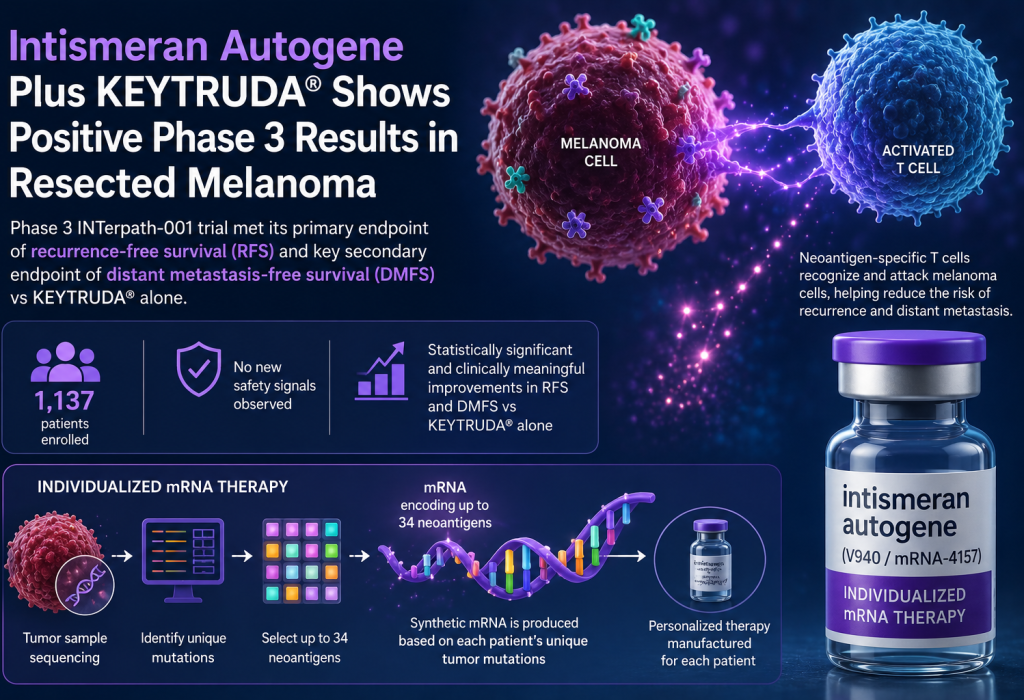
Merck and Moderna report positive Phase 3 INTerpath-001 results for intismeran plus KEYTRUDA, improving recurrence-free and distant metastasis-free survival in resected stage IIB-IV melanoma.
Written By: Anamika Koshti, PharmD
Reviewed By: Pharmacally Editorial Team
Merck and Moderna have announced positive topline results from the Phase 3 INTerpath-001 trial (NCT05933577), evaluating intismeran autogene (intismeran; V940 or mRNA-4157) in combination with KEYTRUDA (pembrolizumab) as adjuvant therapy for patients with completely resected stage IIB-IV cutaneous melanoma.
At a pre-specified interim analysis, the combination met the trial’s primary endpoint of recurrence-free survival (RFS) and a key secondary endpoint of distant metastasis-free survival (DMFS), demonstrating statistically significant and clinically meaningful improvements compared with KEYTRUDA alone. The companies described the findings as the first positive Phase 3 readout for an individualized neoantigen therapy and an mRNA-based cancer therapy.
Intismeran is designed around each patient’s tumor
Intismeran autogene is an investigational mRNA-based individualized neoantigen therapy jointly developed by Merck and Moderna. The treatment is designed using a patient’s tumor sample to identify the unique mutational signature of their cancer and generate an individualized immune response.
Each therapy consists of synthetic mRNA encoding up to 34 neoantigens selected according to the patient’s tumor biology. Following administration, the RNA-encoded sequences are translated in the body and presented to the immune system, helping generate specific T-cell responses against cancer cells.
This approach is intended to train and activate the immune system against tumor-specific mutations rather than relying solely on a standardized, off-the-shelf treatment.
INTerpath-001 tested the combination after complete tumor resection
INTerpath-001 is a randomized, double-blind, placebo- and active-comparator-controlled global Phase 3 trial that enrolled 1,137 patients with high-risk, completely resected stage IIB-IV cutaneous melanoma who had not undergone prior systemic therapy.
Following surgery, patients were randomized 2:1 to receive intismeran plus KEYTRUDA or KEYTRUDA alone. The investigational group received intismeran at 1 mg every three weeks for up to nine doses together with KEYTRUDA 400 mg every six weeks for up to nine cycles. Treatment continued for approximately one year, or until disease recurrence or unacceptable toxicity, with a maximum treatment duration of approximately 56 weeks.
The primary endpoint was RFS, defined as the time from randomization to disease recurrence or death from any cause. Key secondary endpoints include DMFS, overall survival (OS), safety, tolerability and quality of life.
Phase 3 results show significant improvements in RFS and DMFS
At the interim analysis, intismeran plus KEYTRUDA produced statistically significant and clinically meaningful improvements in both RFS and DMFS compared with KEYTRUDA alone.
The companies have not disclosed detailed numerical efficacy results from INTerpath-001 in the topline announcement, including hazard ratios, confidence intervals or median survival estimates. Full data are expected to be presented at an upcoming international medical meeting.
The study will continue as planned to evaluate additional key secondary endpoints, including OS.
Findings build on five-year Phase 2b data
The Phase 3 results build on previously reported findings from the Phase 2b KEYNOTE-942/mRNA-4157-P201 trial (NCT03897881) in patients with high-risk stage III-IV melanoma following complete resection.
Five-year follow-up data presented at the 2026 ASCO Annual Meeting showed that intismeran plus KEYTRUDA reduced the risk of recurrence or death by 49% compared with KEYTRUDA alone (HR 0.51; 95% CI, 0.294-0.887). The combination also reduced the risk of distant metastasis or death by 59% (HR 0.411; 95% CI, 0.200-0.843).
No new safety signals reported as regulatory discussions begin
The safety profile of intismeran plus KEYTRUDA in INTerpath-001 was consistent with previously reported studies of the combination, with no new safety signals observed.
Merck and Moderna plan to present the detailed Phase 3 findings at an upcoming international medical meeting and engage with regulatory authorities regarding filing submissions for intismeran in combination with KEYTRUDA.
The broader INTerpath development program currently includes nine Phase 2 and Phase 3 trials evaluating intismeran across multiple tumor types and disease stages, including melanoma, non-small cell lung cancer, bladder cancer and renal cell carcinoma, with additional early-stage studies in pancreatic, gastric and lung cancers.
For patients with completely resected melanoma who remain at risk of recurrence, the INTerpath-001 findings support further evaluation of an individualized neoantigen approach in the adjuvant setting. However, intismeran remains investigational, and regulatory review and additional follow-up, including overall survival data, will be important in determining its potential role in clinical practice.
References

About the Writer
Anamika Koshti (LinkedIn) is a PharmD professional and healthcare writer with interests in clinical research, pharmacovigilance, and evidence-based medicine. She has authored peer-reviewed publications on Alzheimer’s disease and PCOS, presented research at national conferences, and gained hands-on experience in medical content development and clinical data interpretation. She is committed to translating complex medical research into accurate, accessible content for healthcare professionals and patients.