
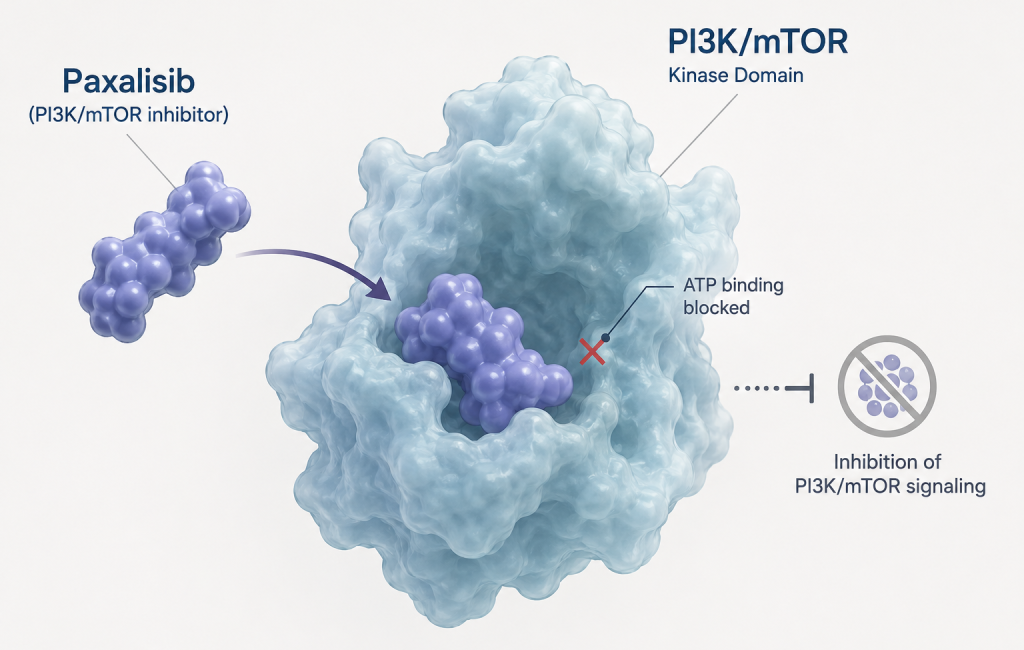
Kazia reports early clinical responses and immune biomarker changes with paxalisib in advanced metastatic triple-negative breast cancer.
Written By: Mayuresh Salvi, PharmD
Reviewed By: Pharmacally Editorial Team
Kazia Therapeutics has reported new clinical and translational data from its ongoing Phase 1b study of paxalisib in patients with advanced metastatic triple-negative breast cancer (TNBC), with all six evaluable patients demonstrating clinical benefit.
Five of the six patients achieved objective responses, including one complete response and four partial responses, while the remaining patient achieved stable disease. This resulted in an objective response rate (ORR) of 83% and a company-reported clinical benefit rate of 100%.
The responses were observed across multiple metastatic sites, including the lung, liver, bone, lymph nodes and central nervous system, with responses emerging as early as approximately three months after randomization.
Durable Complete Metabolic Response
One 44-year-old woman with Stage IV TNBC achieved a complete metabolic response and has had no evidence of disease since November 2025. Her response remained durable through the latest assessment reported by Kazia.
The response was accompanied by sustained and complete abolishment of circulating tumor cell (CTC) clusters, a significant reduction in terminally exhausted CD8+ T cells and overall improvement in markers of immune function. Kazia had previously reported that this patient had received pembrolizumab and chemotherapy before receiving paxalisib-based treatment under an expanded-access protocol.
Immune and Metastatic Biomarker Changes
Translational analyses showed reductions in terminally exhausted CD8+ T cells across all six evaluable patients, with a median reduction of 51% within approximately three weeks of treatment. Total CD8+ T-cell counts remained unchanged.
According to Kazia, this pattern suggests that paxalisib may be affecting the functional state of existing immune cells rather than simply depleting the broader CD8+ T-cell population. Blood-based multimodal protein, RNA and plasma profiling also showed increases in immune-cell populations associated with antitumor activity, reductions in immune exhaustion markers and evidence of PI3K-AKT pathway target engagement.
In parallel, all six patients demonstrated reductions in CTC clusters, with a median reduction of 83% within six to seven weeks of treatment. CTC clusters are associated with metastatic dissemination.
Kazia said the simultaneous changes in exhausted T cells and CTC clusters provide early evidence that paxalisib may influence biological mechanisms associated with both treatment resistance and metastasis. The company described the findings as potentially representing a first-in-class effect and hypothesized that paxalisib may exert a dual influence by restoring immune function and reducing metastatic dissemination.
These mechanistic interpretations remain investigational and will require validation in larger patient populations.
Safety and Path Forward
No paxalisib-related serious adverse events were observed among the six evaluable patients. In addition, no Grade 3 or higher hyperglycemia, stomatitis or mucositis was reported, adverse events commonly associated with PI3K/mTOR pathway inhibition.
The findings come from an ongoing Phase 1b study evaluating paxalisib in combination with pembrolizumab (Keytruda) and chemotherapy in advanced metastatic TNBC. The study is an early-stage clinical investigation, and the current efficacy and biomarker findings are based on only six evaluable patients.
Kazia expects enrollment in the Phase 1b study to be completed by July 2027, with interim clinical updates anticipated throughout 2026 and 2027.
The next datasets will be important in determining whether the observed tumor responses and accompanying immune and CTC changes can be reproduced in a larger patient population and whether these biological changes translate into durable clinical benefit.
Reference

About the Writer
Mayuresh Sunil Salvi (Linkedin) is a PharmD professional and healthcare writer with a strong interest in pharmacovigilance, drug safety, and emerging medical research. He is passionate about exploring new drug discoveries, clinical research, and advances in evidence-based medicine. His interests also include ward rounds, prescription audits, and treatment analysis to support rational pharmacotherapy and improved patient care.