
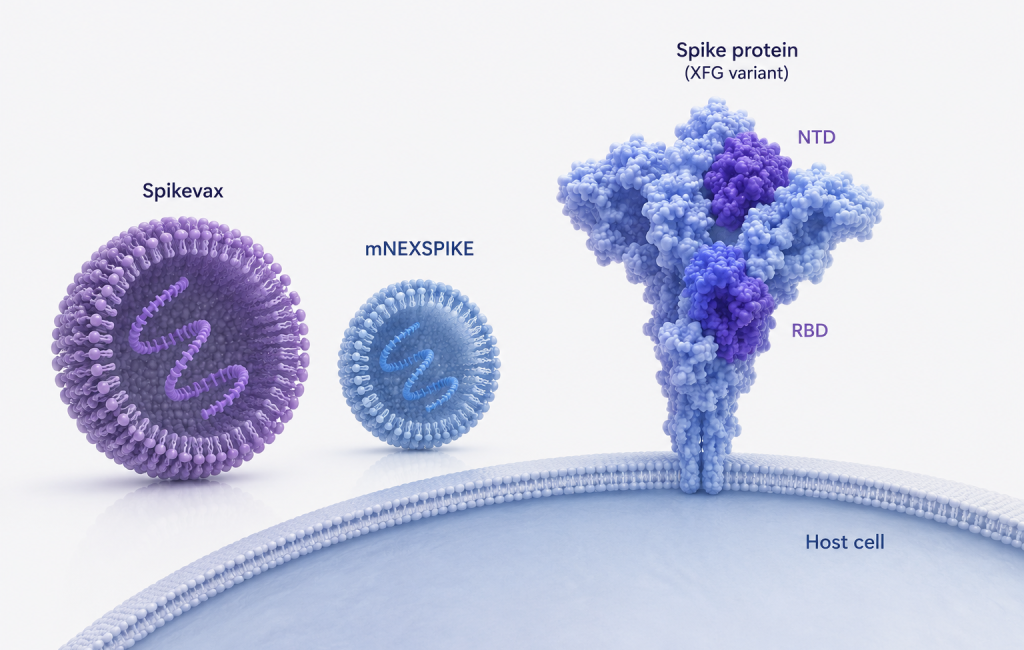
Moderna wins FDA approval for updated Spikevax and mNEXSPIKE COVID-19 vaccines targeting the XFG subvariant for the 2026-2027 season.
Written By: Anshu Gupta, PharmD
Reviewed By: Pharmacally Editorial Team
Moderna has received U.S. FDA approval for updated 2026-2027 formulations of Spikevax and mNEXSPIKE, both containing a monovalent JN.1-lineage XFG SARS-CoV-2 composition. The approvals cover adults 65 years and older and younger people at high risk of severe COVID-19, with U.S. availability expected in the coming days.
FDA Clears Updated XFG Formulations
The FDA approved supplemental Biologics License Applications for the updated vaccines on August 27, 2026, ahead of the 2026-2027 respiratory virus season.
Spikevax is approved for individuals 6 months through 64 years of age who have at least one underlying condition associated with a high risk of severe COVID-19, as well as all adults 65 years and older. mNEXSPIKE is approved for people 12 through 64 years with at least one underlying high-risk condition and for all adults 65 years and older.
The updated formulations use a monovalent XFG antigen in line with FDA guidance issued after its May 2026 advisory committee review. The agency considered variant circulation, vaccine effectiveness, human and animal immunogenicity, and antigenic characterization before recommending XFG as the preferred strain for the 2026-2027 season.
XFG Becomes the Target for the New Season
XFG is a recombinant SARS-CoV-2 subvariant within the JN.1 lineage that emerged through recombination involving earlier viral lineages. It became a dominant circulating variant in the United States, supporting the need to update vaccine composition as the virus continues to evolve.
Importantly, FDA’s decision was based on the totality of available evidence, rather than a single measure of immune escape. The agency concluded that a monovalent JN.1-lineage XFG vaccine would provide a closer antigenic match to circulating SARS-CoV-2 viruses.
mNEXSPIKE Uses a Different Antigen Design
mNEXSPIKE, also known as mRNA-1283, differs from Spikevax in both its mRNA dose and antigen design.
The next-generation vaccine uses 10 micrograms of mRNA, compared with 50 micrograms for Spikevax, and encodes the spike protein’s N-terminal domain and receptor-binding domain rather than the full-length spike. This distinct design is part of Moderna’s effort to develop a more streamlined mRNA vaccine platform with different formulation and storage characteristics.
The FDA’s May 2026 materials identify mNEXSPIKE and Spikevax as separate licensed Moderna COVID-19 vaccines with distinct antigen constructs and indications.
Pfizer and BioNTech Also Receive FDA Approval
Moderna’s regulatory milestone comes alongside a parallel U.S. approval for Pfizer and BioNTech’s updated Comirnaty XFG vaccine.
The FDA cleared the 2026-2027 formulation for adults 65 years and older and people 5 through 64 years with at least one underlying condition associated with high risk of severe COVID-19. Pfizer and BioNTech said shipments would begin immediately.
The parallel approvals establish XFG as the central target for the leading updated mRNA COVID-19 vaccines entering the U.S. market for the new season.
Global Rollout
The 2026-2027 Spikevax formulation has already received regulatory approval in Europe, South Korea, Singapore, Switzerland, the United Kingdom and other markets, while the updated mNEXSPIKE formulation has been approved in Japan.
Moderna expects the newly approved U.S. vaccines to become available in the coming days, while additional international regulatory applications remain under review. The company will also continue to track SARS-CoV-2 evolution and vaccine performance as the 2026-2027 season progresses
Reference
Moderna Receives U.S. FDA Approval for Updated 2026-2027 COVID-19 Vaccines

About the Writer
Anshu Gupta (LinkedIn) is a PharmD professional and healthcare writer with interests in clinical research, pharmacovigilance, regulatory affairs, and medical writing. She has presented research at academic conferences and completed certifications in Good Clinical Practice (GCP), ICH-GCP, and drug safety. Passionate about clinical trials and evidence-based medicine, she is committed to translating scientific evidence into accurate, reliable, and accessible healthcare content.