
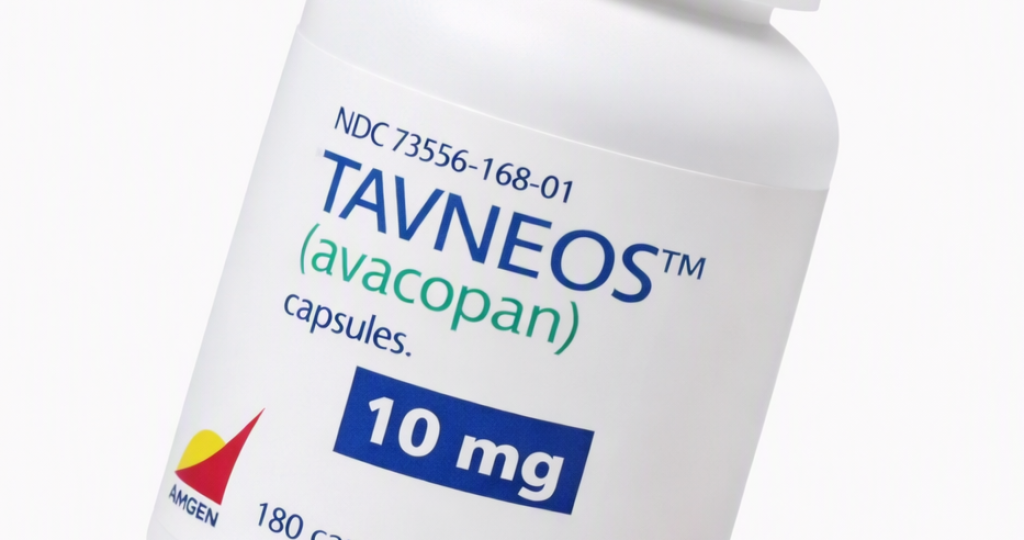
Amgen files clinical data, real-world evidence, and trial re-analyses to support TAVNEOS (avacopan) safety and efficacy ahead of an FDA withdrawal hearing.
Written By: Kirti Kumbhar, M. Pharm (QA)
Reviewed By: Pharmacally Editorial Team
Amgen has formally submitted additional scientific data and analyses to the U.S. Food and Drug Administration in support of its request for a hearing over the agency’s proposal to withdraw TAVNEOS (avacopan) from the U.S. market. The submission, filed on July 23, 2026, brings together updated clinical analyses, real-world evidence, post-marketing safety findings, and patient experience data that the company says collectively support continued access to the complement C5a receptor inhibitor for patients with severe active ANCA-associated vasculitis (AAV).
Scientific and Clinical Context
TAVNEOS is approved in the United States as an adjunct to standard therapy for adults with severe active granulomatosis with polyangiitis (GPA) and microscopic polyangiitis (MPA), the two major forms of AAV. By blocking the complement C5a receptor, avacopan reduces neutrophil activation and vascular inflammation while allowing patients to reduce exposure to long-term corticosteroids.
AAV is a rare autoimmune disease that can rapidly damage the kidneys, lungs, nerves, skin, and other organs. Approximately 80% to 90% of patients present with kidney- or other organ-threatening disease. Long-term corticosteroid therapy remains a major source of treatment-related toxicity, making steroid-sparing strategies an important clinical objective.
New Evidence Submitted to the FDA
A central component of Amgen’s submission is an independent, blinded 2026 re-adjudication of the Phase 3 ADVOCATE trial conducted by the Duke Clinical Research Institute. The analysis confirmed noninferiority of TAVNEOS versus a prednisone taper for remission at Week 26 and showed numerically higher sustained remission at Week 52, although superiority was not demonstrated in the re-analysis. Patients receiving TAVNEOS also experienced substantially lower glucocorticoid exposure than those receiving prednisone taper therapy.
The company also highlighted a systematic review and meta-analysis of 71 real-world studies involving more than 2,200 patients. Across these studies, remission rates reached 87% at six months and 93% at 12 months, while sustained remission at one year reached 86%. Investigators also reported improved kidney function, reduced steroid use, and liberation from dialysis in many patients previously dependent on renal replacement therapy.
Safety findings remained generally consistent with the known profile of avacopan. Hepatotoxicity and serious liver injury were identified, particularly among older patients in Japan, reinforcing the importance of routine liver function monitoring. These observations contributed to updated U.S. prescribing information that took effect in May 2026.
Executive Perspective
Amgen maintains that TAVNEOS satisfies the statutory standard for substantial evidence of effectiveness and continues to offer a favorable benefit-risk profile for appropriately selected patients. The company argues that the FDA should consider the complete body of evidence, including randomized clinical trial data, independent re-analysis, post-marketing safety surveillance, real-world outcomes, and patient experience before reaching a final regulatory decision.
Amgen also supported its submission with patient and advocacy statements describing the burden of long-term corticosteroid use. Patients living with severe active GPA reported that reducing steroid exposure improved their quality of life and lessened treatment-related complications, while a rare disease advocacy representative argued that preserving steroid-sparing treatment options remains important for individualized patient care. The FDA will weigh these perspectives alongside the clinical and safety evidence during the hearing process.
Regulatory Path Forward
The FDA hearing will determine whether TAVNEOS remains available in the United States for patients with severe active GPA and MPA. Amgen plans to present its full scientific case during the proceedings while emphasizing the limited treatment options available for this rare, life-threatening disease. The outcome could influence not only the future of TAVNEOS but also broader regulatory discussions on the role of real-world evidence and post-marketing data in maintaining approvals for rare disease therapies.
Reference
Amgen Statement on FDA Data Submission for TAVNEOS® (avacopan) | Amgen

About the Writer
Kirti Kumbhar (LinkedIn) is an M.Pharm graduate with experience in Quality Assurance at Lupin Limited and a strong interest in clinical research, regulatory affairs, and Trial Master File (TMF) management. She has developed knowledge of regulatory documentation, quality systems, compliance, and healthcare research through her professional experience. Passionate about clinical development and continuous learning, Kirti is committed to supporting high-quality healthcare documentation, regulatory excellence, and research-driven healthcare advancements.