
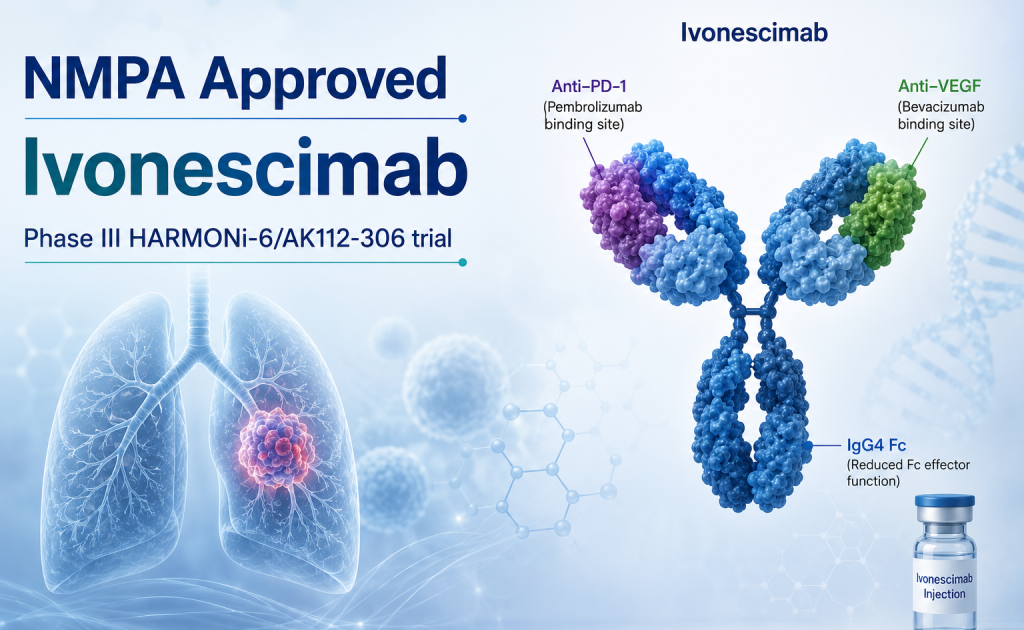
China’s NMPA approves ivonescimab plus chemotherapy for first-line advanced squamous NSCLC after Phase III HARMONi-6 showed significant PFS and OS benefits.
Written By: Siddhi Bhadekar, M. Pharm (QA)
Reviewed By: Pharmacally Editorial Team
China’s National Medical Products Administration has approved ivonescimab injection in combination with chemotherapy for the first-line treatment of advanced sq-NSCLC, giving the PD-1/VEGF bispecific its third lung cancer indication in China.
The supplemental New Drug Application was supported by results from the Phase III HARMONi-6/AK112-306 trial (NCT05840016), in which ivonescimab plus chemotherapy significantly improved both progression-free survival (PFS) and overall survival (OS) compared with tislelizumab plus chemotherapy.
The approval strengthens ivonescimab’s position in a lung cancer setting where treatment options remain limited, particularly for patients with low PD-L1 expression or substantial metastatic disease.
PD-1 and VEGF Targeting in One Bispecific
Ivonescimab is a bispecific antibody that targets PD-1 and vascular endothelial growth factor (VEGF), combining immune checkpoint blockade with VEGF pathway inhibition in a single molecule.
The approach is intended to address two complementary drivers of tumor progression. PD-1 blockade restores antitumor T-cell activity, while VEGF inhibition can alter the tumor microenvironment and suppress angiogenic signaling that supports tumor growth.
The HARMONi-6 results provide clinical evidence that this dual-target strategy can improve outcomes beyond PD-1 inhibition plus chemotherapy in first-line sq-NSCLC.
HARMONi-6 Shows Dual PFS and OS Benefit
HARMONi-6 enrolled 532 patients with advanced sq-NSCLC. About 63% had centrally located squamous tumors, 39.0% had PD-L1 tumor proportion score below 1%, and 33.8% had multi-site metastases, liver metastases, or brain metastases.
Ivonescimab plus chemotherapy reduced the risk of death by 34% versus tislelizumab plus chemotherapy, with a hazard ratio of 0.66 (95% CI, 0.50-0.87; P=0.0017). Median OS reached 27.9 months compared with 23.7 months in the control group.
The 12-month OS rate was 78.9% versus 72.2%, while the 24-month OS rate was 64.7% versus 48.6%.
PFS also favored ivonescimab. At the prespecified interim analysis, median PFS was 11.1 months versus 6.9 months, corresponding to a 40% reduction in the risk of progression or death (HR, 0.60; 95% CI, 0.46-0.78; P<0.0001).
OS benefit remained consistent across prespecified subgroups regardless of PD-L1 expression or metastatic burden. The safety profile was favorable and comparable between treatment groups.
Clinical and Development Significance
HARMONi-6 generated international attention after its OS results were presented in a plenary session at the 2026 ASCO Annual Meeting and published simultaneously in The Lancet. Earlier PFS results were presented at the 2025 ESMO Congress and also published in The Lancet.
Ivonescimab has also produced positive Phase III results in other NSCLC settings. In HARMONi-2, first-line treatment produced median PFS of 11.14 months in PD-L1-positive NSCLC versus 5.8 months with pembrolizumab. In HARMONi-A, the drug improved both PFS and OS in patients with advanced non-squamous NSCLC who had progressed after EGFR-TKI therapy.
Global Development Continues
The latest approval expands ivonescimab’s clinical reach while Akeso and Summit Therapeutics continue global development of the therapy. The companies are evaluating ivonescimab across additional cancer settings and in combinations with next-generation antibody-drug conjugates and bispecific ADCs.
The HARMONi-6 approval adds another regulatory milestone for a China-originated immuno-oncology therapy and provides further evidence for the clinical potential of combined PD-1 and VEGF targeting in advanced lung cancer.
Reference

About the Writer
Siddhi Rajendra Bhadekar (Linkedin) is an M.Pharm professional with expertise in medical and scientific writing, literature review, publication writing, and evidence synthesis, supported by four peer-reviewed publications.
She brings working knowledge of ICH-GCP, MedDRA, pharmacovigilance, ADR/AE reporting, clinical data management, and regulatory documentation.
With experience across pharmaceutical R&D, Quality Control, and Quality Assurance, she combines scientific research skills with strong attention to accuracy and detail.
Her background in manuscript development, publication planning, and scientific communication enables her to translate complex healthcare information into clear, reliable content.