
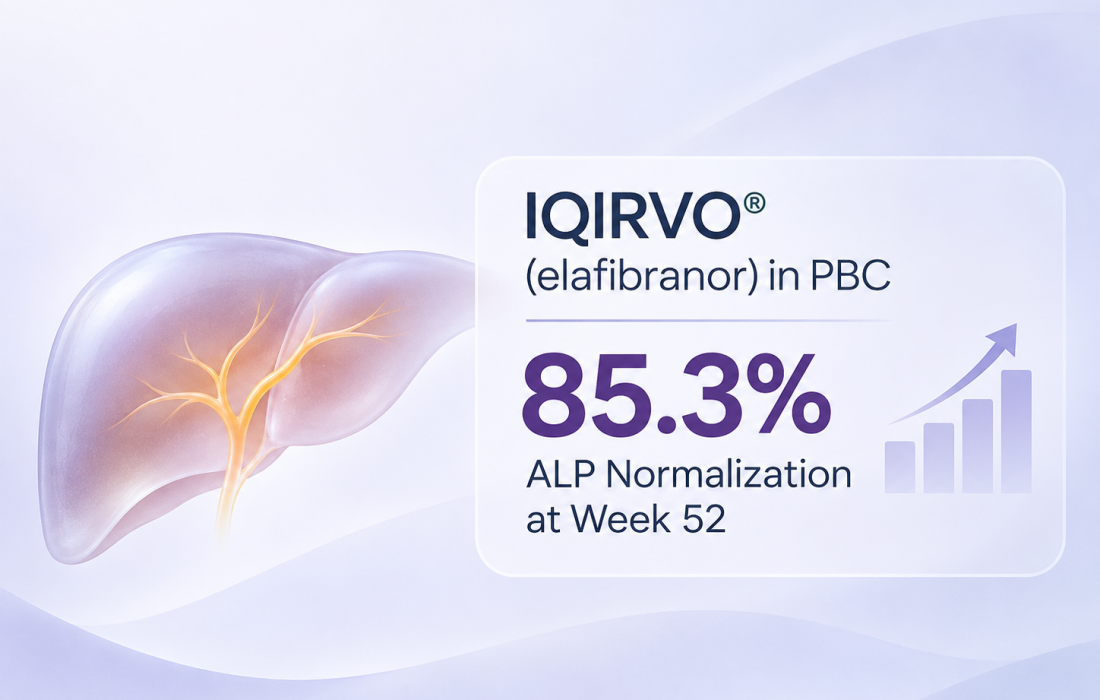
IQIRVO achieved 85.3% ALP normalization at Week 52 in the Phase III ELSPIRE study, evaluating elafibranor in patients with primary biliary cholangitis.
Written By: Kirti Kumbhar, M. Pharm (QA)
Reviewed By: Pharmacally Editorial Team
Ipsen has reported positive results from the Phase III ELSPIRE study, showing that IQIRVO® (elafibranor) achieved alkaline phosphatase (ALP) normalization in 85.3% of patients with primary biliary cholangitis (PBC) at Week 52, compared with 23.3% receiving placebo (p<0.0001). The findings address a population with baseline ALP levels between 1 and 1.67 times the upper limit of normal (ULN), extending evidence for elafibranor into a relatively less-studied PBC population.
The results will be presented as late-breaking data at the American Association for the Study of Liver Diseases (AASLD) The Liver Meeting 2026 and simultaneously published in HEPATOLOGY. Ipsen also confirmed that data from an expanded patient population are being shared with regulatory authorities.
ELSPIRE Evaluates Patients Below the Conventional ALP Threshold
PBC is a chronic autoimmune liver disease characterized by progressive destruction of the small bile ducts, disrupting bile flow and potentially leading to liver fibrosis, cirrhosis and liver failure. Ursodeoxycholic acid (UDCA) remains the established first-line treatment, although some patients have an inadequate response or cannot tolerate it.
Historically, ALP below 1.67× ULN has been used as a biochemical response threshold in PBC clinical trials. However, achieving ALP normalization may represent a more ambitious treatment goal.
ELSPIRE (NCT06383403) is a randomized, double-blind, placebo-controlled Phase III study involving 92 adults with PBC across 10 countries. Participants with an inadequate response or intolerance to UDCA were randomized 2:1 to receive IQIRVO 80 mg once daily (n=62) or placebo (n=30). The primary endpoint was the proportion of patients achieving ALP levels at or below ULN at Week 52.
IQIRVO Demonstrates Broad Biochemical Improvements
At Week 52, 85.3% of IQIRVO-treated patients achieved ALP normalization, compared with 23.3% receiving placebo (p<0.0001).
Additional biochemical findings supported the primary endpoint:
- ALP reduction: Adjusted mean reduction from baseline was 36.5% with IQIRVO versus 4.2% with placebo (p<0.0001).
- ALP normalization with additional reduction: 84.5% achieved normalization alongside at least a 15% reduction from baseline, compared with 20.0% on placebo (p<0.0001).
- Complete biochemical response: 64.3% achieved normal total bilirubin, ALP, AST, ALT, albumin and INR, compared with 16.7% receiving placebo (p<0.0001).
- Total bilirubin: Change from baseline favored IQIRVO, with an adjusted 15-percentage-point difference between treatment groups at Week 52 (p=0.0260).
- GGT: The adjusted mean difference in reduction was 36.3 U/L in favour of IQIRVO (p=0.0002).
IQIRVO was generally well tolerated, with no new safety signals. Most treatment-emergent adverse events were mild or moderate, and no serious adverse events were considered related to treatment. Discontinuations due to adverse events were reported as low, although detailed event frequencies were not provided.
ELFINITY Adds Real-World Biochemical and Symptom Evidence
Ipsen also reported six-month findings from ELFINITY (NCT06447168), an ongoing prospective, global, non-interventional Phase IV observational study evaluating IQIRVO in routine clinical practice. Unlike ELSPIRE, ELFINITY does not involve randomized placebo-controlled treatment allocation.
Among 113 evaluable patients, 57.5% (65/113) met the study’s biochemical response definition: ALP below 1.67× ULN, at least a 15% reduction from baseline and total bilirubin at or below ULN.
Among patients with moderate-to-severe fatigue at baseline, clinically meaningful improvements were reported in 42.3% using PBC-40 Fatigue and 38.5% using PROMIS Fatigue Short Form 13a. Improvements in pruritus were also observed across WI-NRS, 5D-itch and PBC-40 Itch measures.
These findings provide supportive real-world context, although the observational design and six-month follow-up differ from the controlled ELSPIRE trial.
Clinical Implications: Moving Beyond the 1.67× ULN Threshold
ELSPIRE extends the evidence for elafibranor into a PBC population with baseline ALP between 1 and 1.67× ULN, demonstrating ALP normalization in 85.3% of treated patients. Improvements in bilirubin, GGT and complete biochemical response further support a consistent biochemical treatment effect.
The findings raise an important question about evolving treatment goals in PBC: whether achieving normal ALP should become a broader therapeutic ambition rather than focusing primarily on reducing levels below 1.67× ULN.
However, biochemical normalization should not be equated with proven improvement in transplant-free survival, prevention of cirrhosis or reduction in liver-related complications. ELSPIRE enrolled only 92 patients, limiting the size of the population evaluated. Longer-term follow-up will be important to determine whether the observed biochemical improvements translate into meaningful clinical benefits. Regulatory assessment will also help establish whether these findings influence treatment strategies for PBC.
Reference
IQIRVO® late-breaking data raises ambitions in PBC with more than 85% of patients on treatment achieving ALP normalization, IPSEN, 05 November 2026
Kowdley et al, Treatment with elafibranor to normalize alkaline phosphatase in patients with primary biliary cholangitis and incomplete response to ursodeoxycholic acid: Results from the phase III randomized controlled ELSPIRE trial, Hepatology https://doi.org/10.1097/HEP.0000000000001906
A Study of Elafibranor in Adults with Primary Biliary Cholangitis and Inadequate Response or Intolerance to Ursodeoxycholic Acid. (ELSPIRE), ClinicalTrials.gov ID NCT06383403
A Study Observing Everyday Effectiveness and Safety of the Drug Elafibranor in Participants with Primary Biliary Cholangitis Who Are Receiving Ongoing Treatment (ELFINITY), ClinicalTrials.gov ID NCT06447168

About the Writer
Kirti Kumbhar (LinkedIn) is an M.Pharm graduate with experience in Quality Assurance at Lupin Limited and a strong interest in clinical research, regulatory affairs, and Trial Master File (TMF) management. She has developed knowledge of regulatory documentation, quality systems, compliance, and healthcare research through her professional experience. Passionate about clinical development and continuous learning, Kirti is committed to supporting high-quality healthcare documentation, regulatory excellence, and research-driven healthcare advancements.