
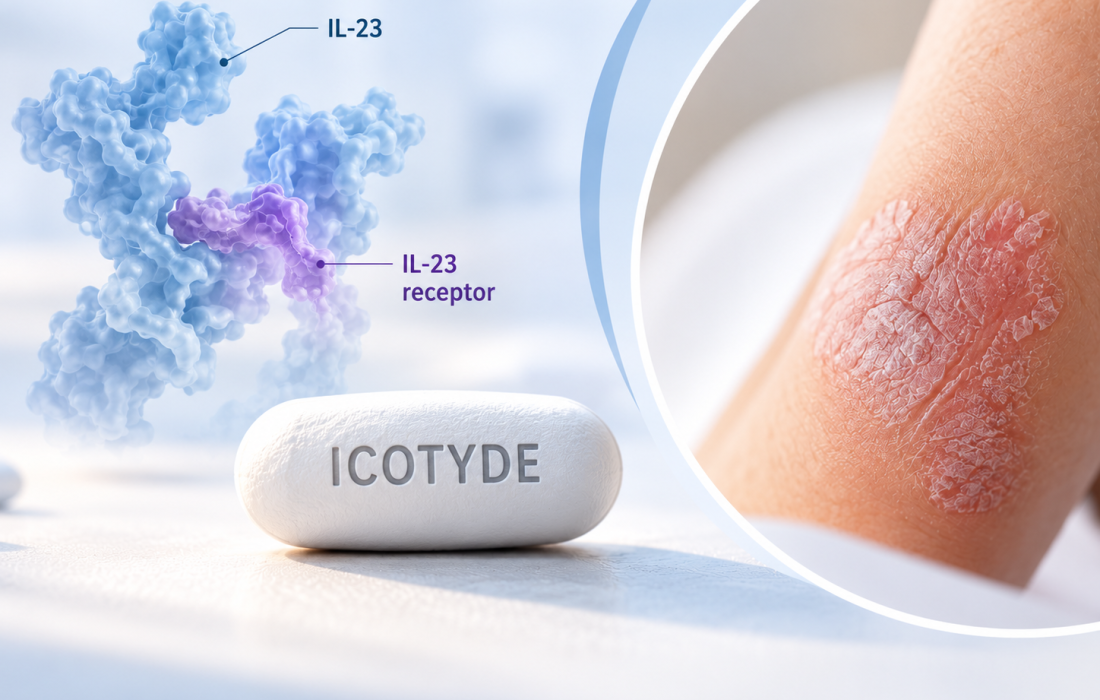
Johnson & Johnson reports two-year ICONIC-TOTAL data showing sustained skin clearance with ICOTYDE (icotrokinra) in difficult-to-treat plaque psoriasis.
Written By: Malavatu Satvika, PharmD
Reviewed By: Pharmacally Editorial Team
Johnson & Johnson has announced new two-year findings from the Phase 3 ICONIC-TOTAL study (NCT06095102), evaluating ICOTYDE (icotrokinra) in adults and adolescents aged 12 years and older with at least moderate plaque psoriasis affecting high-impact sites, including the scalp, genital area, and hands and/or feet. The late-breaking findings were presented as an oral presentation at the 2026 European Academy of Dermatology and Venereology (EADV) Congress. Through Week 112, ICOTYDE demonstrated sustained overall skin clearance, with continued improvement across several difficult-to-treat psoriasis sites.
A Targeted Oral Approach to IL-23
ICOTYDE is an oral interleukin-23 (IL-23) receptor antagonist. According to Johnson & Johnson, it is the first and only targeted oral peptide designed to precisely block the IL-23 receptor. The IL-23 pathway has an established role in the inflammatory processes underlying plaque psoriasis.
ICOTYDE received U.S. Food and Drug Administration (FDA) approval in March 2026 for the treatment of moderate-to-severe plaque psoriasis in adults and pediatric patients aged 12 years and older who weigh at least 40 kg and are candidates for systemic therapy or phototherapy.
The ongoing clinical development program is also evaluating icotrokinra in other immune-mediated diseases, including psoriatic arthritis, ulcerative colitis, and Crohn’s disease. These indications remain under clinical investigation.
ICONIC-TOTAL and High-Impact Psoriasis Sites
ICONIC-TOTAL is a Phase 3 randomized controlled study evaluating the efficacy and safety of ICOTYDE compared with placebo in patients with at least moderate plaque psoriasis affecting special areas, including the scalp, genital region, and/or hands and feet. Participants received once-daily ICOTYDE or placebo, with patients assigned to placebo transitioning to ICOTYDE at Week 16. The study enrolled 311 participants, including 208 assigned to ICOTYDE and 103 to placebo.
The study focused on psoriasis affecting body sites that can be particularly difficult to treat and can have a substantial effect on patients’ daily activities and quality of life. The two-year follow-up provides additional information on the durability of clinical response with continued ICOTYDE treatment.
Sustained Skin Clearance Through Week 112
Among patients treated with ICOTYDE, the proportion achieving clear or almost clear skin, defined as an Investigator’s Global Assessment (IGA) score of 0 or 1, increased from 57% at Week 16 to 67% at Week 24 and 70% at Week 112.
Site-specific assessments also showed sustained clearance at Week 112. Among patients with scalp psoriasis, 60% achieved a scalp-specific Investigator’s Global Assessment (ss-IGA) score of 0, indicating absence of scalp disease. In patients with genital psoriasis, 89% achieved a Physician’s Global Assessment of Genitalia (sPGA-G) score of 0, while 63% of patients with psoriasis affecting the hands and/or feet achieved a hand and/or foot Physician’s Global Assessment (hf-PGA) score of 0.
These findings indicate that clinical responses were maintained through two years across the high-impact psoriasis sites evaluated in ICONIC-TOTAL.
Continued Improvement in Nail Psoriasis
Nail psoriasis was also assessed using the modified Nail Psoriasis Severity Index (mNAPSI), a measure of nail disease severity.
Mean percentage improvement in mNAPSI increased from 33% at Week 16 to 62% at Week 52 and 71% at Week 112. The continued improvement over time provides additional evidence of the longer-term clinical response observed with ICOTYDE in patients with plaque psoriasis involving high-impact sites.
Safety Findings Through Two Years
Safety findings through Week 112 remained consistent with the established safety profile of ICOTYDE, and Johnson & Johnson reported that no new safety signals were identified during the two-year follow-up.
The Week 112 findings therefore provide additional long-term safety information from patients who continued ICOTYDE treatment. However, the two-year announcement did not provide detailed adverse-event rates, so the findings should be interpreted as an update on the overall safety profile rather than a comprehensive analysis of individual adverse events.
Expert Perspective
Richard B. Warren, M.D., Ph.D., Professor of Dermatology at the University of Manchester, highlighted the importance of long-term data for patients with psoriasis affecting difficult-to-treat areas such as the scalp, genitals, hands, and feet. He noted that these areas can cause substantial functional and daily-life burden even when they represent a relatively small proportion of total body surface area.
David M. Lee, M.D., Ph.D., Global Immunology Therapeutic Area Head at Johnson & Johnson, said that the two-year results provide additional evidence supporting sustained clinical outcomes with ICOTYDE in high-impact psoriasis sites.
What the Two-Year Data Add
The Week 112 findings extend the clinical evidence for ICOTYDE in patients with plaque psoriasis affecting high-impact sites. The sustained responses across scalp, genital, and hand and/or foot psoriasis, together with continued improvement in nail disease, provide additional information on the durability of treatment response with longer-term therapy.
The absence of new safety signals through two years also adds to the longer-term safety experience with ICOTYDE. Further follow-up and data from the broader clinical development program will help characterize the durability of treatment response and safety across different patient populations and inflammatory diseases.
Reference
Johnson & Johnson announces new ICOTYDE® (icotrokinra) data in difficult-to-treat plaque psoriasis with proven durability through 2-years, affirming its use as a powerful first line systemic therapy, Johnson and Johnson, 02 October 2026
A Study of JNJ-77242113 for the Treatment of Participants with Plaque Psoriasis Involving Special Areas (Scalp, Genital, and/or Palms of the Hands and the Soles of the Feet) (ICONIC-TOTAL), ClinicalTrials.gov ID NCT06095102

About the Writer
Malavatu Satvika (Linkedin) is a Pharm.D professional and aspiring healthcare medical writer with clinical exposure and research experience. Her interests include medical writing, drug safety, pharmaceutical research, and evidence-based healthcare communication. She has contributed to two research publications in pharmaceutical journals and has gained practical experience in prescription review, patient counselling, medication review, adverse drug reaction monitoring, drug information services, literature review, and clinical documentation through regular hospital training.
She has completed certifications in clinical research, ICH-GCP E6(R3), data management for clinical research, and congenital hypothyroidism. With a strong foundation in pharmacy, clinical practice, and scientific research, she aims to translate complex medical and pharmaceutical information into accurate, clear, and evidence-based healthcare content. She is also preparing to pursue a PhD and further develop her expertise in medical writing and pharmaceutical research.