
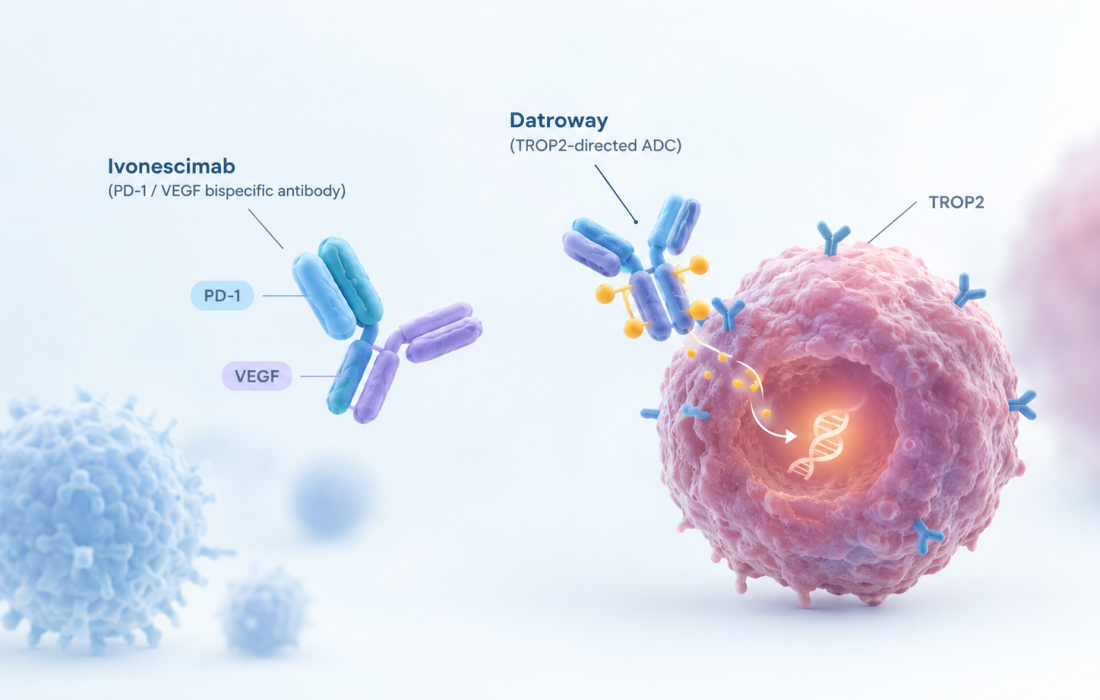
AstraZeneca, Daiichi Sankyo, and Summit partner to evaluate Datroway (TROP2 ADC) plus ivonescimab (PD-1/VEGF bispecific) in 1L triple-negative breast cancer.
Written By: Rishabh Sonawane, BPharm
Reviewed By: Pharmacally Editorial Team
AstraZeneca and Daiichi Sankyo have entered a clinical collaboration with Summit Therapeutics to evaluate datopotamab deruxtecan (Datroway) in combination with ivonescimab across multiple solid tumors, beginning with a planned Phase III study in first-line triple-negative breast cancer (TNBC).
Phase III Development to Begin in First-Line TNBC
The collaboration brings together two distinct cancer therapies: Datroway, a TROP2-directed antibody-drug conjugate (ADC), and ivonescimab, a bispecific antibody that combines PD-1 immune checkpoint blockade with VEGF inhibition.
The companies plan to initiate a Phase III trial evaluating the combination in patients with previously untreated TNBC. The collaboration may subsequently extend into additional tumor types, including lung and breast cancers.
The agreement follows AstraZeneca’s recently announced equity investment in Summit, which is intended in part to support clinical collaborations evaluating ivonescimab with AstraZeneca’s oncology medicines.
Complementary ADC and Immunotherapy Mechanisms
Datroway (datopotamab deruxtecan; datopotamab deruxtecan-dlnk in the US) is a TROP2-directed ADC developed using Daiichi Sankyo’s DXd technology. The ADC contains a humanized anti-TROP2 antibody linked to a topoisomerase I inhibitor payload, DXd, through a cleavable tetrapeptide linker.
After binding TROP2-expressing tumor cells, the ADC is internalized and releases the cytotoxic payload, producing DNA damage and tumor-cell death.
Ivonescimab uses a different approach by combining PD-1 blockade with VEGF inhibition in a single bispecific antibody. This dual activity is intended to engage antitumor immunity while targeting VEGF-mediated angiogenic signaling and the tumor microenvironment.
The combination therefore brings an ADC-based cytotoxic mechanism together with immune checkpoint and angiogenesis targeting.
Datroway Has Established Activity Across Multiple Cancers
Datroway is approved in more than 30 countries and regions for adults with unresectable or metastatic TNBC who are not candidates for PD-1/PD-L1 inhibitor therapy, based on the TROPION-Breast02 study (NCT05374512).
It is also approved in more than 45 countries and regions for adults with unresectable or metastatic hormone receptor-positive, HER2-negative breast cancer after prior endocrine-based therapy and chemotherapy, supported by TROPION-Breast01 (NCT05104866).
In the US and several other countries, Datroway is approved for adults with locally advanced or metastatic EGFR-mutated NSCLC after prior EGFR-directed therapy and platinum-based chemotherapy, based on TROPION-Lung05 (NCT04484142) and TROPION-Lung01 (NCT04656652). In the US, continued approval is contingent on confirmatory evidence of clinical benefit.
Its global development program now includes more than 20 trials spanning NSCLC, TNBC and urothelial cancer, including multiple Phase III studies.
Ivonescimab Expands into Breast Cancer
Ivonescimab is approved in China for certain patients with NSCLC, while a US BLA for EGFR-mutated NSCLC remains under FDA review. Summit is also evaluating the drug in Phase III studies across NSCLC, small cell lung cancer, biliary tract cancer, bladder cancer, TNBC, head and neck squamous cell carcinoma, colorectal cancer and pancreatic cancer.
The new collaboration extends ivonescimab’s development into a combination strategy with an established ADC platform and establishes first-line TNBC as the initial Phase III setting.
Companies to Share Development Costs
AstraZeneca, Daiichi Sankyo and Summit will each contribute their respective medicines and share costs associated with the planned combination trials. The trials will be sponsored by AstraZeneca or Daiichi Sankyo, while each company will retain development and commercial rights to its own medicine.
Susan Galbraith of AstraZeneca said the collaboration reflects the company’s strategy of combining immunotherapy with ADCs to pursue deeper and more durable cancer responses. Summit’s Maky Zanganeh described the agreement as an expansion of ivonescimab’s development into breast cancer and a potential platform for additional solid-tumor combinations.
The planned Phase III TNBC study will provide the first major clinical test of the Datroway–ivonescimab combination in this setting. Further details on the trial design, enrollment and endpoints have not yet been disclosed.
Reference
AstraZeneca and Daiichi Sankyo announce clinical collaboration with Summit Therapeutics to evaluate Datroway in combination with ivonescimab across multiple tumour types, Astra Zeneca, 02 October 2026
Daiichi Sankyo and AstraZeneca Enter into Clinical Trial Collaboration with Summit Therapeutics to Evaluate Datroway® in Combination with Ivonescimab Across Multiple Tumor Types, Daiichi Sankyo, 02 October 2026
Summit Therapeutics Announces Clinical Trial Collaboration with AstraZeneca and Daiichi Sankyo to Evaluate Ivonescimab in Combination with TROP2-Directed ADC Datroway, Summit Therapeutics, 02 October 2026

About the Writer
Rishabha Sonawane, B.Pharm (LinkedIn) is healthcare writer with a strong interest in medical writing, regulatory affairs, clinical research, and AI-driven drug discovery. He has completed specialized training from the NIH and ICMR in clinical pharmacology, clinical research, and scientific writing. Passionate about evidence-based healthcare communication, he focuses on translating complex scientific research into clear, accurate, and engaging medical content.