
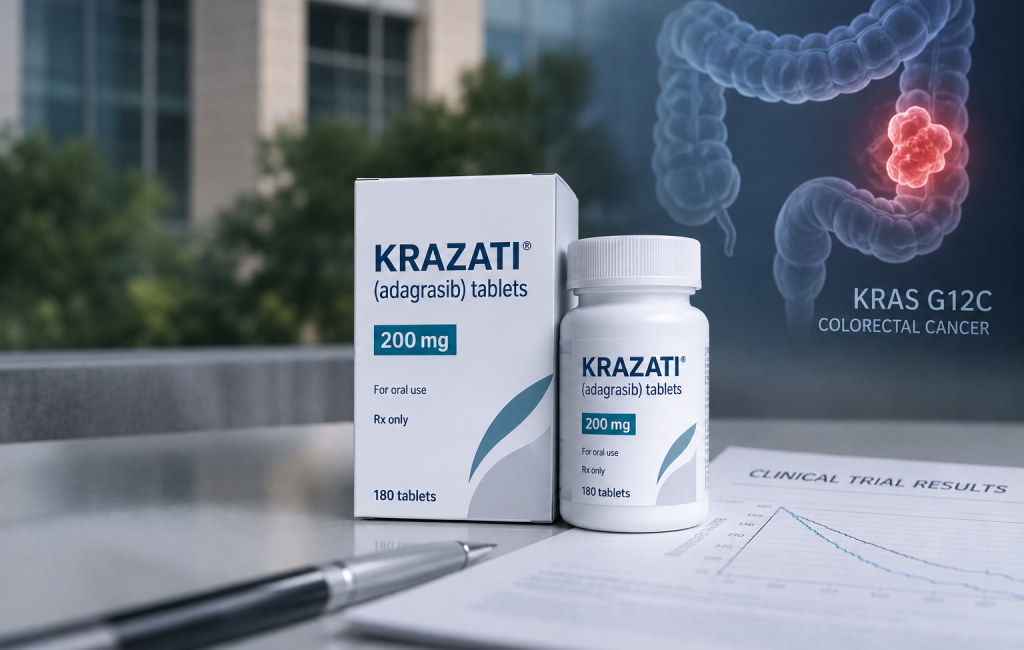
FDA withdraws KRAZATI plus cetuximab approval for KRAS G12C-mutated colorectal cancer after Phase 3 KRYSTAL-10 fails PFS and OS endpoints.
Written By: Umesh Hanumante,
M.Pharm (Reg. Affairs)
Reviewed By: Pharmacally Editorial Team
The U.S. Food and Drug Administration (FDA) has withdrawn the accelerated approval of KRAZATI (adagrasib) in combination with cetuximab for adults with KRAS G12C-mutated locally advanced or metastatic colorectal cancer (CRC) who had previously received fluoropyrimidine-, oxaliplatin-, and irinotecan-based chemotherapy. The withdrawal became effective September 1, 2026.
The decision followed final results from the Phase 3 KRYSTAL-10 (NCT04793958) confirmatory trial, which failed to demonstrate statistically significant improvement in either of its dual primary endpoints, progression-free survival (PFS) or overall survival (OS), compared with chemotherapy.
Accelerated Approval and Confirmatory Testing
The FDA granted accelerated approval to adagrasib plus cetuximab in June 2024 for previously treated patients with KRAS G12C-mutated advanced CRC. The approval was based on earlier evidence of antitumor activity, with confirmatory testing required to establish clinical benefit.
KRYSTAL-10 was designed to provide that confirmatory evidence. The randomized Phase 3 trial enrolled 461 patients with KRAS G12C-mutated metastatic CRC whose disease had progressed after first-line chemotherapy. Patients received either adagrasib plus cetuximab or investigator’s-choice chemotherapy.
KRYSTAL-10 Failed Its Primary Endpoints
The final results did not confirm a survival or progression benefit for the targeted combination.
Median PFS was 7.5 months with adagrasib plus cetuximab versus 8.1 months with chemotherapy (HR, 0.89; P=0.3241). Median OS was 21.6 versus 21.7 months, respectively (HR, 0.83; P=0.0938).
Endpoint | Adagrasib + Cetuximab | Chemotherapy |
Median PFS | 7.5 months (HR 0.89; P=0.3241) | 8.1 months |
Median OS | 21.6 months (HR 0.83; P=0.0938) | 21.7 months |
Objective Response Rate (ORR) | 47% (7% CR) | 16% (<1% CR) |
Neither endpoint reached statistical significance.
Higher Response Rate Did Not Translate into Clinical Benefit
The findings were notable because adagrasib plus cetuximab demonstrated substantially greater tumor shrinkage. The objective response rate was 47% compared with 16% with chemotherapy, including complete responses in 7% versus less than 1%.
However, this higher response rate did not translate into statistically significant improvements in PFS or OS. Median duration of response was also broadly similar between the groups.
The results highlight an important distinction in oncology drug development: evidence that a treatment can shrink tumors does not necessarily establish that it improves progression-free or overall survival compared with available therapy.
Safety and Subsequent Treatment
The safety profile did not reveal a new signal that would explain the regulatory outcome. Grade 3 or higher treatment-related adverse events occurred in 46% of patients receiving adagrasib plus cetuximab compared with 55% with chemotherapy.
Interpretation of OS also requires consideration of subsequent treatment. Approximately 30% of patients in the chemotherapy arm subsequently received a KRAS G12C inhibitor compared with 4% in the adagrasib-plus-cetuximab arm. This may complicate interpretation of the OS comparison, although it does not alter the trial’s primary finding.
What the Withdrawal Means
The FDA withdrawal applies specifically to the CRC indication for KRAZATI plus cetuximab. It does not represent withdrawal of KRAZATI from every cancer setting.
For KRAS G12C-mutated CRC, the decision means the combination is no longer an FDA-approved treatment option under the withdrawn indication.
The case illustrates the purpose of accelerated approval: early evidence can provide access to promising therapies, but subsequent randomized trials must establish meaningful clinical benefit. In KRYSTAL-10, adagrasib plus cetuximab showed clear antitumor activity but failed to demonstrate statistically significant improvement in the required PFS and OS endpoints, leading to withdrawal of the indication.
Reference
Withdrawn | Cancer Accelerated Approvals- Krazati (Adagrasib). 01 September 2026

About the Writer
Umesh Hanumante (M.Pharm) (LinkedIn) is a pharmacy professional and healthcare writer with a background in Regulatory Affairs, pharmaceutical innovation, and clinical research. He has around two years of industry experience as an Executive PMT at Troikaa Pharmaceuticals Ltd and qualified GPAT 2024. His areas of interest include regulatory compliance, dossier preparation, clinical trials, emerging therapies, and advancements in the global pharmaceutical and healthcare sector.