
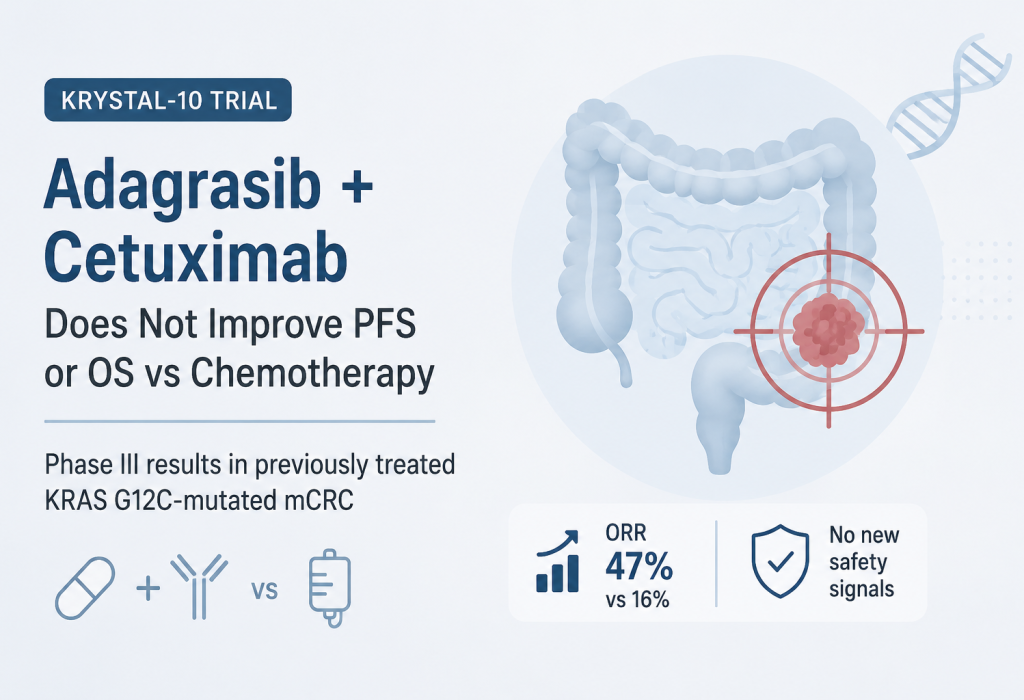
The Phase III KRYSTAL-10 trial found no significant PFS or OS benefit with adagrasib plus cetuximab versus chemotherapy in KRAS G12C-mutated metastatic colorectal cancer.
Written By: Anshu Gupta, PharmD
Reviewed By: Pharmacally Editorial Team
The Phase III KRYSTAL-10 trial did not demonstrate a statistically significant improvement in progression-free survival (PFS) or overall survival (OS) with second-line adagrasib plus cetuximab compared with chemotherapy in patients with KRAS G12C-mutated metastatic colorectal cancer (mCRC). Although the combination produced a higher objective response rate (ORR), the trial did not meet its dual primary endpoints. Final results were presented as Late-Breaking Abstract LBA1 at the ESMO Gastrointestinal Cancers Congress 2026.
Study Design
KRYSTAL-10 (NCT04793958) was a global, open-label, randomized Phase III trial involving 461 patients with KRAS G12C-mutated mCRC whose disease had progressed after first-line fluoropyrimidine-based doublet chemotherapy. Patients were randomized 1:1 to adagrasib plus cetuximab or investigator’s-choice chemotherapy, with or without a VEGF/VEGFR inhibitor. A total of 231 patients received the adagrasib combination and 230 received chemotherapy. PFS and OS were the trial’s dual primary endpoints.
The study evaluated adagrasib in combination with cetuximab against chemotherapy-based treatment in the second-line setting. ClinicalTrials.gov identifies mFOLFOX6 and FOLFIRI as the chemotherapy regimens used in the comparator arm. Secondary outcomes included objective response rate, duration of response, adverse events, and patient-reported outcomes.
Progression-Free and Overall Survival
At the final analysis, median PFS by blinded independent central review was 7.5 months with adagrasib plus cetuximab compared with 8.1 months with chemotherapy. The hazard ratio (HR) was 0.89 (95% CI, 0.71–1.13; P=0.3241). Because the P value did not reach statistical significance, the study did not demonstrate a PFS benefit for the adagrasib combination.
Median OS was 21.6 months with adagrasib plus cetuximab and 21.7 months with chemotherapy. The HR was 0.83 (95% CI, 0.67–1.03; P=0.0938). The OS analysis had a minimum follow-up of 35.3 months, but the difference between treatment groups did not reach statistical significance.
Together, these results meant that KRYSTAL-10 did not meet either of its dual primary survival endpoints. The findings did not demonstrate superior PFS or OS with adagrasib plus cetuximab over chemotherapy in the second-line setting.
Tumor Response
The higher response rate with adagrasib plus cetuximab was one of the notable findings of the trial. The ORR was 47% with the combination compared with 16% with chemotherapy.
The response findings therefore differed from the primary survival results. More patients experienced a measurable tumor response with adagrasib plus cetuximab, but this higher response rate was not accompanied by a statistically significant improvement in PFS or OS.
Safety
The safety profile of adagrasib plus cetuximab was consistent with the known profiles of the individual agents, and no new safety signals were identified.
Clinical Perspective
KRYSTAL-10 Results in Context
The KRYSTAL-10 results provide a different outcome from the earlier Phase I/II KRYSTAL-1 experience with adagrasib plus cetuximab. In KRYSTAL-1, heavily pretreated patients with KRAS G12C-mutated mCRC treated with the combination had an ORR of 46%, a median duration of response of 7.6 months, and a median PFS of 6.9 months. The Phase III findings therefore did not confirm superiority over standard chemotherapy in previously treated mCRC.
An important consideration in interpreting the OS findings was the unexpectedly strong performance of the chemotherapy arm. Prof. Per Pfeiffer noted that the experimental arm appeared to perform broadly as expected based on the earlier Phase I/II findings, whereas the chemotherapy arm performed better than might have been predicted from prior randomized trials. The 21.7-month median OS observed with chemotherapy was particularly notable given the generally unfavorable prognosis associated with KRAS G12C-mutated mCRC.
Factors Influencing Overall Survival
Subsequent KRAS G12C inhibitor therapy may also have influenced the OS comparison. ESMO reported that 30% of patients in the chemotherapy group subsequently received a KRAS G12C inhibitor compared with 4% in the adagrasib-plus-cetuximab group. This difference could influence OS comparisons between the treatment arms, although subsequent therapy would not be expected to alter the primary PFS analysis.
Exploratory subgroup analyses also indicated potentially favorable OS outcomes with adagrasib plus cetuximab among European patients and those with right-sided tumors. These findings should be interpreted cautiously because they are subgroup observations from a trial that did not meet its primary PFS or OS endpoints.
The KRYSTAL-10 findings therefore show that second-line adagrasib plus cetuximab produced a higher objective response rate than chemotherapy, but this response advantage did not translate into statistically significant improvements in PFS or OS. The final results did not demonstrate superiority of adagrasib plus cetuximab over chemotherapy for either PFS or OS in the population studied.
Reference
Adagrasib + Cetuximab fails to outperform chemo in KRAS G12C mCRC

About the Writer
Anshu Gupta (LinkedIn) is a PharmD professional and healthcare writer with interests in clinical research, pharmacovigilance, regulatory affairs, and medical writing. She has presented research at academic conferences and completed certifications in Good Clinical Practice (GCP), ICH-GCP, and drug safety. Passionate about clinical trials and evidence-based medicine, she is committed to translating scientific evidence into accurate, reliable, and accessible healthcare content.