
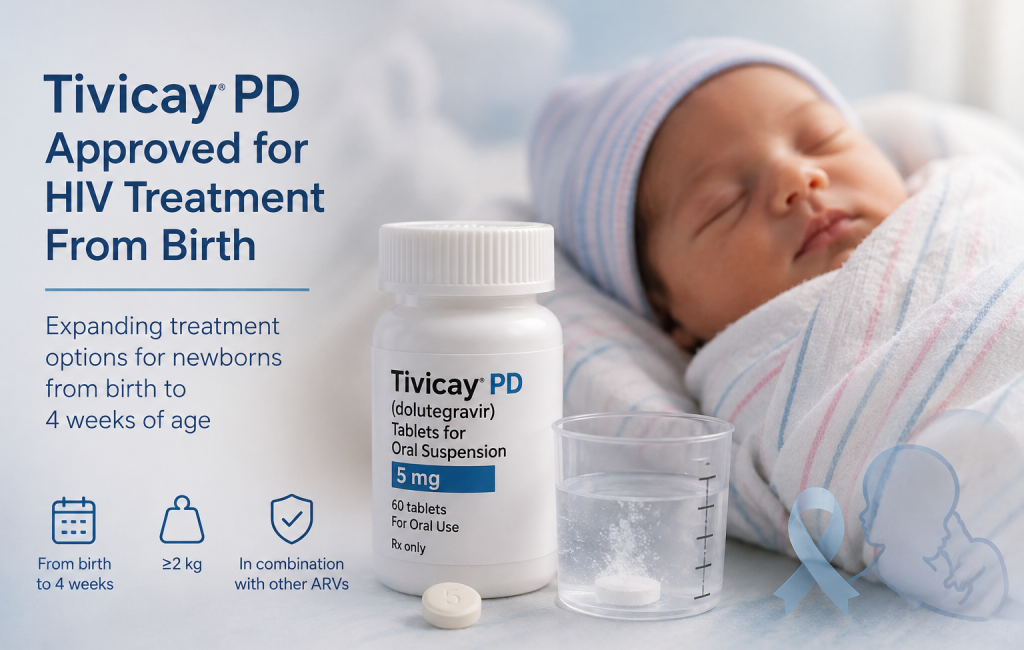
FDA approves Tivicay PD (dolutegravir) for HIV-1 treatment in newborns from birth to 4 weeks weighing at least 2 kg.
Written by: Kirti Kumbhar, M. Pharm (QA)
Reviewed by: Pharmacally Editorial Team
The U.S. Food and Drug Administration (FDA) has approved Tivicay PD tablets for oral suspension (dolutegravir) for the treatment of HIV-1 infection in babies from birth up to four weeks of age who weigh at least 2 kg. Tivicay PD is indicated for use in combination with other antiretroviral agents. The approval expands the use of dolutegravir to newborns, while Tivicay and Tivicay PD were previously approved for adults and children older than four weeks.
HIV Infection in Newborns
Human immunodeficiency virus (HIV) attacks the body’s immune system and, without treatment, can increase the risk of serious infections and cancer and progress to acquired immunodeficiency syndrome (AIDS). Although there is no cure for HIV, antiretroviral therapy can control the infection.
The newborn indication provides an approved dolutegravir-based treatment option during the first four weeks of life, when age-appropriate formulations and dosing options are important.
Clinical Evidence Supporting Approval
The FDA’s decision was supported by data from the IMPAACT 2023 study (NCT05406583) and pharmacokinetic modeling. The study included 48 newborns exposed to HIV-1 who weighed at least 2 kg. Participants received Tivicay PD from birth for up to six weeks in combination with standard-of-care antiretroviral medications used to prevent mother-to-child HIV transmission. The newborns were followed for 16 weeks.
Pharmacokinetic assessments showed that dolutegravir drug levels in newborns were similar to those associated with efficacy in adults. These findings, together with pharmacokinetic modeling, supported the application for use in the newborn population.
Safety and Adverse Reactions
The safety profile observed in newborns was similar to that reported in older pediatric and adult patients. The FDA labeling identifies insomnia, fatigue, and headache among the most common adverse reactions reported with dolutegravir. These adverse reactions reflect broader clinical experience and should not be interpreted as findings specific to the 48 newborns in IMPAACT 2023.
Tivicay and Tivicay PD should not be administered to patients with a previous hypersensitivity reaction to dolutegravir or to patients receiving dofetilide. Serious hypersensitivity reactions have been reported, and patients should be monitored for hepatotoxicity. Immune reconstitution syndrome has also been reported with combination antiretroviral therapy.
Administration and Drug Interactions
Tivicay PD is formulated as tablets for oral suspension. The tablets are dispersed in water before administration, while pediatric patients who can swallow tablets may take them whole. Tivicay tablets and Tivicay PD tablets for oral suspension are not substitutable on a milligram-per-milligram basis.
Dolutegravir has clinically important drug interactions. Cation-containing antacids or laxatives, sucralfate, and oral supplements containing iron or calcium can reduce dolutegravir exposure. Tivicay or Tivicay PD should generally be administered two hours before or six hours after these products. When taken with food, Tivicay or Tivicay PD and calcium- or iron-containing supplements can be administered at the same time.
Regulatory Significance
Tivicay PD received Priority Review for the newborn population. The FDA approval extends dolutegravir use to babies from birth up to four weeks of age who weigh at least 2 kg, when administered in combination with other antiretroviral agents.
Reference

About the Writer
Kirti Kumbhar (LinkedIn) is an M.Pharm graduate with experience in Quality Assurance at Lupin Limited and a strong interest in clinical research, regulatory affairs, and Trial Master File (TMF) management. She has developed knowledge of regulatory documentation, quality systems, compliance, and healthcare research through her professional experience. Passionate about clinical development and continuous learning, Kirti is committed to supporting high-quality healthcare documentation, regulatory excellence, and research-driven healthcare advancements