
Astellas advances ASP2138 into Phase 3 development for CLDN18.2-positive, HER2-negative gastric and GEJ adenocarcinoma as a first-line treatment.
Written By: Creola Gonsalves, MS Biotech
Reviewed By: Pharmacally Editorial Team
Astellas Pharma Inc. announced that the first patient has been dosed in a Phase 3 study evaluating ASP2138 in combination with chemotherapy and pembrolizumab as a first-line treatment for adults with locally advanced unresectable or metastatic gastric or gastroesophageal junction (GEJ) adenocarcinoma whose tumors are CLDN18.2-positive and HER2-negative.
The Phase 3 advancement of ASP2138 marks an important milestone in Astellas’ efforts to advance CLDN18.2 research through multiple scientific approaches designed to address different patient needs.
Design of the study
The Phase 3 (NCT07673887) randomized, double-blind, placebo-controlled study is designed to evaluate the efficacy and safety of ASP2138 plus chemotherapy, consisting of CAPOX or mFOLFOX6, with pembrolizumab versus placebo plus chemotherapy with or without pembrolizumab.
The study is being conducted as a first-line treatment in participants with locally advanced unresectable or metastatic gastric or GEJ adenocarcinoma whose tumors are CLDN18.2-positive and HER2-negative.
Overall survival and progression-free survival are the two co-primary endpoints of the study. The trial plans to enroll 570 participants across multiple countries.
Why understanding CLDN18.2 is important
Despite recent advances in the treatment of gastric and GEJ cancers, many people with advanced disease continue to face poor outcomes. Astellas reported that median progression-free survival is 6 to 7 months with current standard-of-care treatments that do not target CLDN18.2.
CLDN18.2 is a tight junction protein normally expressed in gastric mucosal cells that can remain expressed in certain gastric and GEJ cancers. The protein has emerged as an important therapeutic target in gastric cancer, prompting the development of different treatment approaches for tumors expressing this biomarker.
Astellas is exploring multiple scientific approaches to deepen understanding of CLDN18.2 and potentially address the evolving needs of people with CLDN18.2-positive cancers.
ASP2138 is designed to activate an antitumor response
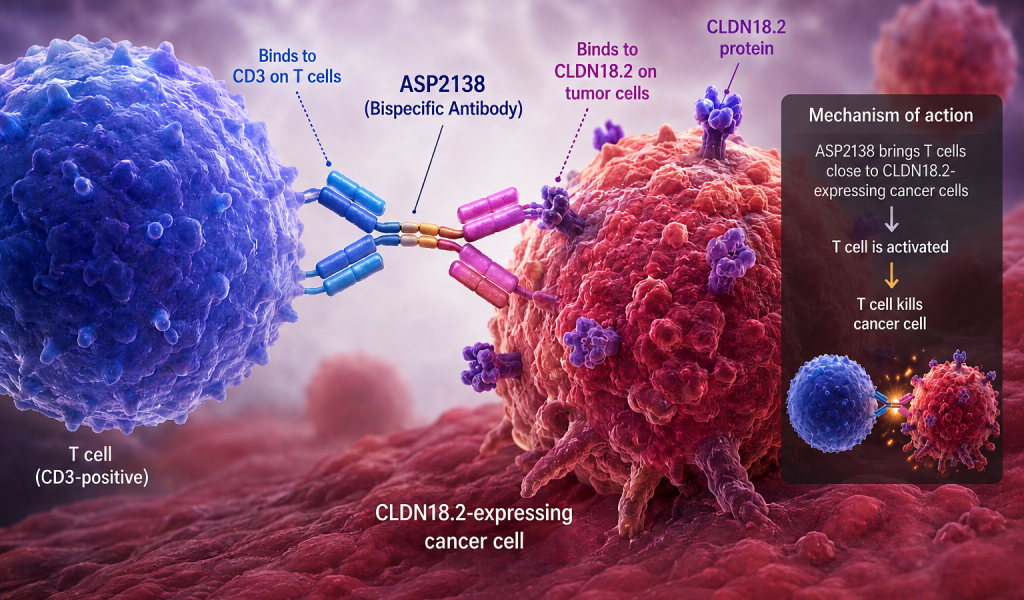
ASP2138 is an investigational, subcutaneously administered bispecific antibody designed to bind to CLDN18.2, a protein expressed on certain tumor cells, and CD3-positive T cells, a type of white blood cell capable of killing cancer cells.
By binding to both targets, ASP2138 is intended to bring T cells into close proximity with CLDN18.2-expressing tumor cells and activate their antitumor response.
ASP2138 is Astellas’ lead program within its Immuno-Oncology Primary Focus. The Phase 3 study supports the company’s Corporate Strategic Plan, including its ambition to initiate five or more Phase 3 or pivotal studies by fiscal year 2027.
ASP2138 remains investigational. Its safety and efficacy have not been established for the uses being studied, and there is no guarantee that it will receive regulatory approval or become commercially available for these uses.
Reference

About the Writer
Creola Gonsalves (Linkedin) is an M.S. Biotechnology postgraduate with a strong interest in clinical research, evidence interpretation, and healthcare writing, with a focus on translating life-science knowledge into meaningful real-world insights.
She is trained in Good Clinical Practice (GCP), clinical research principles, and critical interpretation of randomized clinical trials, with certifications from NIH and Stanford University.
Her research background in biotechnological applications and microbial research strengthens her ability to understand scientific evidence and develop clear, accurate, and research-driven healthcare content.