
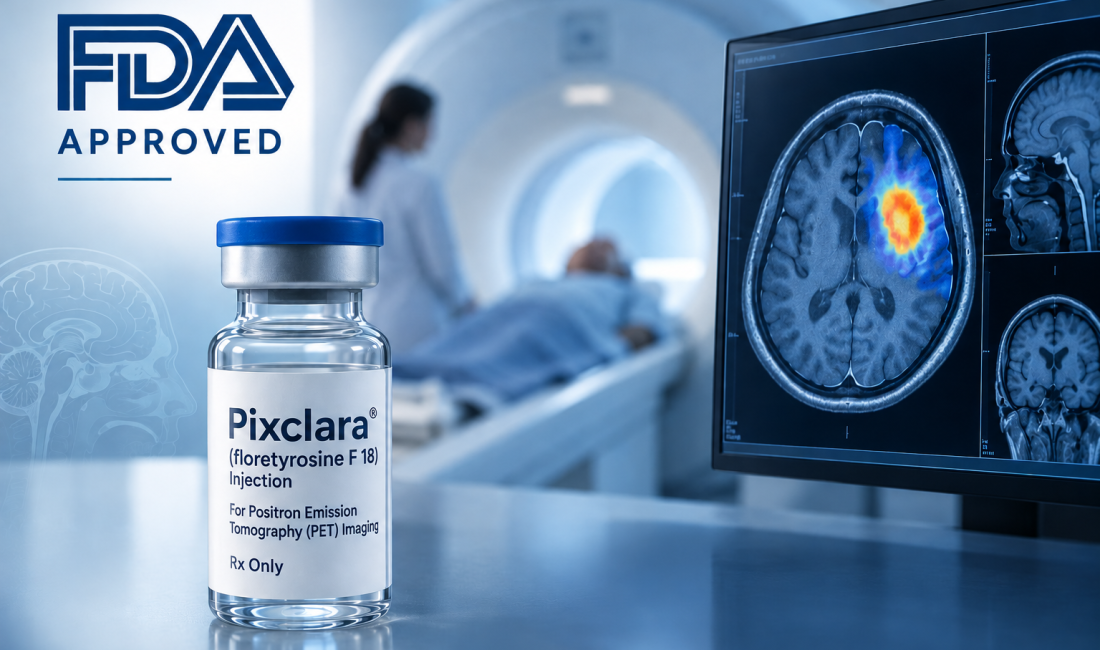
FDA approves Telix’s Pixclara, the first FET-PET imaging drug for glioma, to help distinguish recurrent or progressive tumors from treatment-related changes.
Written By: Rishabh Sonawane, BPharm
Reviewed By: Pharmacally Editorial Team
The U.S. Food and Drug Administration (FDA) has approved Telix Pharmaceuticals’ Pixclara® (floretyrosine F 18, or 18F-FET), making it the first FDA-approved fluorine-18 fluorotyrosine positron emission tomography (FET-PET) imaging drug for glioma. The approval provides physicians with a new imaging option to distinguish recurrent or progressive glioma from treatment-related changes in adults and children aged 1 month and older.
FDA Approval Addresses a Diagnostic Gap in Glioma Care
Pixclara is indicated for use with PET, alongside other diagnostic evaluations, to differentiate recurrent or progressive glioma from treatment-related change. This distinction can be difficult with conventional imaging because treatment effects can resemble active tumor on MRI, complicating decisions about further therapy.
FET-PET has already gained recognition in international clinical practice guidelines, including the National Comprehensive Cancer Network (NCCN) Guidelines. However, no FDA-approved FET-PET product had previously been available in the U.S.
Gliomas represent the most common type of central nervous system cancer, accounting for about 30% of brain and CNS tumors and approximately 80% of malignant brain tumors. Around 24,000 new glioma cases are diagnosed annually in the U.S., underscoring the need for improved tools to characterize disease after treatment.
How Pixclara Works
Pixclara is an intravenous PET radiopharmaceutical that combines the amino acid analogue floretyrosine with the diagnostic radioisotope fluorine-18. After administration, the tracer targets L-type amino acid transporters 1 and 2 (LAT1 and LAT2), membrane proteins involved in amino acid transport that are relevant to tumor biology.
Fluorine-18 emits positrons that PET scanners detect, allowing clinicians to visualize tracer distribution in the brain. Increased uptake can provide metabolic information that complements anatomical imaging and may help distinguish active or recurrent tumor from treatment-related changes.
The FDA-approved indication covers both adult and pediatric patients from 1 month of age, broadening access to FET-PET across a wide glioma population.
Pixclara’s Role in Glioma Imaging
The approval establishes Pixclara as a new diagnostic option in the U.S. rather than as a treatment for glioma. Its clinical role is complementary to MRI and other diagnostic assessments, with the potential to improve characterization of suspected recurrent or progressive disease and support treatment planning.
Telix is also evaluating Pixclara, known in development as TLX101-Px, in a Phase 3 registrational study for potential expansion into imaging brain metastases. The company has not provided efficacy or safety results from that program in the current announcement.
Kevin Richardson, CEO of Telix Precision Medicine, said the approval will broaden U.S. access to FET-PET and give physicians greater confidence when assessing glioma progression and planning treatment. Neuro-oncology specialist Patrick Wen similarly described the availability of an FDA-approved FET-PET product as an important advance for glioma management.
The approval expands Telix’s precision-medicine portfolio while establishing Pixclara as a clinically available FET-PET option for glioma in the U.S. Future Phase 3 development in brain metastases could further extend the radiopharmaceutical’s diagnostic application.
Reference
FDA Approves Telix’s Brain Cancer Imaging Drug Pixclara, Telix Pharmaceuticals, 14 September 2026

About the Writer
Rishabha Sonawane, B.Pharm(LinkedIn) is healthcare writer with a strong interest in medical writing, regulatory affairs, clinical research, and AI-driven drug discovery. He has completed specialized training from the NIH and ICMR in clinical pharmacology, clinical research, and scientific writing. Passionate about evidence-based healthcare communication, he focuses on translating complex scientific research into clear, accurate, and engaging medical content.