
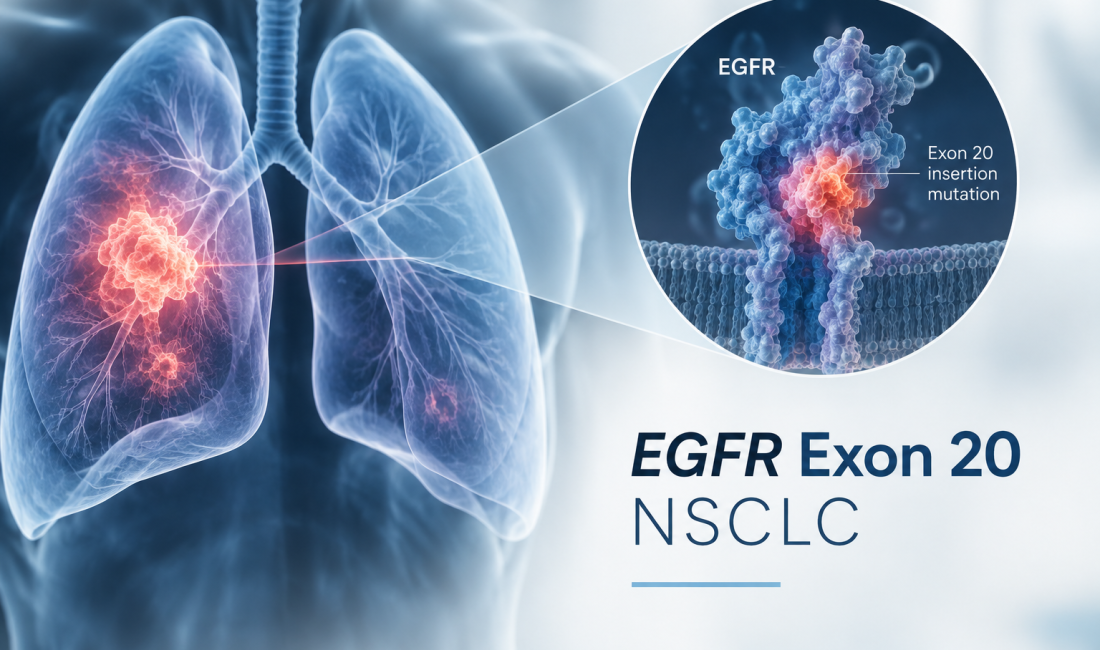
J&J reports final PAPILLON results showing 34.3-month median overall survival with amivantamab plus chemotherapy in EGFR exon 20 NSCLC.
Written By: Mayuresh Salvi, PharmD
Reviewed By: Pharmacally Editorial Team
Johnson & Johnson’s RYBREVANT (amivantamab-vmjw) plus carboplatin-pemetrexed chemotherapy delivered a median overall survival (OS) of 34.3 months in previously untreated advanced non-small cell lung cancer (NSCLC) with EGFR exon 20 insertion mutations, compared with 27.9 months with chemotherapy alone, according to final results from the Phase 3 PAPILLON study. The findings, presented at the 2026 World Conference on Lung Cancer (WCLC), mark the longest reported median OS in this historically difficult-to-treat population.
Final PAPILLON analysis shows durable survival
PAPILLON enrolled 308 patients with newly diagnosed advanced or metastatic NSCLC harboring EGFR exon 20 insertion mutations. Patients were randomized to first-line intravenous RYBREVANT plus carboplatin-pemetrexed or chemotherapy alone. Patients in the control arm could receive second-line RYBREVANT after confirmed disease progression.
In the protocol-specified final analysis, median OS was 34.3 months with RYBREVANT plus chemotherapy versus 27.9 months with chemotherapy alone. The hazard ratio was 0.87 (95% CI, 0.66-1.14; P=0.307), meaning the unadjusted OS comparison did not reach statistical significance.
Interpretation of the OS comparison is important because 76% of eligible patients in the chemotherapy arm crossed over to second-line RYBREVANT after disease progression. A prespecified analysis accounting for this crossover showed a 43% reduction in the risk of death with first-line RYBREVANT plus chemotherapy (HR, 0.57; 95% CI, 0.39-0.82; nominal P=0.003).
Benefit extended beyond first progression
The long-term analysis also showed sustained disease control beyond the initial progression event. Median progression-free survival through second disease progression (PFS2) was 28.3 months with RYBREVANT plus chemotherapy versus 17.5 months with chemotherapy alone, corresponding to an HR of 0.59 (95% CI, 0.45-0.77; nominal P<0.0001).
At the clinical cutoff, 12% of patients receiving the combination remained on first-line treatment, compared with none in the chemotherapy arm. Patient-reported outcomes also favored the combination, with treatment delaying worsening of several key lung cancer symptoms.
A difficult EGFR-mutated population
EGFR exon 20 insertion mutations account for approximately 12% of EGFR mutations and have historically been difficult to treat with targeted medicines. Median OS has ranged from approximately 16 to 24 months, while five-year survival has been reported at just 8%.
RYBREVANT is a fully human bispecific antibody that targets EGFR and MET, two pathways involved in tumor growth and treatment resistance, while also engaging the immune system. The drug is approved for advanced EGFR-mutated NSCLC across common EGFR alterations and exon 20 insertion mutations.
The final PAPILLON findings build on the study’s earlier primary analysis, which demonstrated a statistically significant 60% reduction in the risk of disease progression or death with first-line RYBREVANT plus chemotherapy versus chemotherapy alone. Those findings supported global approvals of the regimen.
Safety remained consistent with earlier reports
The safety findings reflect treatment with intravenous RYBREVANT plus chemotherapy before prophylactic strategies were introduced in subsequent development programs. With longer follow-up, no new safety signals emerged.
The most common treatment-related adverse events occurring in at least 30% of patients were paronychia (60%), neutropenia (60%) and rash (58%). These findings provide safety context for the IV PAPILLON regimen and should be distinguished from later studies evaluating prophylactic management strategies and subcutaneous RYBREVANT FASPRO.
Amivantamab platform expands beyond NSCLC
Yusri Elsayed, J&J’s global therapeutic area head for oncology, said the results add to the evidence supporting RYBREVANT across common, atypical and exon 20 insertion EGFR mutations and reinforce its potential as a treatment backbone.
The WCLC program also includes data from COPERNICUS and PALOMA-2 evaluating RYBREVANT FASPRO, the subcutaneous formulation of amivantamab and hyaluronidase-lpuj. These studies examine prophylactic strategies and subcutaneous administration as the company works to improve the treatment experience.
Beyond NSCLC, RYBREVANT-based therapies are being investigated in other solid tumors, including head and neck and colorectal cancers. These programs extend evaluation of amivantamab-based approaches and its dual EGFR/MET-targeting mechanism beyond EGFR-mutated lung cancer.
Reference
New overall survival data and treatment experience improvements reinforce the impact of RYBREVANT® (amivantamab-vmjw)-based regimens in EGFR-mutated lung cancer at WCLC 2026, Johnson and Johnson, 11 September 2026
Johnson & Johnson’s RYBREVANT® (amivantamab-vmjw) plus chemotherapy delivers longest reported median overall survival in EGFR exon 20 insertion mutation-positive lung cancer, PR Newswire, 13 September 2026
A Study of Combination Amivantamab and Carboplatin-Pemetrexed Therapy, Compared with Carboplatin-Pemetrexed, in Participants with Advanced or Metastatic Non-Small Cell Lung Cancer Characterized by Epidermal Growth Factor Receptor (EGFR) Exon 20 Insertions (PAPILLON), ClinicalTrials.gov ID NCT04538664
A Study of Amivantamab in Combination with Lazertinib, or Amivantamab in Combination with Platinum-Based Chemotherapy, for Common Epidermal Growth Factor Receptor (EGFR)-Mutated Locally Advanced or Metastatic Non-Small Cell Lung Cancer (NSCLC) (COPERNICUS), ClinicalTrials.gov ID NCT06667076
A Study of Amivantamab in Participants with Advanced or Metastatic Solid Tumors Including Epidermal Growth Factor Receptor (EGFR)-Mutated Non-Small Cell Lung Cancer (PALOMA-2), ClinicalTrials.gov ID NCT05498428
A Study of Amivantamab and Lazertinib Combination Therapy Versus Osimertinib in Locally Advanced or Metastatic Non-Small Cell Lung Cancer (MARIPOSA), ClinicalTrials.gov ID NCT04487080

About the Writer
Mayuresh Sunil Salvi (Linkedin) is a PharmD professional and healthcare writer with a strong interest in pharmacovigilance, drug safety, and emerging medical research. He is passionate about exploring new drug discoveries, clinical research, and advances in evidence-based medicine. His interests also include ward rounds, prescription audits, and treatment analysis to support rational pharmacotherapy and improved patient care.