
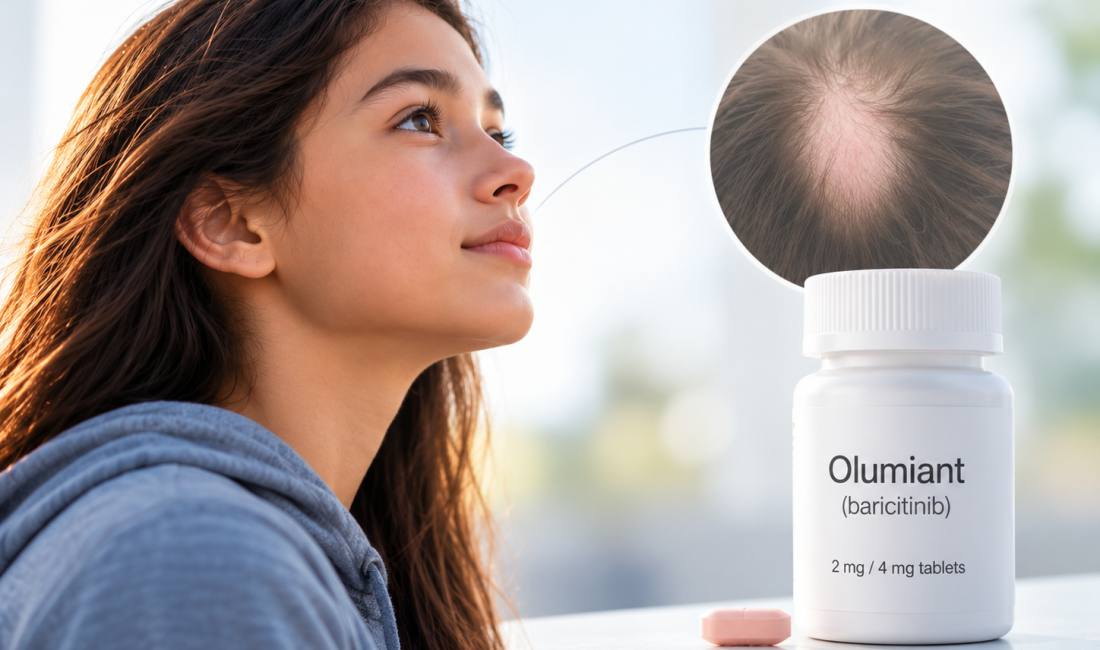
FDA approves Eli Lilly’s Olumiant (baricitinib) for adolescents aged 12 years and older with severe alopecia areata, supported by Phase 3 BRAVE-AA-PEDS data.
Written By: Saniya Katakdhond, PharmD
Reviewed By: Pharmacally Editorial Team
The U.S. FDA has expanded the approval of Eli Lilly’s Olumiant (baricitinib) to patients aged 12 years and older with severe alopecia areata (AA), supported by 36-week results from the Phase 3 BRAVE-AA-PEDS trial. The approval adds a pediatric indication to baricitinib’s established use in adults with severe AA.
Pediatric Approval Supported by Phase 3 Data
The FDA decision is based on the adolescent cohort of BRAVE-AA-PEDS (NCT05723198), an ongoing placebo-controlled Phase 3 study specifically evaluating pediatric patients with severe AA. The trial enrolled adolescents aged 12 to under 18 years with at least 50% scalp hair loss, defined by a Severity of Alopecia Tool (SALT) score of ≥50.
Among the 257 participants in the first adolescent cohort, patients received once-daily placebo, baricitinib 2 mg, or baricitinib 4 mg in a 1:1:1 randomization. At baseline, the median SALT score was 100, indicating complete scalp hair loss, while patients had lived with AA for a mean of 6.4 years.
At Week 36, 42% of patients receiving baricitinib 4 mg and 27% receiving 2 mg achieved a SALT score of ≤20, corresponding to at least 80% scalp hair coverage. The response rate was 5% with placebo.
A more stringent threshold of SALT ≤10, representing at least 90% scalp hair coverage, was reached by 37% of patients receiving 4 mg and 21% receiving 2 mg, compared with 2% with placebo. Patients treated with the 4-mg dose also showed improvements in eyebrow and eyelash coverage among those with substantial hair loss in these areas at baseline.
Baricitinib Targets JAK-Dependent Immune Signaling
Alopecia areata is a chronic immune-mediated disorder in which immune activity disrupts the normal hair-growth cycle, producing unpredictable areas of hair loss that can become extensive in severe disease.
Baricitinib is an oral Janus kinase (JAK) inhibitor that modulates signaling pathways involved in immune and inflammatory responses. Its activity against JAK-dependent signaling provides the pharmacologic basis for suppressing immune processes associated with AA.
Early-onset AA can be particularly extensive and may persist for years. The adolescent population in BRAVE-AA-PEDS had substantial disease burden at study entry, underscoring the severity of the population evaluated.
Safety Profile and Dosing
The safety profile observed in adolescents aged 12 years and older was consistent with the established safety profile of baricitinib in adults with severe AA.
The U.S. prescribing information carries a boxed warning for serious infections, mortality, malignancy, major adverse cardiovascular events and thrombosis.
For severe AA, the recommended dose is 2 mg once daily, with an increase to 4 mg once daily when response is inadequate. For patients with nearly complete or complete scalp hair loss, with or without substantial eyebrow or eyelash involvement, treatment with 4 mg daily may be considered. After an adequate response is achieved, the dose should be reduced to 2 mg daily.
Expanding Treatment Options for Adolescents
The FDA action extends a systemic treatment option to adolescents with severe AA, a population in which extensive hair loss can occur during a period of significant social and psychological development.
The approval follows the European Commission’s April 2026 decision to approve baricitinib for adolescents aged 12 to under 18 years with severe AA. Olumiant was first approved in the U.S. for adults with severe AA in 2022.
Olumiant becomes the second oral JAK inhibitor approved by the FDA for severe alopecia areata in adolescents aged 12 years and older, following Pfizer’s LITFULO (ritlecitinib), which received FDA approval for this population in June 2023.
BRAVE-AA-PEDS remains ongoing. Its second adolescent cohort enrolled 166 additional participants randomized to baricitinib 4 mg or 2 mg to further characterize safety. The continuing study will provide additional evidence on the use of baricitinib in pediatric severe AA as treatment experience expands.
Reference
FDA approves Lilly’s Olumiant (baricitinib) for pediatric patients 12 years of age and older with severe alopecia areata, Lilly, 25 September 2026
A Study of Baricitinib (LY3009104) in Children From 6 Years to Less Than 18 Years of Age With Alopecia Areata (BRAVE-AA-PEDS), ClinicalTrials.gov ID NCT05723198

About the Writer
Saniya Sanjay Katakdhond (Linkedin) is a Doctor of Pharmacy professional with hands-on experience in patient case review, clinical documentation, medical record analysis, and patient care.
Her hospital experience has strengthened her understanding of clinical conditions, treatment approaches, and multidisciplinary healthcare practices.
With ICH-GCP certification and a research-oriented approach, she brings clinical insight and attention to detail to healthcare content development.
As a healthcare writer, Saniya focuses on translating clinical knowledge and patient-care experience into clear, accurate, and evidence-informed medical content.