
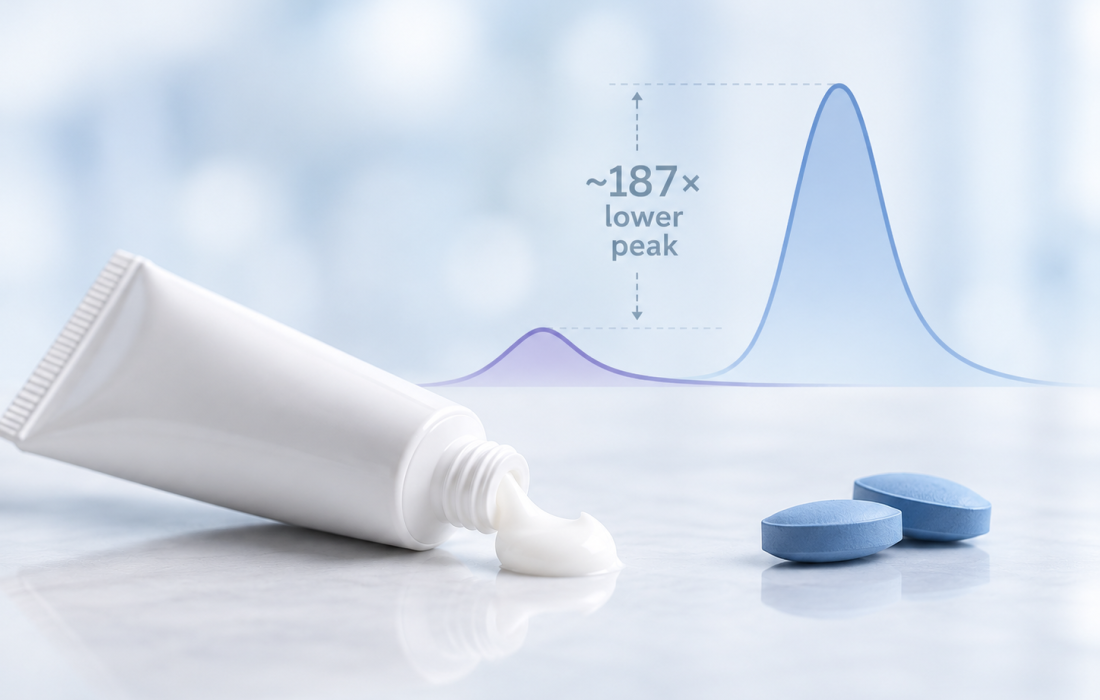
Daré Bioscience reports 187-fold lower peak sildenafil concentration and 33–34-fold lower systemic exposure with topical cream in a Phase 1 study.
Written By: Aasritha Thippavajjala, PharmD
Reviewed By: Pharmacally Editorial Team
Daré Bioscience (NASDAQ: DARE) announced on October 8, 2026, that data from a Phase 1 study of its investigational Sildenafil Cream, 3.6% will be presented at the Annual Fall Scientific Meeting of the Sexual Medicine Society of North America (SMSNA), taking place October 8–11, 2026, in Orlando, Florida. The study compared topical sildenafil cream with oral sildenafil in healthy adult men and evaluated pharmacokinetics, including maximum plasma concentration and systemic exposure, as well as treatment-emergent adverse events.
Phase 1 Study Design and Presentation
The Phase 1 study was an open-label, single-dose, randomized, parallel-cohort study comparing a 71 mg topical dose of Sildenafil Cream with a 50 mg oral dose of sildenafil in healthy adult men. Annie Thurman, MD, FACOG, Daré’s Medical Director, is scheduled to present the findings during the Innovations in Sexual Medicine Abstracts session on October 9, 2026. The findings have also been published in Sexual Medicine, the official journal of the International Society for Sexual Medicine.
The study was designed to characterize the pharmacokinetic profile and tolerability of topical sildenafil relative to oral administration. The findings therefore provide pharmacokinetic and safety information in healthy men rather than evidence of clinical efficacy in women with female sexual arousal disorder (FSAD).
Topical Sildenafil Shows Lower Peak Plasma Concentration
According to Daré, mean maximum plasma concentration (Cmax) of sildenafil following the 71 mg topical dose was approximately 187-fold lower than that observed with the 50 mg oral dose. Systemic exposure, measured by the area under the plasma concentration-time curve (AUC), was approximately 33- to 34-fold lower with topical administration.
The findings indicate substantially lower systemic exposure following topical administration in this Phase 1 comparison. However, the two formulations were evaluated at different doses and in healthy men, so the pharmacokinetic differences should not be interpreted as evidence that the topical formulation is more effective or clinically superior to oral sildenafil.
In a company statement, Thurman said the findings support the rationale for topical delivery of sildenafil and the potential for substantially lower systemic exposure compared with oral administration. She also said that understanding the pharmacokinetic and potential safety profile in men is an important component of advancing the cream as a potential treatment for FSAD.
Treatment-Emergent Adverse Events Were Mild
Daré reported that all treatment-emergent adverse events observed in the study were mild. The company reported no serious adverse events, severe adverse events, deaths, or discontinuations due to treatment-emergent adverse events.
These findings describe the tolerability profile observed in this early-stage study and should not be interpreted as establishing the overall safety of Sildenafil Cream across broader or longer-term populations.
Development Program in Female Sexual Arousal Disorder
Sildenafil Cream, 3.6% is being developed for women with female sexual arousal disorder. According to Daré, the formulation has previously been evaluated in Phase 1, Phase 2a, and Phase 2b studies in women with FSAD.
The company said it is continuing activities needed to advance the program toward a potential FDA 505(b)(2) regulatory pathway. The Phase 1 study in men is described as complementary to the broader female sexual health development program.
The company has also stated that there are currently no FDA-approved pharmacological treatments for FSAD. Sildenafil Cream, 3.6% remains investigational and has not been approved by the FDA.
Presentation and Next Steps
Daré said a copy of the presentation will be made available through the Presentations, Events & Webcasts section of its investor website following the meeting. The company indicated that the poster will remain accessible for approximately 30 days after the live presentation.
The company has cautioned that positive findings from early-stage studies may not predict outcomes in later clinical development. It also noted that regulators or the medical community may not agree with its interpretation of the data and that the anticipated 505(b)(2) regulatory pathway may ultimately not be available as expected.
Overall, the Phase 1 findings provide pharmacokinetic evidence of substantially lower systemic sildenafil exposure following topical administration compared with oral sildenafil in healthy men. The results add to Daré’s ongoing development program for Sildenafil Cream as an investigational treatment for FSAD, while further clinical and regulatory development will be required before its potential therapeutic role can be established.
Reference
Daré Bioscience to Present Phase 1 Sildenafil Cream Data at Sexual Medicine Society of North America (SMSNA) Annual Fall Scientific Meeting, Dare Bioscience, 08 October 2026
Katherine Cornell, Isabella Johnson, Andrea Thurman, David Friend, An open-label, single-dose, randomized, parallel-group study of the safety and relative bioavailability of topical sildenafil cream vs oral sildenafil in healthy male adults, Sexual Medicine, Volume 14, Issue 6, December 2026, qfag083, https://doi.org/10.1093/sexmed/qfag083
Single-Dose Relative Bioavailability Study of SST-6006, a Topical Sildenafil Cream Versus Oral Sildenafil in Healthy Male Adults, ClinicalTrials.gov ID NCT01986673

About the Writer
Aasritha Thippavajjala (Linkedin) is a pharm D student and aspiring medical writer with medical writing, clinical training experience and a strong interest in clinical research and patient safety She has hands-on exposure to clinical pharmacy activities including medication profile assessment, clinical case review, identification of potential drug-related problems, ADR awareness, patient counselling, and clinical documentation. She has also gained experience in medical literature review, evidence synthesis, and scientific communication through her published review article on digital twin-based patient simulation and her poster presentation at the 74th Indian Pharmaceutical Congress. Certified in ICH Good Clinical Practice (E6(R3)) and Scientific Writing in Health Research, she is passionate about applying her clinical knowledge and research skills to medical writing ,clinical research and contributing to accurate, evidence-based healthcare.